Now Reading: Can AI Replace Teachers? The Future of Teaching and AI
-
01
Can AI Replace Teachers? The Future of Teaching and AI
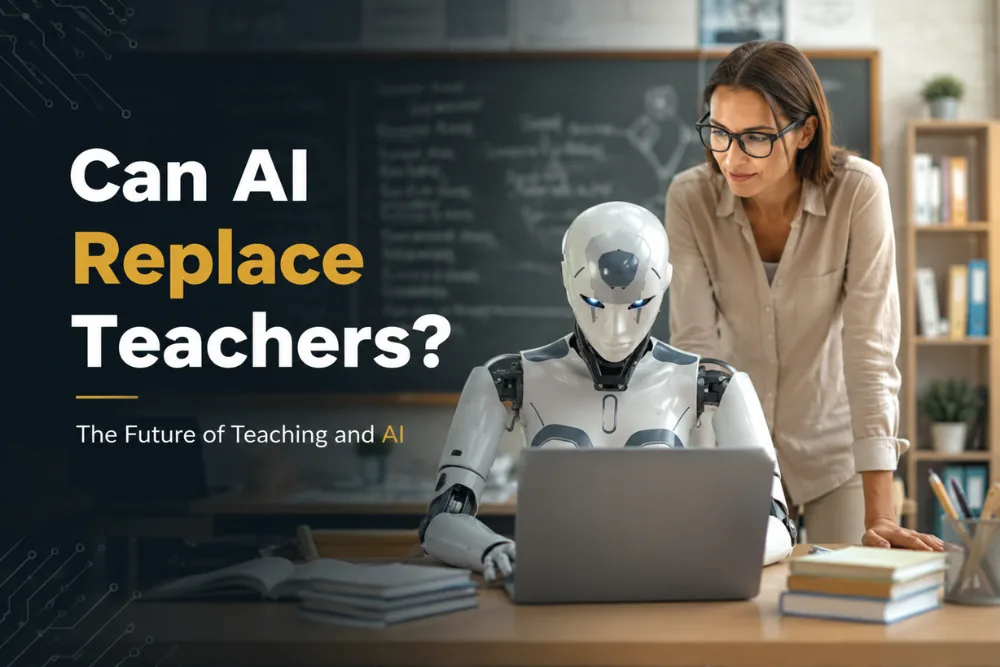
AI cannot fully replace teachers, even as artificial intelligence becomes more capable of tutoring, grading, lesson planning, and personalizing learning. Teachers provide empathy, mentorship, creativity, emotional understanding, motivation, and human connection that AI cannot fully replicate.
The most effective future is likely to combine capable AI tools with skilled human educators.
Can AI Replace Teachers?
The question “can AI replace teachers” has become increasingly important as artificial intelligence becomes a bigger part of modern education.
AI can already perform many tasks that once required considerable teacher time, including preparing lesson materials, supporting assessment, analyzing student performance, and creating personalized learning experiences. However, teaching involves far more than delivering information or completing repetitive tasks.
A teacher does not simply provide answers to questions. A teacher understands students, notices when someone is struggling, encourages participation, builds confidence, manages classroom relationships, and helps learners develop socially and emotionally. These human qualities remain central to effective education. AI can support many parts of the teaching process, but it cannot fully reproduce the complete role of a human educator.
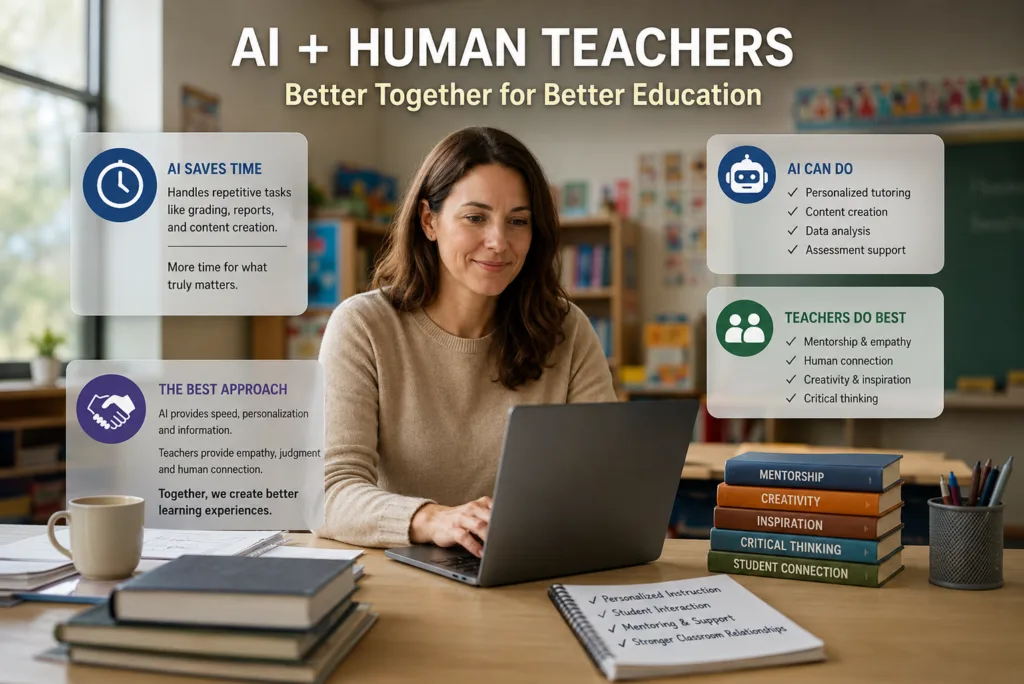
AI is better understood as a powerful co pilot for teachers rather than a replacement. It can help educators work more efficiently and create learning experiences that are more personalized and interactive. Instead of spending large amounts of time on repetitive responsibilities, teachers can use AI assistance to redirect more of their attention toward students.
This distinction matters because education is fundamentally a human experience. Technology can make learning more efficient, but students still need people who can understand their individual situations, provide encouragement, offer mentorship, and create meaningful classroom relationships.
Why Teachers Are Still Essential in the Classroom
One of the strongest reasons AI cannot fully replace teachers is the unique combination of human qualities educators bring to the classroom. Teachers use critical thinking, creativity, emotional understanding, and social emotional skills every day.
Consider a student who is struggling with a lesson. An AI system may identify that the student has provided an incorrect answer and offer another explanation. A teacher, however, may notice that the student is distracted, anxious, confused, embarrassed, or simply lacking confidence. That understanding can influence how the teacher responds.
Human interaction also plays an important role in motivation and personal growth. Students often need encouragement when a subject feels difficult. They may need someone to recognize their effort, celebrate progress, or help them understand that making mistakes is part of learning.
AI can provide information and personalized assistance, but the relationship between teacher and student remains important. Teachers provide guidance that extends beyond academic content. They help students develop confidence, communication skills, and a sense of connection within the learning environment.
This is why the growing presence of AI in education does not necessarily mean the disappearance of teachers. Instead, it creates an opportunity for educators to focus more strongly on the parts of teaching that require human judgment and interpersonal connection.
How AI Can Support Teachers
AI can significantly improve the teaching process by handling routine responsibilities that consume valuable time. Lesson planning, grading, preparing educational materials, analyzing student performance, and creating assessments can all require substantial effort.
When AI assists with these responsibilities, teachers can spend more time doing what matters most, interacting with students and supporting their learning.
For example, AI can help prepare lesson plans and quizzes, generate educational materials, and analyze student performance information. This can make preparation more efficient while allowing teachers to remain responsible for the final learning experience.
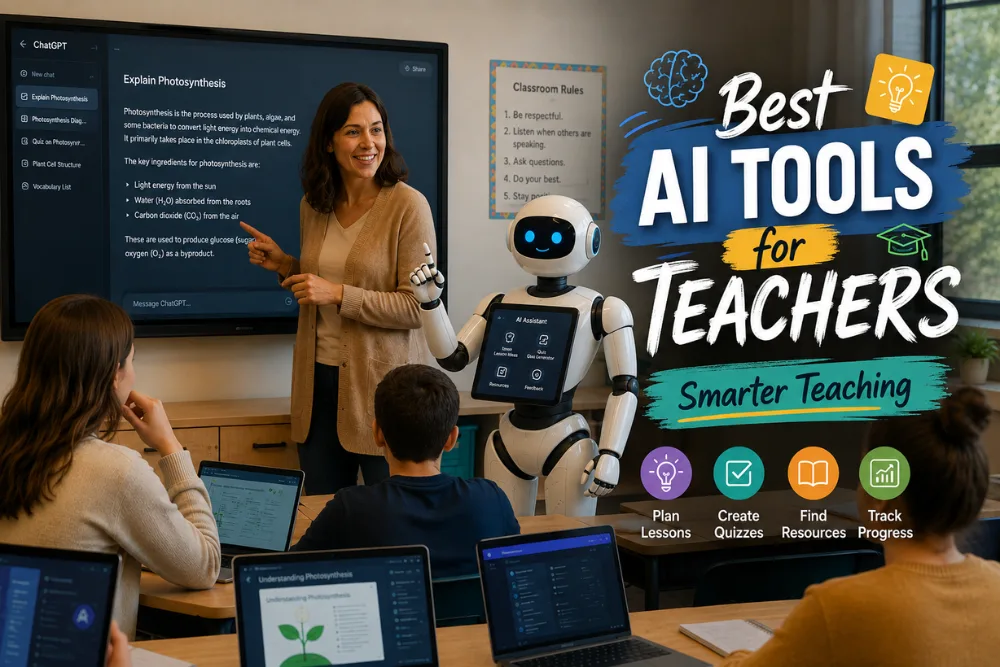
Also read: Best AI Tools for Teachers for Smarter Teaching
AI can also personalize learning. Students in the same classroom may have different abilities, learning speeds, and levels of understanding. AI tools can adapt educational content to different needs, giving teachers additional support when creating individualized learning experiences.
This does not mean that teachers become less important. In many cases, AI assistance can make teachers more valuable because educators have more time to focus on mentoring, coaching, classroom relationships, and personalized instruction.
The central idea is simple. AI can handle some of the work around teaching, while teachers continue to handle the human side of education.
How Effective Are AI Tutors Compared to Human Teachers?
AI tutors have shown promising benefits, particularly when it comes to personalized and adaptive learning. They can provide students with tailored explanations, adjust learning experiences based on individual needs, and offer support without requiring students to wait for a teacher to become available.
Some studies have reported that AI tutoring can produce significantly better learning outcomes in less time compared with traditional in class active learning settings. One randomized controlled trial found that college students learned more and were more engaged and motivated when taught using an AI tutor designed around pedagogical best practices compared with active classroom learning.
These findings show that AI tutoring can be highly effective in certain situations. However, they do not mean that AI tutors are universally better than human teachers.
Education involves many factors that cannot be measured only through a particular learning outcome. Human teachers provide interpersonal skills, mentorship, inspiration, emotional understanding, and real world educational experiences. These qualities are difficult to reproduce through an AI tutoring system.
The effectiveness of an AI tutor also depends heavily on context. AI can be particularly useful when students need personalized explanations or additional practice. A human teacher remains essential when students need broader guidance, emotional support, motivation, or help dealing with complex situations.
The evidence therefore points toward a nuanced future. AI tutoring can be extremely effective as part of education, but that does not automatically make human teachers unnecessary.
Can AI Tutors Be More Engaging Than Human Tutors?
One interesting aspect of AI tutoring is its ability to create a patient and supportive learning environment. Students can ask the same question multiple times without worrying about embarrassing themselves or frustrating a teacher.
Research involving educator perceptions has found that large language model based AI tutors were rated highly in areas including engagement, empathy, scaffolding, and conciseness when teaching grade school mathematics problems. In that research, 80 percent of annotators preferred the AI tutor for empathy.
- AI can act as a personal tutor by helping students learn and solve problems.
- Researchers compared AI tutors with human tutors while teaching school level math problems.
- AI tutors performed better in engagement, empathy, guidance, and clear explanations.
- Empathy was AI’s biggest strength, with 80% of teachers preferring AI tutors more often.
- AI tutors could support teachers by reducing their workload and helping students learn.
This is an important observation because it shows that AI can sometimes create interactions that students perceive as supportive. A learner who feels uncomfortable asking questions in front of classmates may feel more confident interacting with an AI tutor.
AI tutors can also provide immediate responses. Students do not necessarily need to wait until the next class or until a teacher has time to review their work. They can receive assistance while they are learning.
However, this does not eliminate the need for teachers. An AI tutor may respond patiently to a question, but a human teacher can understand the wider context of the student and determine what kind of support is actually needed.
The strongest model may therefore involve both. AI can provide immediate personalized academic support, while teachers provide human guidance, motivation, mentorship, and broader educational direction.
What AI Tutors Still Cannot Fully Provide
AI tutors are becoming increasingly capable, but they still cannot fully replicate the social and emotional role of a human teacher.
Teaching requires more than explaining concepts. Educators often need to understand student emotions, classroom relationships, individual circumstances, and changes in motivation. They may need to adjust their approach based on subtle signals that are difficult for an AI system to understand completely.
A teacher can also inspire students in ways that extend beyond the lesson itself. A teacher may encourage a student to pursue a particular subject, help them overcome a lack of confidence, or become a trusted mentor during an important stage of their development.
AI can assist with learning, but human teachers remain responsible for guiding the overall educational experience.
This is also reflected in innovative educational models that combine AI tutoring with human coaches. In these environments, AI can support academic learning while human educators provide guidance in areas that require broader interpersonal skills.
This hybrid approach demonstrates why the question “can AI replace teachers” may not be the most useful way to think about the future. A better question may be how AI and teachers can work together to create better learning experiences.
Which Companies Offer AI Driven Teaching Platforms for Schools?
Several companies now offer AI driven teaching platforms designed to support schools, teachers, and students. These platforms approach education in different ways, but they share a common focus on improving efficiency, personalization, assessment, engagement, and learning support.
MagicSchool is one example of a comprehensive AI platform designed specifically for school districts. It provides more than 80 teacher tools and more than 50 student tools. Its capabilities include lesson planning, grading, personalized learning activities, IEP generation, email assistance, and report card drafting.
The platform also integrates with familiar educational tools such as Google Docs, Google Classroom, and Canvas. Its focus includes responsible AI use, privacy, and security, with attention to FERPA and COPPA compliance.
Frizzle focuses on grading handwritten mathematics assignments using AI. Its approach is designed to reduce one of the more time consuming responsibilities for teachers while also providing analytics that can help educators personalize instruction.
Risely AI operates as an AI operating system for universities and has broader applications within education. Its focus includes institutional efficiency, retention, productivity, and administrative automation, indirectly supporting teaching and learning environments.
Quizlet uses AI to provide adaptive study plans and personalized learning resources. It is widely used for flashcards, quizzes, and study materials that can adapt to individual learner needs.
Century Tech combines cognitive neuroscience with AI to develop personalized learning plans. It tracks student progress, identifies learning gaps, and provides recommendations to students and teachers.
SchoolAI focuses on AI driven lesson planning and assessment tools that can integrate with existing teacher workflows, including Google Classroom and Microsoft tools. Its approach is designed to reduce preparation time while keeping teachers in control of content and student interaction.
These platforms demonstrate that AI in education is not limited to one specific activity. The technology can support multiple stages of the teaching process, from preparation and classroom engagement to assessment and performance tracking.
How AI Can Make Lesson Planning Easier
Lesson planning is one area where AI can provide significant assistance. Teachers regularly need to prepare educational materials that match the needs of their students, and creating these resources manually can take considerable time.
AI can help generate lesson plans, quizzes, presentations, rubrics, and other curriculum materials. This can reduce preparation time and allow teachers to focus more attention on how the materials will actually be used in the classroom.
Brisk Teaching, for example, is designed to help educators create curriculum materials efficiently. It integrates with Google Docs and Google Slides, making it useful for teachers who already use these platforms.
The value of this type of assistance is not simply speed. Teachers can use the time saved through AI to think more deeply about student needs, classroom activities, and instructional strategies.
AI therefore changes how teachers spend their time rather than simply removing teachers from the process.
How AI Can Personalize Learning
Personalized learning is another major area where AI can support teachers. Students do not all learn at the same pace, and they may have very different levels of understanding.
Diffit, for example, focuses on differentiation by allowing teachers to rewrite texts at multiple reading levels. This can make educational materials more accessible to students with different abilities.
Brisk Teaching also supports adjustments to reading levels and text translation. These capabilities can help educators adapt materials for students who may need different levels of complexity or support in another language.
SchoolAI also focuses on personalized tutoring and learning support. Teachers can create custom AI bots that guide students while educators monitor progress and manage AI interactions.
This type of personalization can help teachers respond to different learning needs without requiring them to manually create every variation of a lesson.
The teacher remains central because educators decide how these materials should be used and how learning should progress. AI provides additional flexibility, but human judgment remains necessary.
How AI Can Improve Student Engagement
Keeping students engaged is one of the most important responsibilities of a teacher. AI can contribute to engagement by making classroom activities more interactive and responsive.
Curipod is designed around real time classroom engagement. It can provide AI feedback on student writing while a lesson is taking place. This allows teachers to gain insight into student responses as the class progresses.
If students are struggling with a concept, teachers can adjust the lesson. If students demonstrate strong understanding, educators can introduce additional challenges.
ClassPoint takes another approach by bringing interactive learning directly into PowerPoint presentations. It supports quizzes, polls, and gamification, allowing students to participate without leaving the presentation environment.
These tools demonstrate how AI and related educational technologies can turn students from passive recipients of information into active participants.
Still, technology alone does not create meaningful engagement. Teachers remain responsible for understanding their students, choosing appropriate activities, and creating an environment where participation feels valuable.
How AI Can Help With Assessment and Feedback
Assessment can take a significant amount of teacher time, particularly when educators are responsible for many students and multiple assignments.
AI can help reduce some of this workload by supporting grading, feedback, and performance analysis.
Edcafe AI, for example, provides auto grading with rubrics and real time dashboards. These features can help teachers manage assessment responsibilities while maintaining awareness of student performance.
Frizzle also focuses on AI assisted grading for handwritten mathematics assignments and provides analytics that can help teachers understand student progress.
The advantage is not simply that grading becomes faster. Better access to performance information can help teachers identify when students need additional explanation or when they are ready to move forward.
AI can therefore support assessment as a decision making tool. Teachers can use the information provided by AI while continuing to apply their own professional judgment.
Can AI Save Teachers Time?
Yes, saving time is one of the strongest potential benefits of AI in education.
Teachers spend many hours on responsibilities that happen outside direct classroom instruction. Writing emails, preparing reports, creating materials, grading assignments, and handling documentation can all reduce the time available for student focused activities.
MagicSchool AI addresses several of these responsibilities through tools for email writing, report cards, IEP generation, and other educational tasks.
Brisk Teaching can help teachers create quizzes, lesson plans, rubrics, and presentations. Edcafe AI supports content creation, grading, and performance tracking.
When these responsibilities become easier to manage, teachers can redirect more time toward personalized instruction, student interaction, mentoring, and classroom relationships.
This is an important reason why AI should be viewed as an assistant rather than a replacement. The technology can reduce repetitive work while allowing teachers to concentrate on responsibilities that require human judgment.
What Does the Future of AI and Teaching Look Like?
The future of education is likely to involve collaboration between teachers and AI rather than complete replacement.
AI will probably continue becoming more capable at personalized tutoring, lesson preparation, assessment, content creation, and student performance analysis. As these capabilities improve, teachers may spend less time on repetitive administrative tasks and more time on mentoring, coaching, creativity, and interpersonal connection.
Developing AI literacy among teachers will also become increasingly important. Educators need to understand how these tools work, where they can provide value, and how they should be used responsibly.
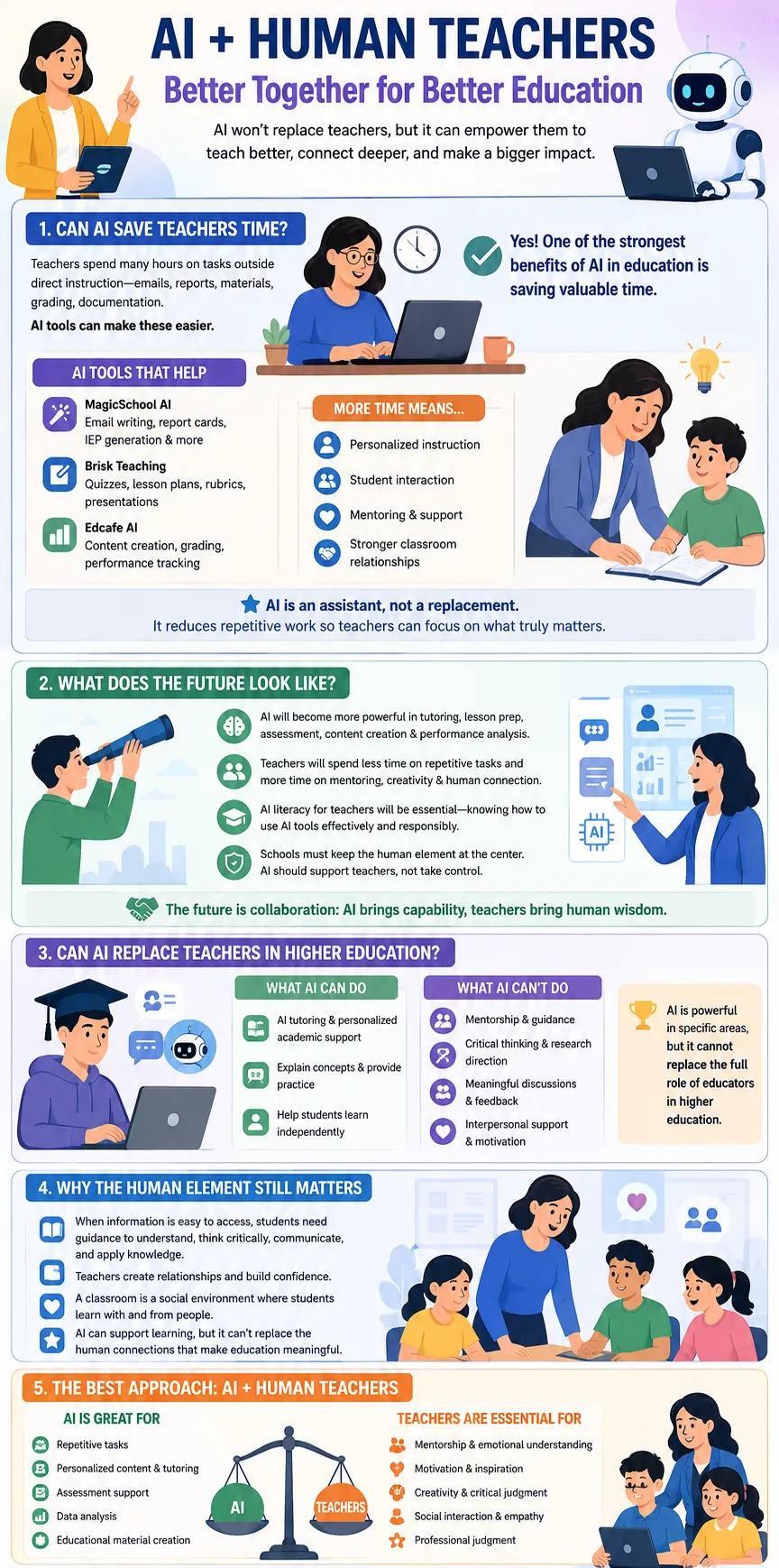
At the same time, schools need to maintain the human element of education. AI should support teachers without removing teacher control over the learning experience.
The most promising approach is therefore a balanced relationship. AI can provide speed, personalization, and access to information, while teachers provide empathy, judgment, inspiration, motivation, and meaningful human connection.
Can AI Replace Teachers in Higher Education?
AI may have an increasing role in higher education, particularly through AI tutoring and personalized academic support. Students can use AI systems to receive explanations, practice concepts, and get assistance when they are learning independently.
However, higher education involves much more than delivering academic information. Professors and educators contribute mentorship, critical thinking, research guidance, discussion, feedback, and interpersonal support.
AI tutoring research can show strong results in specific learning situations, but these results should not be interpreted as proof that AI can replace educators across higher education.
The same principle applies to schools and universities. AI can become a powerful part of the educational environment, but human educators remain important for the broader learning experience.
Why the Human Element Still Matters
The human element may ultimately become even more important as AI becomes more common.
When information is increasingly easy to access, the value of education is not simply knowing where to find an answer. Students need guidance in understanding information, thinking critically, communicating ideas, developing confidence, and applying knowledge.
Teachers provide this broader context.
They also create relationships. A classroom is not simply a place where information moves from one system to another. It is a social environment where students learn with and from other people.
AI can support that environment, but it cannot fully replace the human relationships that make education meaningful.
The Best Approach Is AI Plus Human Teachers
The strongest educational model may not be about choosing between AI and teachers. It may be about combining their strengths.
AI is highly useful for repetitive tasks, personalized content, tutoring, assessment support, data analysis, and educational material creation. Teachers are highly valuable for mentorship, emotional understanding, motivation, creativity, social interaction, and professional judgment.
When these strengths work together, teachers can become more efficient without becoming less human.
Students can receive personalized academic support from AI while continuing to benefit from the guidance and relationships provided by educators.
This approach also gives teachers more time to focus on meaningful classroom interaction. Instead of spending much of their day completing repetitive responsibilities, educators can devote more energy to helping students understand, participate, grow, and succeed.
Conclusion
So, can AI replace teachers? The evidence and information available here point toward a clear answer. AI cannot fully replace teachers because education involves much more than delivering lessons, grading work, or answering questions. Teachers bring empathy, creativity, critical thinking, emotional understanding, mentorship, motivation, and interpersonal connection to the classroom.
At the same time, AI is becoming an extremely powerful educational assistant. It can help with lesson planning, personalized learning, tutoring, assessment, grading, student engagement, performance tracking, and administrative responsibilities. These capabilities can save teachers time and help them provide more responsive learning experiences.
The future of education is therefore more likely to involve collaboration than replacement. AI can handle many repetitive and personalized tasks, while teachers continue to guide students and provide the human connection that technology cannot fully reproduce.
The real opportunity is not to ask how quickly AI can replace teachers. It is to ask how teachers can use AI to become more effective, more efficient, and more available to their students.
More AI tools to know:
- Best AI Tools for Academic Research and Literature Review
- These AI Rewording Tools Make Academic Writing Faster
- Best AI for Studying That Helps You Learn 10X Faster
Frequently Asked Questions
Can AI replace teachers completely?
No. AI can support teaching through tutoring, lesson planning, grading, personalization, and assessment, but it cannot fully reproduce the empathy, mentorship, emotional understanding, creativity, and human connection provided by teachers.
Will AI reduce the need for teachers?
AI may reduce some repetitive responsibilities teachers currently handle, but the information provided suggests that teachers will remain essential. AI can give educators more time for mentoring, student interaction, and personalized instruction.
Are AI tutors better than human teachers?
AI tutors can be highly effective in specific situations and some studies have reported strong learning outcomes. However, they do not provide the full range of social, emotional, interpersonal, and mentoring support offered by human teachers.
What can AI do for teachers?
AI can assist with lesson planning, quizzes, presentations, grading, assessment, personalized learning, student performance analysis, administrative tasks, and other routine responsibilities.
Can AI personalize education?
Yes. AI can adapt educational materials to different learning levels and provide personalized tutoring and learning support. Tools such as Brisk Teaching, Diffit, SchoolAI, Quizlet, and Century Tech are presented as examples of platforms supporting personalization.
Which AI tools can schools use?
The provided information identifies MagicSchool, Frizzle, Risely AI, Quizlet, Century Tech, and SchoolAI as AI driven platforms that can support schools, teachers, and students.
Can AI improve student engagement?
Yes. AI can support engagement through interactive activities, personalized tutoring, real time feedback, quizzes, polls, and other learning experiences. Curipod and ClassPoint are examples provided in the source material.
Can AI help teachers save time?
Yes. AI can automate or assist with repetitive responsibilities such as lesson preparation, grading, report writing, email drafting, and performance tracking, allowing teachers to spend more time with students.
Why are teachers still important if AI can tutor students?
Teachers provide much more than academic explanations. They offer mentorship, emotional support, motivation, creativity, interpersonal guidance, and human understanding, all of which remain important parts of education.
What is the future of AI in education?
The information provided points toward a collaborative model where AI supports teachers rather than replaces them. AI can improve efficiency and personalization while teachers remain responsible for guiding students and maintaining the human side of education.

Dony Garvasis is the founder of Search Ethics, a freelance SEO consultant, and a passionate technology blogger. With over 8 years of experience in SEO, blogging and content marketing, I provide expert content on Tech, digital marketing, SEO, Artificial intelligence, gadgets, science, automobiles, lifestyle, tips, tutorials and much more. My mission is simple: Ethical Search, Genuine Results! I will make sure people everywhere get trustworthy and helpful information.