Now Reading: Best AI Tools for Teachers for Smarter Teaching
-
01
Best AI Tools for Teachers for Smarter Teaching
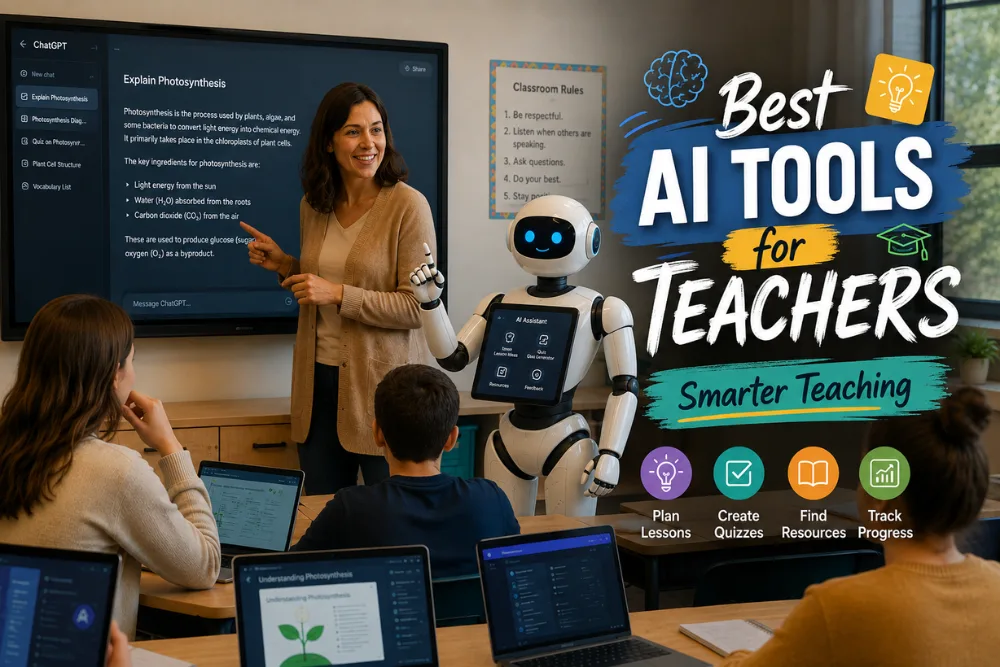
Artificial intelligence is helping teachers create more personalized, interactive, and efficient learning experiences.
Tools such as Brisk Teaching, Curipod, MagicSchool AI, SchoolAI, ClassPoint, Diffit, and Edcafe AI can support lesson planning, assessment, accessibility, student engagement, and administrative work, giving teachers more time to focus on meaningful classroom interaction.
Best AI Tools for Teachers
AI is becoming an increasingly useful part of modern education, particularly for teachers who need to balance lesson planning, classroom engagement, assessment, administrative responsibilities, and the individual needs of students.
Instead of replacing teachers, AI can act as a powerful co pilot that supports educators with everyday tasks while helping them create learning experiences that are more personalized and interactive.
Several AI tools are designed specifically around the needs of educators. Brisk Teaching, Curipod, MagicSchool AI, SchoolAI, ClassPoint, Diffit, and Edcafe AI each approach teaching support differently.
Some focus on creating educational materials, while others concentrate on real time engagement, personalized learning, assessment, accessibility, or administrative efficiency.
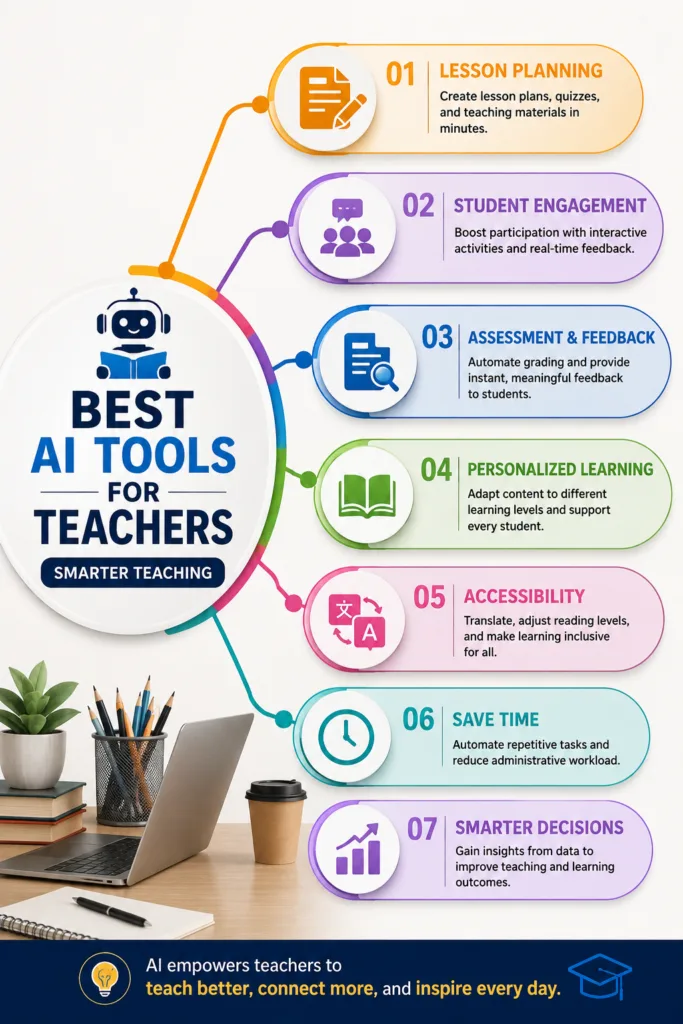
The common goal is to help teachers spend less time managing repetitive work and more time interacting with students.
When used thoughtfully, these tools can support teachers without removing the human element that remains central to education.
Brisk Teaching
Brisk Teaching is an AI tool designed to help teachers create curriculum materials efficiently. It integrates with Google Docs and Google Slides, making it useful for educators who already use these familiar platforms as part of their teaching workflow.
Teachers can use Brisk Teaching to generate quizzes, lesson plans, rubrics, and presentations. This can reduce the amount of time required to prepare classroom materials and allow educators to focus more attention on how those materials will be used with students.
One particularly useful feature is the ability to adjust reading levels. Students in the same classroom may have very different levels of reading ability, and presenting identical material to everyone can make it difficult for some learners to fully understand the lesson. Brisk Teaching can help teachers adapt content to different reading levels, making complex information more accessible.
The tool also supports text translation. This can be useful when teachers are working with students who may benefit from content in another language. By making learning materials more accessible, teachers can create a classroom environment where more students can participate meaningfully.
Brisk Teaching therefore supports both efficiency and personalization. Teachers can spend less time creating basic materials and more time considering how those materials can support individual student needs.
Curipod
Curipod focuses strongly on real time classroom engagement. One of its important features is AI feedback on student writing while a lesson is taking place.
This real time approach can change the way teachers respond to student learning. Instead of waiting until an assignment is completed and reviewed later, teachers can gain insight into student responses as the class progresses.
For teachers, this can make classroom instruction more dynamic. If students are struggling with a particular concept, the teacher can adjust the lesson based on what is happening in the classroom. If students demonstrate a strong understanding, the teacher can move forward or introduce additional challenges.
Curipod can therefore help maintain student involvement during lessons. Students are not simply receiving information from the teacher. They can participate, respond, and receive feedback as the learning experience develops.
This ability to respond to students during a lesson is particularly valuable because effective teaching often requires adjustment. Every classroom is different, and student understanding can change from one topic to another. Tools that provide real time information can help teachers make more informed instructional decisions.
MagicSchool AI
MagicSchool AI provides a broad collection of tools designed for educators. The platform offers more than 80 tools, including IEP generators, email writing assistants, and report card drafters.
Teachers often spend significant time on responsibilities that happen outside direct classroom instruction. Writing emails, preparing reports, creating educational materials, and handling documentation can all take time away from student focused activities.
MagicSchool AI can help reduce this administrative workload. By supporting teachers with tasks such as drafting emails and report cards, the platform can give educators more time to concentrate on teaching and student engagement.
Its range of tools also means that teachers can use AI support across different parts of their daily responsibilities. Rather than focusing on a single classroom activity, MagicSchool AI addresses several areas of the teaching cycle.
Reducing administrative pressure can have an important effect on how teachers use their available time. When routine work becomes easier to manage, educators can redirect more attention toward personalized instruction, student interaction, and classroom relationships.
SchoolAI
SchoolAI is designed for K through 12 classrooms and focuses on personalized tutoring and learning support. Teachers can create custom AI bots that guide and assist students while also allowing educators to monitor progress and manage AI interactions.
Personalized support can be particularly useful in classrooms where students have different levels of understanding. A student who needs additional explanation can receive support, while another student who is ready to move ahead can continue developing their understanding.
SchoolAI also provides real time insights that can help teachers maintain student focus and engagement. Rather than relying only on a final assessment to understand student performance, teachers can use available information to gain a clearer picture of how students are progressing.
The ability to create custom AI bots gives educators greater flexibility. Teachers can design interactions around the needs of their students and provide additional learning support within the classroom environment.
At the same time, the teacher remains responsible for guiding the learning experience. AI can provide assistance, but the teacher continues to provide the human understanding, motivation, and support that students need.
ClassPoint
ClassPoint brings interactive learning directly into PowerPoint presentations. It supports quizzes, polls, and gamification, allowing teachers to make presentations more engaging without requiring students to leave the presentation environment.
Traditional presentations can sometimes make students passive participants. Interactive questions and polls can change that dynamic by encouraging students to respond during the lesson.
ClassPoint can help teachers introduce interactive elements into familiar presentation materials. Instead of creating a completely separate classroom environment, educators can add activities directly to their presentations.
Gamification can also make lessons more engaging. Students can participate in quizzes and other interactive activities while the teacher continues guiding the lesson.
The simplicity of staying within a familiar presentation environment can be valuable for teachers and students. Educators can focus on the lesson rather than managing several different platforms at the same time.
For classrooms where participation and interaction are important, ClassPoint provides a practical way to turn presentations into more active learning experiences.
Diffit
Diffit focuses on differentiation, which is an important part of supporting students with different learning needs. The tool can rewrite texts at multiple reading levels in seconds.
Students do not always learn at the same pace or understand information in the same way. A single version of a reading passage may be appropriate for some students while being too difficult or too simple for others.
Diffit gives teachers a way to customize reading materials for different learners. By adjusting the reading level of content, educators can help students access the same general topic in a way that better matches their current ability.
This can support comprehension and engagement. When students can understand the material they are working with, they are more likely to participate and make meaningful progress.
The ability to create different versions quickly can also save teachers time. Instead of manually rewriting the same material several times, educators can use AI assistance to prepare content for different reading levels.
Diffit therefore connects efficiency with personalized learning. Teachers can prepare more accessible materials while still maintaining the focus of the original content.
Edcafe AI
Edcafe AI covers several parts of the teaching cycle, from creating materials to grading and performance tracking. This broad approach can help teachers organize classroom responsibilities while maintaining awareness of student progress.
One of its useful features is auto grading with rubrics. Grading can require a significant amount of time, especially when teachers are working with many students and multiple assignments. AI assisted grading can help reduce the amount of routine work involved.
Edcafe AI also provides real time dashboards. These dashboards can help teachers monitor performance and stay responsive to student needs.
The combination of content creation, grading, and performance tracking means that Edcafe AI can support teachers throughout different stages of instruction. Rather than focusing only on lesson preparation or only on assessment, it connects multiple parts of the teaching process.
This can help educators remain organized while gaining a clearer understanding of how students are progressing. Better access to performance information can also help teachers determine when a concept needs additional explanation or when students are ready to move forward.
How Can AI Help Teachers
Integrating AI applications into classroom teaching can provide several advantages for both educators and students. The most important point is that AI does not need to replace the human element of teaching. Instead, it can work as a support system that improves efficiency, accessibility, and engagement.
Teachers have many responsibilities beyond explaining lessons. They prepare materials, assess student work, track progress, manage administrative tasks, and provide individual support. AI can assist with many of these responsibilities, allowing educators to redirect more time toward direct interaction with students.
AI can also help teachers understand individual learning needs. By analyzing student performance, AI systems can identify areas where learners may need additional support. This information can help educators make more informed decisions about instruction.
Another important advantage is the ability to provide immediate feedback. Students can receive information about mistakes while the lesson or activity is still fresh in their minds. This can make the learning process more responsive.
AI can also support accessibility. Translation, text to speech, speech to text, and other technologies can help students access educational content in ways that better match their individual needs.
Overall, AI can help teachers become more efficient without removing the relationships and human judgment that make education meaningful.
Personalized and Adaptive Learning
One of the most important ways AI can support teachers is through personalized and adaptive learning. Traditional classroom instruction can make it difficult to provide exactly the right level of support to every student at the same time.
Some students may struggle with a particular concept and need additional explanation. Others may already understand the topic and need a greater challenge. AI driven learning systems can analyze student performance and adjust difficulty, provide additional support, or introduce extension activities.
This creates a more flexible learning experience. Instead of expecting every student to move through material at exactly the same pace, AI can help accommodate different learning needs.
AI can also help identify individual knowledge gaps earlier. If a student repeatedly struggles with a particular concept, teachers can use this information to provide targeted intervention.
For educators, this means having clearer information about who needs help and where that help may be most valuable. AI does not make the instructional decision for the teacher, but it can provide information that supports better decisions.
Immediate Feedback and Assessment Support
Feedback plays an important role in learning, and AI can make feedback more immediate. Students can receive responses to quizzes, writing assignments, and language practice without necessarily waiting several days for the teacher to complete the assessment.
Immediate feedback can help students recognize misunderstandings while the subject is still fresh. Instead of moving forward with an incorrect understanding, students can have an opportunity to review the concept and make corrections.
AI can also support grading. Multiple choice tests, code submissions, and structured written responses can be processed more quickly with AI assisted systems.
This can reduce the amount of routine assessment work teachers need to complete manually. The time saved can then be used for more personalized instruction and student support.
Assessment is not simply about assigning a grade. It is also about understanding what students know and where they need additional help. AI can contribute to this process by making information available more quickly.
Reducing Administrative Work and Teacher Burnout
Administrative responsibilities can consume a large part of a teacher’s working day. Attendance tracking, scheduling, lesson planning, formatting materials, drafting emails, and preparing reports are examples of tasks that may take significant time.
Generative AI can help accelerate some of these activities. Tools such as MagicSchool AI can support email writing and report card drafting, while other platforms can assist with lesson materials and assessments.
When teachers spend less time on routine administrative responsibilities, they can redirect more energy toward the human side of education.
That can include mentoring students, providing emotional support, answering questions, and building meaningful relationships. These are areas where the teacher’s presence and understanding remain essential.
AI therefore has the potential to reduce workload without reducing the importance of teachers. The purpose is not to remove educators from the learning process. Instead, it is to give them more time for the responsibilities that require human connection and judgment.
Enhanced Accessibility and Inclusivity
AI can also help make classroom learning more accessible. Students can have different language backgrounds, learning needs, and abilities, and technology can help reduce some of the barriers that make participation difficult.
Translation tools can help English Language Learners and non native speakers understand curriculum content and participate more meaningfully in classroom activities.
Text to speech and speech to text technologies can also support students with visual, auditory, or cognitive disabilities. These tools can provide alternative ways to access or communicate information.
Accessibility is not only about providing additional technology. It is about creating opportunities for more students to participate in learning.
When teachers can adapt content and communication methods, students may have a better opportunity to understand lessons and contribute to classroom activities.
AI tools that support reading level adjustments and translation can therefore become useful parts of a more inclusive learning environment.
Intelligent Tutoring and Support
AI tutors and conversational chatbots can provide students with assistance when teachers are not immediately available. They can answer routine questions, explain complex problems step by step, and guide students through learning activities.
This type of support can be useful outside regular classroom hours. Students may have questions while studying at home and may not always be able to ask a teacher immediately.
AI support can also help students who feel uncomfortable asking questions in front of a large group. Some learners may worry about making mistakes or appearing confused in front of their classmates. A conversational AI system can provide a more comfortable environment for asking questions and seeking clarification.
However, this support should complement teachers rather than replace them. Teachers understand the social, emotional, and personal factors that influence learning in ways that AI cannot fully understand.
Data Driven Insights for Teachers
AI can help teachers make better use of student performance information. Learning systems can track engagement, performance trends, and attendance, giving educators a clearer picture of classroom progress.
Instead of relying only on individual observations, teachers can use data to identify broader patterns. A class may demonstrate difficulty with a particular concept, or a smaller group of students may need additional support.
Actionable dashboards can highlight areas where students are struggling. Teachers can then use this information to adjust upcoming lessons or revisit concepts that students have not fully understood.
This creates a continuous process of improvement. Teaching does not need to remain fixed after a lesson has been prepared. Teachers can use information from student performance to adjust future instruction.
AI can therefore support teachers as they evaluate what is working and where changes may be needed.
How Can AI Be Used in Education for Students
AI can personalize learning experiences for students in several important ways. It can adapt content, provide immediate feedback, support teachers, increase engagement, and help make personalized learning available to larger groups of students.
One of the clearest advantages is the ability to tailor content and instruction to individual needs. AI systems can analyze information about student performance, pace, strengths, and areas requiring improvement.
Based on this information, AI can help customize lessons, assignments, and feedback. Virtual tutors and conversational systems can provide explanations and practice activities based on areas where a student is struggling.
This allows students to learn at a pace that is more appropriate for their current understanding.
Real Time Feedback and Adaptive Assessments for Students
Students can benefit from immediate feedback because it allows them to understand mistakes more quickly. AI can provide feedback on quizzes and assignments while the learning experience is still fresh.
AI can also support adaptive assessments. These assessments can adjust their difficulty depending on how the student performs.
If a student demonstrates strong understanding, the system can provide a greater challenge. If the student struggles, the experience can provide additional support.
This approach can help prevent students from becoming overwhelmed while also ensuring that learners who are progressing quickly continue to be challenged.
For teachers, these insights can provide useful information about student progress and help identify areas requiring additional attention.
Supporting Teachers With Human Centered Instruction
Although AI can automate many routine tasks, teachers remain central to education. AI can support educators by handling activities such as grading, data collection, and lesson planning, giving teachers more time for personalized instruction.
Teachers can also use information generated through AI systems to consider targeted interventions and instructional strategies.
The human element remains especially important for emotional support and motivation. Students are not simply collections of performance data. Their learning can be influenced by personal experiences, relationships, confidence, motivation, and social factors.
A teacher can recognize these factors and respond with empathy and understanding.
AI can therefore support human centered instruction by reducing routine work and providing useful information, while the teacher continues to guide the overall learning experience.
Enhancing Student Engagement Through Interactive Content
AI can make learning more interactive by supporting multimedia content, simulations, games, and other activities that can be adapted to student preferences.
Engagement is important because students are more likely to participate when learning activities are interesting and accessible.
Tools such as ClassPoint demonstrate how interactive quizzes, polls, and gamification can be incorporated into lessons. Curipod provides another example by supporting real time interaction and feedback during classroom activities.
These approaches can make students active participants rather than passive listeners.
AI can also support different learning modalities, helping teachers create experiences that provide greater flexibility for students.
Scalability and Equity in Personalized Learning
Personalized learning can be difficult to provide at scale when teachers have many students with different needs. AI can help make individualized support more practical.
By analyzing student information and identifying learners who may need timely assistance, AI can help teachers prioritize support.
This can reduce some barriers to access and create more equitable learning opportunities. Students who need additional help can potentially receive targeted support without requiring the teacher to manually create every piece of material from scratch.
Tools such as Brisk Teaching and Diffit can help teachers adapt materials for different reading levels, while SchoolAI can provide personalized tutoring and learning support.
The goal is not to create completely separate education systems for every student. Instead, AI can help teachers make learning materials and support more responsive to individual needs.
Data Driven Continuous Improvement
AI can support continuous improvement by tracking student progress and analyzing trends over time.
Teachers can use these insights to understand how students are developing and whether instructional approaches are producing the desired results.
If a particular concept continues to cause difficulty, educators can revisit it. If students demonstrate strong understanding, teachers can move forward or provide additional challenges.
This creates an ongoing cycle in which instruction responds to student development.
AI can provide the information needed for this process, but teachers remain responsible for interpreting that information and deciding what action makes sense for their students.
AI Should Support Teachers, Not Replace Them
One of the most important ideas in modern AI supported education is that technology should augment teachers rather than replace them.
AI can process information quickly, generate materials, provide feedback, and support routine tasks. However, teaching involves much more than delivering information.
Teachers provide encouragement, motivation, emotional support, context, and human connection. They understand classroom relationships and can recognize personal or social factors that may affect a student’s ability to learn.
AI can assist with some of the practical responsibilities of education, but the teacher remains the person who guides the overall learning experience.
The strongest use of AI in education is therefore one where technology and teachers work together. AI handles appropriate routine and analytical tasks, while educators remain focused on students and meaningful instruction.
Responsible and Ethical Use of AI in Education
As AI becomes more common in education, responsible use is also important. Many of the tools discussed here include features that can help teach students responsible and ethical AI use.
Students need to understand that AI is a learning support tool rather than a replacement for thinking, effort, or human judgment.
Teachers can guide students in using AI appropriately while maintaining the importance of understanding concepts and developing independent skills.
Responsible AI use is particularly relevant as students become more familiar with conversational systems, personalized tutoring, and automated content generation.
The role of teachers remains important in helping students understand how technology can support learning while ensuring that the educational experience continues to encourage meaningful participation.
Can Artificial Intelligence Replace Teachers?
Research suggests that AI tutors can support students by providing personalized learning, clear explanations, guidance, and empathy. In some areas, AI tutors performed better than human tutors, with 80% of teachers preferring AI for empathy. This could help reduce teachers’ workload while giving students additional learning support.
Know more:
Can AI Replace Teachers? The Future of Teaching and AI
Conclusion
AI is changing the way teachers can plan lessons, create materials, assess learning, personalize instruction, and engage students. Tools such as Brisk Teaching, Curipod, MagicSchool AI, SchoolAI, ClassPoint, Diffit, and Edcafe AI provide different forms of support, from interactive classroom activities and personalized learning to grading and administrative assistance.
The biggest advantage may be the time AI can give back to teachers. When routine tasks become easier, educators can spend more time building relationships, supporting students, providing personalized instruction, and responding to individual needs.
For students, AI can provide adaptive learning, immediate feedback, personalized content, interactive experiences, and additional support outside regular classroom hours. It can also help make learning more accessible and equitable.
However, the value of AI in education depends on how it is used. Technology should support teachers rather than replace them. Human connection, emotional support, motivation, and professional judgment remain essential.
When teachers use AI thoughtfully, these technologies can become useful partners in creating smarter, more personalized, and more engaging learning experiences.
More AI tools to know:
- Best AI Tools for Academic Research and Literature Review
- I Tool for Excel That Save Hours of Manual Work
- These AI Rewording Tools Make Academic Writing Faster
- Best AI for Studying That Helps You Learn 10X Faster
- AI Tools for Landscape Design
Frequently Asked Questions
What are the best AI tools for teachers?
Brisk Teaching, Curipod, MagicSchool AI, SchoolAI, ClassPoint, Diffit, and Edcafe AI are among the AI tools described for supporting teachers with lesson planning, engagement, assessment, personalization, accessibility, and administrative work.
How can AI help teachers save time?
AI can assist with lesson planning, quiz creation, grading, report card drafting, email writing, material creation, and performance tracking. This can reduce routine work and give teachers more time for student focused activities.
Can AI personalize learning for students?
Yes. AI can analyze student performance, pace, strengths, and areas that need improvement. It can then support customized content, assignments, feedback, practice activities, and learning experiences.
How does AI improve student engagement?
AI can support interactive quizzes, polls, gamification, real time feedback, personalized tutoring, multimedia content, simulations, and other learning activities that encourage students to participate more actively.
Can AI help students who learn at different reading levels?
Yes. Tools such as Brisk Teaching and Diffit can adjust or rewrite texts for different reading levels, helping teachers provide more accessible learning materials for students with different needs.
Can AI replace teachers?
AI is designed to support rather than replace teachers. It can assist with routine tasks, feedback, data analysis, and learning materials, while teachers continue to provide human connection, motivation, emotional support, and professional judgment.
How can AI support students outside classroom hours?
AI tutors and conversational chatbots can provide on demand assistance, answer routine questions, explain concepts, and guide students through problems outside regular school hours.
Can AI help make education more inclusive?
Yes. AI can support translation, reading level adjustments, text to speech, speech to text, and alternative communication tools. These capabilities can help students with different languages and abilities participate more meaningfully.
How can teachers use AI data?
Teachers can use AI generated insights to identify performance trends, recognize knowledge gaps, monitor engagement, and determine which concepts may need additional instruction or review.
Why is responsible AI use important in education?
Responsible AI use helps students understand that AI is a learning support tool. Teachers can guide students toward appropriate use while maintaining the importance of independent thinking, understanding, participation, and human judgment.

Dony Garvasis is the founder of Search Ethics, a freelance SEO consultant, and a passionate technology blogger. With over 8 years of experience in SEO, blogging and content marketing, I provide expert content on Tech, digital marketing, SEO, Artificial intelligence, gadgets, science, automobiles, lifestyle, tips, tutorials and much more. My mission is simple: Ethical Search, Genuine Results! I will make sure people everywhere get trustworthy and helpful information.