Now Reading: Best AI Tools for Academic Research and Literature Review
-
01
Best AI Tools for Academic Research and Literature Review

The best AI tools for research in Academic and literature review helps researchers discover relevant studies, summarize complex papers, organize sources, verify evidence, and improve academic writing. Tools such as Elicit, Consensus, ResearchRabbit, Scite, Paperpal, Scholarcy, and SciSummary can significantly reduce the time required for research while supporting better decision making and stronger literature reviews.
Academic research has always required significant time, effort, and attention to detail. Researchers, students, scholars, and professionals often spend countless hours searching for relevant papers, reviewing literature, organizing references, evaluating evidence, and refining their writing. As the volume of published research continues to grow, finding the right information becomes increasingly challenging.
Artificial intelligence is transforming how researchers approach these tasks. Modern AI powered research tools are designed to streamline many aspects of the academic workflow. Rather than replacing researchers, these tools function as intelligent assistants that help users navigate large collections of academic literature, identify relevant studies, summarize findings, and improve writing quality.
The rise of AI in academia has generated both excitement and concern. While some people mistakenly assume that AI tools are designed to write entire academic papers, the most valuable tools serve a very different purpose. They assist researchers in managing information, understanding complex content, and improving productivity while preserving academic integrity.
Understanding which tools are most useful and how they fit into the research process can help students and researchers make informed decisions. From literature discovery and evidence synthesis to paper summarization and source verification, several AI tools stand out for their effectiveness and practical value.
What Are AI Tools for Academic Writing?
AI tools for academic writing are specialized digital assistants designed to support various stages of research and writing. Their primary purpose is not to generate complete academic papers that can be submitted as original work. Instead, they help researchers perform specific tasks more efficiently and accurately.
These tools can assist with discovering academic papers, organizing references, summarizing research findings, improving writing clarity, and evaluating the credibility of sources. By automating repetitive and time consuming tasks, they allow researchers to focus more attention on critical thinking, analysis, and interpretation.
The distinction between assistance and authorship is important. Ethical AI tools support the research process without replacing the intellectual contribution of the researcher. They provide structure, suggestions, and insights while leaving the core arguments, conclusions, and original thinking to the user.
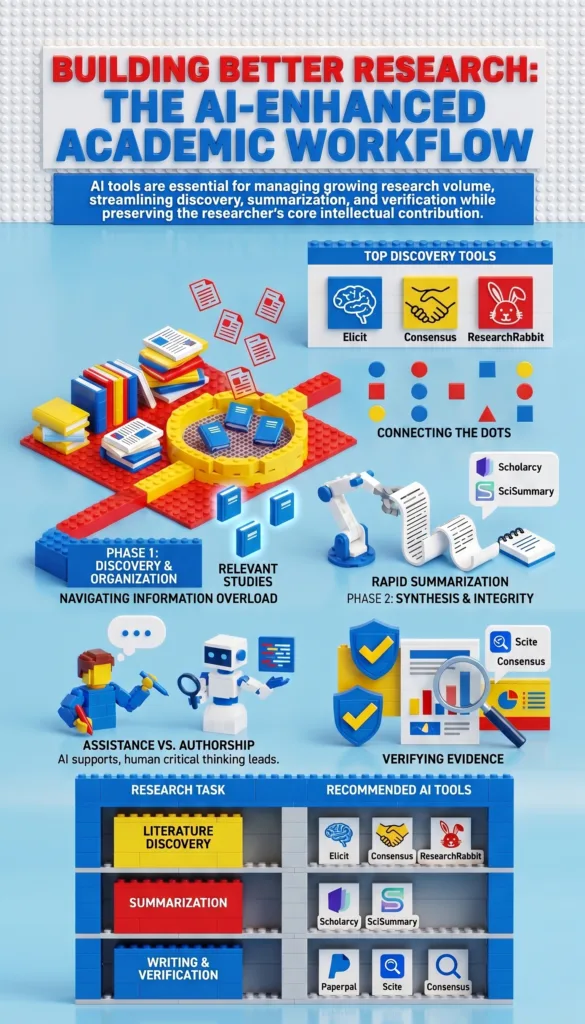
In academic environments, maintaining integrity remains essential. Researchers are responsible for verifying information, interpreting findings, and ensuring that their work accurately reflects the evidence. AI tools can accelerate these processes, but they cannot replace careful judgment and scholarly expertise.
When used responsibly, AI tools can become valuable companions throughout the research journey. They help reduce administrative burdens and information overload, making academic work more manageable and efficient.
Why AI Is Becoming Essential for Academic Research
The academic world produces an enormous amount of new research every year. Researchers across disciplines publish millions of articles, conference papers, reports, and studies. Keeping up with this expanding body of knowledge has become increasingly difficult.
Traditional literature searches often require researchers to review hundreds of abstracts and papers before identifying the most relevant sources. This process can be exhausting and time consuming. AI powered tools help address this challenge by rapidly analyzing large collections of academic content and highlighting the most relevant information.
Another major benefit is improved information organization. Researchers frequently manage dozens or even hundreds of sources within a single project. AI tools can help categorize, summarize, and connect these sources in meaningful ways, making it easier to identify patterns and relationships.
AI also helps reduce information overload. Instead of reading every paper in full detail, researchers can use AI generated summaries to quickly determine whether a source is relevant. This allows them to allocate their time more effectively and focus on the most important studies.
Furthermore, AI tools support evidence based decision making by helping researchers identify credible findings, assess consensus among studies, and understand how research evolves over time. These capabilities make AI an increasingly valuable asset in modern academic workflows.
Elicit
Elicit has emerged as one of the most powerful AI tools for academic research and literature review. Designed specifically for evidence synthesis and literature discovery, it helps researchers find relevant studies quickly and efficiently.
One of Elicit’s most impressive capabilities is its ability to search through more than 138 million academic papers and clinical trials. Rather than simply displaying search results, it generates structured summaries and research reports that help users understand the available evidence.
For researchers conducting systematic reviews, Elicit offers substantial advantages. Screening large numbers of studies and extracting relevant data are often among the most labor intensive parts of the review process. Elicit automates many of these tasks, allowing researchers to work more efficiently while maintaining consistency.
Another strength of Elicit is source organization. Researchers can store, manage, and revisit sources throughout the lifespan of a project. This helps maintain an organized workflow and reduces the risk of losing valuable references.
The tool is particularly useful for researchers who need to evaluate large bodies of literature quickly. By simplifying evidence synthesis and literature exploration, Elicit helps researchers focus more on analysis and interpretation rather than administrative tasks.
Consensus
Consensus takes a unique approach to academic research by focusing on direct evidence from peer reviewed studies. Unlike traditional search engines that return a wide range of results, Consensus aims to provide evidence based answers grounded in scientific research.
One of its most notable features is the Consensus Meter. This feature helps researchers understand the level of agreement among studies on a particular topic. Instead of reviewing dozens of papers individually, users can gain a broader understanding of scientific consensus within a field.
The platform also allows researchers to filter studies according to factors such as study type, population characteristics, and sample size. These filters help users locate research that is most relevant to their specific questions.
For evidence based writing, Consensus can be especially valuable. Researchers often need to support claims with reliable scientific evidence. By surfacing peer reviewed findings and highlighting areas of agreement among studies, the platform simplifies this process.
Another advantage is speed. Researchers can quickly obtain evidence backed insights without spending excessive time navigating multiple databases. This makes Consensus particularly useful during the early stages of literature reviews and research planning.
ResearchRabbit
ResearchRabbit offers a different perspective on literature discovery by emphasizing visualization and exploration. Rather than presenting research as isolated papers, it helps researchers understand connections between studies, authors, and research topics.
The platform creates visual maps that illustrate relationships within academic literature. These maps allow researchers to see how ideas evolve over time and how different studies influence one another. Such insights can be difficult to obtain through conventional search methods.
ResearchRabbit is particularly useful for identifying emerging trends and uncovering hidden connections. Researchers can discover papers that may not appear in standard keyword searches but are closely related through citations or shared themes.
Another significant benefit is its integration with reference management systems such as Zotero. This integration supports smoother workflows and helps researchers maintain organized libraries of sources.
The ability to explore academic networks visually makes ResearchRabbit a valuable tool for both experienced researchers and students. It encourages deeper exploration of the literature and helps users develop a more comprehensive understanding of their field.
Paperpal
Paperpal is widely recognized for its focus on academic writing improvement, but it also provides valuable support for literature reviews and research discovery.
One of its key strengths is helping researchers identify relevant papers based on conceptual similarity rather than relying solely on keywords. Traditional searches sometimes overlook important studies because they use different terminology. Paperpal addresses this issue by focusing on meaning and context.
This capability reduces information overload by directing researchers toward the most relevant sources. Instead of reviewing large numbers of loosely related papers, users can focus on literature that closely aligns with their research objectives.
Paperpal also supports writing quality by helping researchers improve clarity, structure, and readability. Academic writing often requires precision and consistency, and the platform assists users in refining their work.
For literature reviews, Paperpal serves as a valuable complement to discovery focused tools. While platforms such as Elicit and Consensus help researchers find information, Paperpal helps ensure that the resulting review is clear, coherent, and academically sound.
Its dual role as both a research assistant and writing support tool makes it a practical addition to many academic workflows.
Scite
Evaluating the credibility of sources is one of the most important aspects of academic research. Scite addresses this challenge by helping researchers understand how scientific papers have been cited by subsequent studies.
Traditional citation counts provide information about how frequently a paper has been referenced, but they do not reveal the nature of those references. A highly cited paper may be widely supported, frequently challenged, or discussed for various reasons.
Scite provides deeper insight by analyzing citation contexts. It identifies whether later studies support, contradict, or simply mention a particular finding. This information helps researchers assess the reliability and influence of research more effectively.
For literature reviews, this capability is especially valuable. Researchers must evaluate not only the existence of evidence but also its strength and credibility. Understanding how findings have been received by the scientific community contributes to more balanced and accurate interpretations.
Scite helps researchers move beyond simple citation metrics and develop a more nuanced understanding of academic evidence. As a result, it plays an important role in improving the quality and rigor of literature reviews.
Building an Effective AI Powered Literature Review Workflow
The greatest benefits of AI research tools often emerge when they are used together as part of an integrated workflow.
| Stage of Research | AI Tool(s) | Purpose | Key Benefit |
|---|---|---|---|
| Literature Discovery & Evidence Synthesis | Consensus, Elicit | Identify relevant studies and summarize research findings. | Speeds up literature searches and provides structured evidence-based insights. |
| Research Exploration & Mapping | ResearchRabbit | Explore connections between papers, authors, and research topics. | Helps discover additional sources, emerging trends, and research gaps. |
| Evidence Evaluation & Validation | Scite | Assess the credibility and reliability of research findings. | Shows whether studies have been supported, cited, or challenged by other researchers. |
| Writing & Review Enhancement | Paperpal | Improve writing quality, clarity, and academic language. | Ensures the literature review is concise, coherent, and publication-ready. |
| Integrated Research Workflow | All Tools Combined | Support the complete research process from discovery to writing. | Creates a comprehensive ecosystem for research, evaluation, organization, and communication. |
Best AI Tools to Summarize Research Papers Quickly
Reading large volumes of academic literature is one of the most demanding aspects of research. Many papers contain complex methodologies, extensive data analysis, technical terminology, and lengthy discussions. While reading complete papers remains important, researchers often need a faster way to determine whether a study is relevant to their work.
AI powered research paper summarizers help address this challenge by extracting key information from academic documents and presenting it in a more accessible format. These tools allow researchers to understand the purpose, methodology, findings, and conclusions of a study without immediately reading every page in detail.
By providing concise overviews, AI summarization tools help researchers screen literature more efficiently, prioritize important papers, and manage growing collections of research materials. Several tools have become particularly popular among students and researchers because of their ability to simplify complex academic content.
Scholarcy
Scholarcy is one of the most recognized AI tools for summarizing academic literature. It is designed to transform lengthy and information rich documents into interactive summaries that are easier to review and understand.
One of Scholarcy’s most useful features is its ability to create summary flashcards. These flashcards highlight the most important information from research papers, book chapters, and academic articles. Instead of manually extracting key points, researchers receive structured summaries that can be reviewed quickly.
The platform supports multiple document formats and allows users to import content from PDF files, Word documents, Zotero libraries, and cloud storage services. This flexibility makes it convenient for researchers working across different systems and projects.
Scholarcy also includes highlighting and note taking features that help users organize information while reading. Researchers can save important insights and revisit them later without searching through entire documents again.
Another significant advantage is customization. Users can generate summaries ranging from brief overviews to more detailed analyses. This flexibility allows researchers to tailor the level of detail according to their needs and available time.
For students and academics who regularly review large numbers of papers, Scholarcy can significantly improve efficiency and comprehension.
SciSummary
SciSummary is specifically designed for academic and scientific research. Unlike general purpose summarization tools, it focuses on preserving the structure and integrity of scholarly content.
One of the platform’s strongest features is its ability to organize summaries according to standard research paper sections. It separates content into categories such as abstract, methods, results, and conclusions, making it easier for researchers to navigate important information.
This structured approach is particularly useful for scientific disciplines where methodology and results play a critical role in evaluating evidence. Researchers can quickly examine study design and findings without losing context.
SciSummary also preserves citations within its summaries. This capability helps researchers maintain connections to original sources and supports accurate referencing during literature reviews.
Another valuable feature is its ability to interpret figures, charts, and statistical information. Scientific papers often contain complex visual data that can be difficult to understand quickly. By providing explanations and context, SciSummary improves accessibility and understanding.
Because of its academic focus, SciSummary has gained recognition among universities and research communities. It offers both free and paid options, making it accessible to a wide range of users.
Paperguide AI Research Paper Summarizer
Paperguide has earned attention as a powerful research paper summarization platform that combines accessibility with detailed analysis.
The tool is designed to extract essential information from academic papers while preserving the context necessary for meaningful understanding. Researchers can quickly identify study objectives, methodologies, findings, and conclusions without reading every section immediately.
One of Paperguide’s major strengths is its ability to analyze complete PDF documents. This allows users to upload research papers directly and receive comprehensive summaries based on the full content rather than isolated sections.
The platform supports both rapid screening and deeper exploration. Researchers can use it to determine whether a paper is relevant before investing time in a full review. At the same time, the summaries provide enough depth to support more detailed analysis when needed.
Accessibility is another important factor. The availability of free access options makes Paperguide appealing to students and researchers who may have limited budgets. Despite this accessibility, the platform maintains a focus on research quality and detailed interpretation.
For those seeking a balance between speed and depth, Paperguide represents a practical solution for managing academic literature more effectively.
Also read: What Is a Rewriting Sentences Tool? Best AI Tools and Usage Guide
Blainy Document Chat
Blainy introduces a conversational approach to research paper analysis. Rather than simply generating static summaries, it allows researchers to interact directly with uploaded documents through natural language questions.
This feature transforms the research experience. Instead of searching manually for specific information within a paper, users can ask questions about methodology, limitations, findings, or conclusions and receive targeted responses.
The ability to engage with documents conversationally can save substantial time, particularly when working with complex or highly technical studies. Researchers can focus on the information most relevant to their needs without reading every section immediately.
Blainy also supports citation extraction, helping researchers identify references and supporting evidence more efficiently. This capability is especially useful during literature reviews when tracking source relationships is important.
Direct PDF uploads further simplify the workflow. Researchers can upload documents and begin exploring their contents almost immediately.
The combination of document analysis and interactive questioning makes Blainy an innovative option for researchers seeking a more engaging and efficient way to understand academic literature.
Other Useful AI Research Summarization Tools
Several additional AI tools contribute to the growing ecosystem of academic research support.
Glasp provides a convenient way to highlight and save important sections while reading online content. Researchers can build collections of insights and revisit them later, creating a personalized knowledge base over time.
ChatPDF offers another conversational approach to document analysis. By allowing users to interact with PDF files directly, it helps researchers obtain summaries and answers without manually searching through lengthy documents.
Summarify focuses on condensing extensive content into concise and understandable summaries. This capability is useful when researchers need quick overviews of academic materials.
TLDR This extends summarization beyond academic papers to include webpages, articles, and other forms of content. Researchers working across multiple information sources may find this flexibility valuable.
Although these tools may not provide the same level of academic specialization as Scholarcy or SciSummary, they can still support productivity and information management in various research scenarios.
How to Choose Best AI tools for Research Workflow
Selecting the best AI research tool depends on individual goals, disciplines, and working styles. Different tools excel at different stages of the research process, and understanding these strengths helps researchers make informed choices.
Researchers focused on literature discovery may benefit most from platforms such as Elicit, Consensus, and ResearchRabbit. These tools specialize in finding relevant studies and identifying connections within academic literature.
Those conducting evidence based reviews may find Scite particularly valuable because of its ability to evaluate citation contexts and research credibility.
Students and academics seeking writing support can benefit from Paperpal, which improves clarity and helps identify conceptually relevant sources.
Also read: Students Are Loving These AI Essay Writing Tools, Here’s Why
Researchers dealing with large numbers of papers may prioritize summarization tools such as Scholarcy, SciSummary, Paperguide, and Blainy. These platforms help users understand complex content more efficiently and manage information overload.
Rather than relying on a single platform, many researchers achieve the best results by combining multiple tools. Each tool contributes unique capabilities that support different stages of the research process.
The Importance of Human Judgment in AI Assisted Research
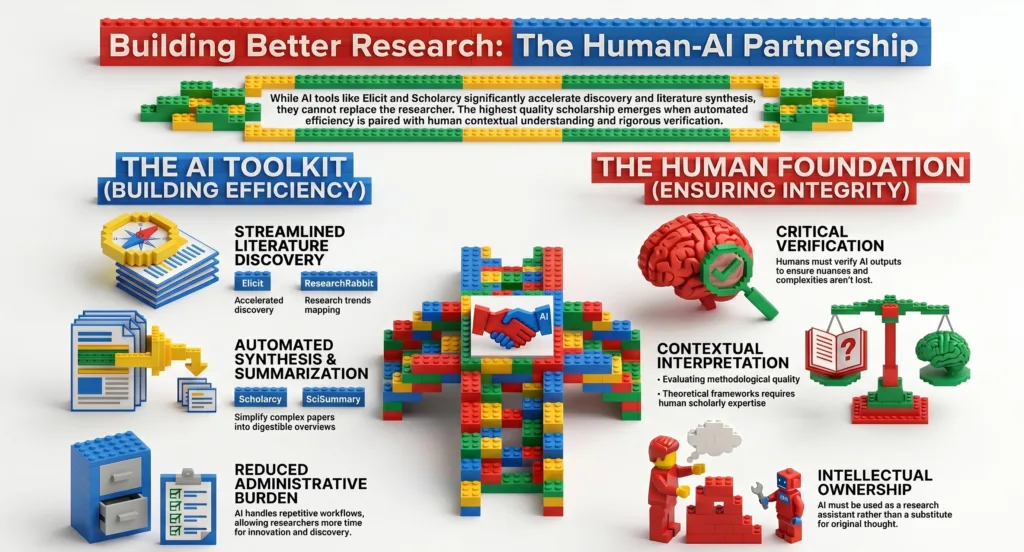
Despite the growing capabilities of AI, human judgment remains central to academic research. AI tools can accelerate workflows and provide valuable insights, but they cannot replace critical thinking, expertise, and scholarly evaluation.
Researchers must verify information obtained through AI systems. Summaries may occasionally omit important nuances, and automated interpretations may not always capture the full complexity of a study.
Evaluating evidence requires contextual understanding that extends beyond algorithmic analysis. Researchers must consider methodological quality, theoretical frameworks, limitations, and broader implications when interpreting findings.
Academic integrity also depends on responsible use of AI. Researchers should use these tools as assistants rather than substitutes for original thought and analysis. The goal is to enhance productivity while maintaining intellectual ownership of the work.
When combined with careful verification and critical evaluation, AI tools can become powerful partners in the research process. Their greatest value lies in supporting researchers rather than replacing them.
The Future of AI in Academic Research
The role of AI in academic research is likely to expand significantly in the coming years. As technology continues to improve, researchers can expect more sophisticated tools for literature discovery, evidence synthesis, writing assistance, and knowledge management.
Future systems may provide even deeper analysis of research trends, stronger integration across databases, and more personalized recommendations based on individual research interests.
At the same time, the principles of academic integrity and rigorous evaluation will remain essential. Successful researchers will be those who combine technological efficiency with critical thinking and scholarly expertise.
AI will continue to reduce administrative burdens and streamline complex workflows, allowing researchers to devote more attention to innovation, interpretation, and discovery.
Conclusion
AI tools have become valuable resources for academic research and literature review. Platforms such as Elicit, Consensus, ResearchRabbit, Paperpal, and Scite help researchers discover, organize, evaluate, and communicate knowledge more effectively. Meanwhile, summarization tools such as Scholarcy, SciSummary, Paperguide, and Blainy simplify the process of understanding complex academic papers.
These tools are most effective when used as research assistants rather than replacements for human expertise. They save time, reduce information overload, and improve productivity while allowing researchers to focus on analysis and critical thinking. By combining the strengths of multiple AI platforms and maintaining careful evaluation of sources, students and researchers can significantly enhance the quality and efficiency of their academic work.
References:
Best AI Tools for Academic Research in 2026: A Step-by-Step Workflow Guide
AI Tools for Research: Summarizing literature
6 Best AI Tools for Literature Review in 2026
Frequently Asked Questions
What are AI tools for academic research?
AI tools for academic research are software platforms that help researchers discover papers, summarize findings, organize references, evaluate evidence, and improve academic writing.
Which AI tool is best for literature reviews?
Elicit is widely considered one of the best tools for literature reviews because it supports literature discovery, evidence synthesis, source organization, and systematic review workflows.
What is Consensus used for?
Consensus is an AI powered academic search engine that provides evidence based answers from peer reviewed studies and highlights levels of agreement among research findings.
How does ResearchRabbit help researchers?
ResearchRabbit helps researchers explore relationships between papers, authors, and research topics through visual maps, making literature discovery more intuitive and comprehensive.
Why is Scite useful for literature reviews?
Scite analyzes citation contexts to show whether studies support, contradict, or mention previous findings, helping researchers evaluate source credibility.
Which AI tool is best for summarizing research papers?
Scholarcy and SciSummary are among the most popular options because they create structured summaries that make complex academic papers easier to understand.
Can AI tools replace researchers?
No. AI tools are designed to assist researchers, not replace them. Human judgment, critical thinking, and verification remain essential parts of academic research.
Are AI research tools ethical to use?
Yes, when used responsibly. Ethical AI tools support research, writing improvement, and literature discovery without replacing original thinking or authorship.

Dony Garvasis is the founder of Search Ethics, a freelance SEO consultant, and a passionate technology blogger. With over 8 years of experience in SEO, blogging and content marketing, I provide expert content on Tech, digital marketing, SEO, Artificial intelligence, gadgets, science, automobiles, lifestyle, tips, tutorials and much more. My mission is simple: Ethical Search, Genuine Results! I will make sure people everywhere get trustworthy and helpful information.