Now Reading: Claude vs ChatGPT vs Gemini: Which AI Chatbot Is Right for You?
-
01
Claude vs ChatGPT vs Gemini: Which AI Chatbot Is Right for You?

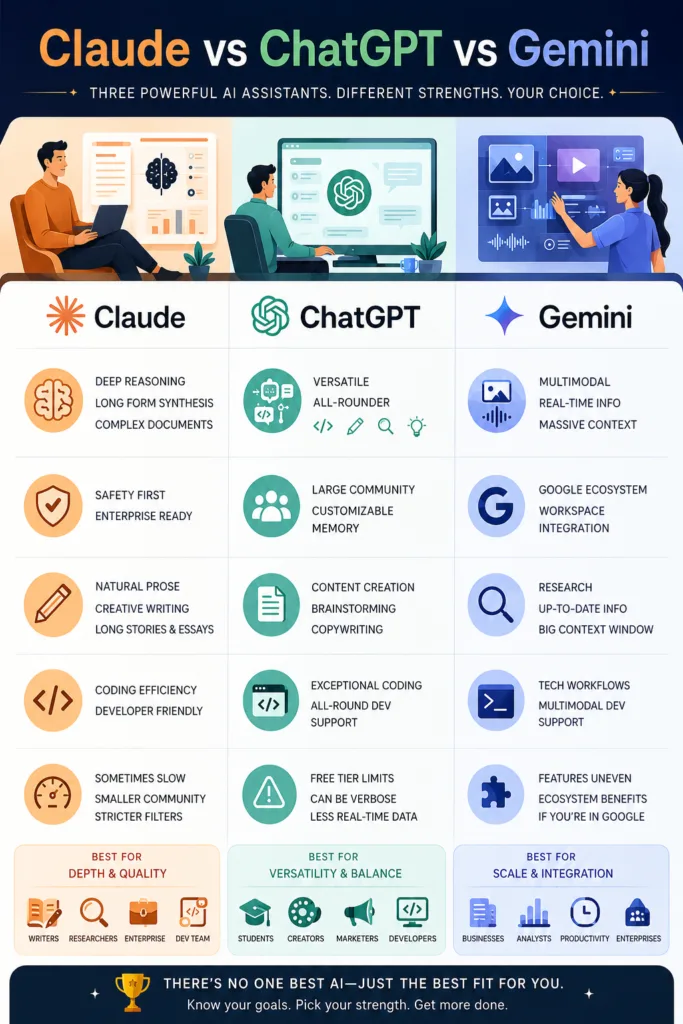
If you are comparing Claude vs ChatGPT vs Gemini, there is no single winner for every task. ChatGPT stands out as the most versatile option, Claude is particularly strong for deep reasoning, long form writing, coding, and sensitive documents, while Gemini shines with multimodal capabilities, huge context windows, real time information, and Google ecosystem integration.
Claude vs ChatGPT vs Gemini: The Big Picture
AI chatbots have moved far beyond simple question and answer tools. Today, ChatGPT, Claude, and Gemini can help with coding, research, writing, document analysis, brainstorming, creative work, and many other everyday tasks. The interesting part is that all three platforms are powerful, but they approach these tasks differently.
ChatGPT from OpenAI focuses heavily on versatility. It is designed to handle a wide range of activities, including coding, content creation, research, creative writing, structured content, brainstorming, and copywriting. It also benefits from strong customization options, memory capabilities, a large community, and a broad knowledge base.
Claude from Anthropic takes a somewhat different approach. It is particularly impressive when the task involves deep reasoning, long form synthesis, complex documents, enterprise use, creative writing, or coding. Its strong emphasis on safety and alignment also makes it appealing for sensitive or regulated environments.
Gemini from Google brings another set of advantages. It has advanced multimodal capabilities, meaning it can work with text, images, audio, and other forms of information. Its connection to the Google ecosystem is also important, particularly for people who already use Google Workspace and other Google services.
So, the choice really depends on what you want from an AI assistant. If you want one versatile tool for many different tasks, ChatGPT is a strong choice. If deep reasoning, long documents, safety, and natural prose matter most, Claude deserves serious consideration. If multimodal work, real time information, massive context, and Google integration are priorities, Gemini can be the better fit.
ChatGPT: The Versatile All Rounder
ChatGPT has developed a reputation as an all around AI assistant because it can handle such a broad collection of tasks. Its strengths cover coding, content creation, research, creative work, structured writing, brainstorming, copywriting, and rapid prototyping.
One of the biggest advantages of ChatGPT is its versatility. You do not necessarily need a separate AI tool for every task when one platform can move between different types of work. You can use it for a coding question, switch to content creation, ask for research assistance, and then work on a creative project.
The quality of its responses is another important strength. ChatGPT is described as producing comprehensive and well structured responses while maintaining a friendly tone. That combination can be useful when you want an answer that is detailed without feeling completely mechanical.
Customization is another area where ChatGPT stands out. Its customization options and memory capabilities allow for more personalized interactions. This can make repeated use more convenient because the experience can become more tailored to the user’s needs.
Also read:
ChatGPT also benefits from a large community and extensive knowledge base support. That broader ecosystem can be useful for people who want to find ideas, workflows, guidance, or discussions around different ways of using the platform.
Creative writing is another area where ChatGPT performs well, particularly for structured content, brainstorming, copywriting, outlines, plots, marketing content, and social media copy. Its writing interfaces, such as Canvas, can also make collaborative editing and rewriting more seamless.
However, ChatGPT is not perfect. The free tier has usage limitations compared with some competitors. It may also not provide the latest real time data access as effectively as some other chatbots. Another criticism is that its responses can sometimes become verbose or less concise than users want.
There is also a creative writing consideration. Without precise prompting or clear constraints, ChatGPT can sometimes fall into predictable AI style patterns, including repeated dramatic transitions, buzzwords, or uniform sentence structures. For users who want a highly distinctive literary voice, that is something worth keeping in mind.
Claude: A Strong Choice for Reasoning and Long Form Work
Claude takes a different position in the Claude vs ChatGPT vs Gemini comparison. Rather than trying to be everything to everyone, Claude has particular strengths in deep reasoning, long form synthesis, complex document analysis, creative writing, and coding.
One of its biggest advantages is its ability to handle complex enterprise level documents. If your work involves large amounts of information that need to be understood, synthesized, and organized, Claude can be particularly useful.
Claude is also known for producing structured outputs and managing context effectively during long conversations. This becomes especially valuable when a task requires the AI to remember detailed instructions, maintain a consistent style, or work through a substantial amount of information.
Creative writing is another area where Claude performs particularly well. Based on the provided comparison, Claude is especially suited to long form fiction, essays, and natural storytelling. Its prose can feel more human because it naturally varies sentence length, establishes narrative rhythm, and tends to avoid repetitive phrasing.
For writers, another useful strength is its ability to follow tone instructions and style guides across longer pieces. That can make it appealing when you want an AI assistant to maintain a particular voice throughout an extended document.
Also read:
- Top 6 AI Like Claude for Business Automation
- Claude Mythos Leads Project Glasswing to Protect Critical Systems
Claude also performs well in coding. Its coding efficiency and strong developer capabilities make it useful for people who want assistance with programming tasks as well as writing and reasoning.
Safety is another major part of Claude’s identity. Anthropic places strong emphasis on safety alignment and ethical AI use. This makes Claude suitable for sensitive or regulated environments where safety considerations are especially important.
At the same time, Claude has some limitations. It can sometimes respond more slowly than other AI assistants, particularly when generating shorter outputs. Its safety filters can also make it more restrictive in certain content generation situations.
The platform also has a smaller user community compared with ChatGPT. For some users, that may matter because a larger community can mean more shared workflows, discussions, examples, and accumulated knowledge around using a platform effectively.
Gemini: Built for Multimodal and Information Heavy Tasks
Gemini is Google’s entry in this three way comparison, and its strengths are particularly interesting for users who work with multiple forms of information.
Gemini supports advanced multimodal capabilities involving text, images, audio, and real time data integration. This gives it a strong position for tasks where the user does not want to work with text alone.
Another major advantage is its connection with the Google ecosystem. Gemini is tightly integrated with Google’s tools, including Google Workspace. For someone who already spends much of their working day inside Google’s productivity environment, that integration can make AI assistance feel more natural.
Gemini is also described as being fast and useful for up to date information retrieval. That makes it attractive for users who care about current information and want an AI system that can work effectively with real time data.
Its free plan is also described as more generous than ChatGPT’s free offering. For users who want to experiment with AI without immediately paying for a subscription, that can be an important consideration.
One of Gemini’s biggest technical advantages is its massive context window. This can be especially useful for writing and research tasks involving large amounts of source material. You can provide extensive research notes, entire books, or large world building documents without the same concern about losing track of important details.
That does not mean Gemini is always the strongest option for creative writing. Its raw prose can sometimes feel more utilitarian or less distinctive compared with Claude. Users who care deeply about natural storytelling and literary voice may therefore prefer Claude.
Gemini also has some unevenness in feature availability across different platforms. That can create an inconsistent experience depending on where and how you use it.
Another limitation is that its integration advantages are strongest for people already using the Google ecosystem. If you do not rely heavily on Google tools, some of Gemini’s ecosystem benefits may be less valuable to you.
ChatGPT vs Claude for Creative Writing
When the main question is creative writing, the Claude vs ChatGPT comparison becomes particularly interesting.
Claude is especially strong for long form fiction, essays, and natural storytelling. Its prose is described as feeling human, with varied sentence lengths, a clear narrative rhythm, and less repetitive phrasing. It can also maintain tone instructions and style guides across longer pieces.
That makes Claude particularly attractive for writers who care about the actual feel of the prose. If your goal is to create fiction or long form narrative material that maintains a consistent voice, Claude has a strong advantage according to the provided comparison.
ChatGPT, however, has its own strengths in creative work. It is particularly effective for structured content, brainstorming, copywriting, outlines, plots, marketing copy, and social media content.
This means the two platforms can appeal to different types of writers. Someone developing a story idea, creating a detailed outline, brainstorming possibilities, or producing structured marketing content may find ChatGPT especially convenient.
Someone writing a long story or essay and focusing heavily on natural prose may prefer Claude.
There is also an important difference in how ChatGPT handles style. Without precise prompting or negative constraints, it can sometimes produce predictable AI cliches and uniform sentence structures. That does not make it unsuitable for creative writing, but it means the quality of the prompt can have a meaningful impact on the final result.
Gemini vs ChatGPT for Research and Large Amounts of Information
For research heavy work, Gemini and ChatGPT have different advantages.
Gemini stands out because of its massive context window. When a task involves a very large amount of background information, this can be extremely useful. Instead of working with smaller sections of source material, Gemini can handle extensive research notes, entire books, and large world building documents.
ChatGPT is also strong in research, but its broader advantage comes from its all around performance. It combines research capabilities with coding, content creation, creative tasks, structured writing, customization, and other tools.
The difference is therefore less about one platform being capable and another being incapable. Both can support research, but their strengths are positioned differently.
If your research workflow involves massive amounts of source material, Gemini’s context capabilities are particularly attractive. If your research workflow regularly moves between research, writing, coding, brainstorming, and structured content, ChatGPT offers a broader general purpose experience.
Gemini’s real time data integration is another consideration. It is described as being good for up to date information retrieval, which can be useful when current information matters.
Claude vs Gemini for Long Documents
Claude and Gemini both have compelling advantages when working with lengthy material.
Claude excels at deep reasoning, long form synthesis, and complex enterprise level document analysis. It also manages context well over long conversations and can maintain specific instructions across longer pieces.
Gemini brings a different strength through its massive context window. Its ability to handle extremely large quantities of information makes it particularly attractive for users who need to provide substantial background material at once.
For document analysis, Claude’s emphasis on deep reasoning and enterprise level analysis can make it a strong choice. For tasks involving huge quantities of source material, Gemini’s context capabilities can be especially useful.
The right option therefore depends on what you are asking the AI to do with the information. If you need detailed synthesis, structured reasoning, and careful handling of complex documents, Claude is compelling. If you need to provide enormous quantities of background material and maintain access to that information, Gemini is particularly interesting.
ChatGPT vs Claude vs Gemini for Coding
Coding is another area where all three platforms can be useful, but they have different strengths.
ChatGPT is described as an exceptional all around performer in coding. It combines coding capabilities with content creation, research, reasoning, and other tasks. This makes it particularly useful for developers who want a general purpose AI assistant rather than a tool focused only on programming.
Claude is also strong in coding efficiency and developer work. Its coding capabilities are one of its major strengths, and its models are associated with popular AI coding editors such as Cursor and Windsurf.
Claude vs ChatGPT vs Gemini, Which AI assistant is right for you?
Gemini can also support technical and development workflows, particularly when multimodal capabilities and massive context are useful. Its positioning toward research, business automation, and interactive applications gives it another angle for technical users.
For someone who spends most of their time coding, Claude can be particularly attractive. For a developer who wants coding assistance alongside research, writing, brainstorming, and other general tasks, ChatGPT offers a balanced experience.
Multimodal Capabilities Compared
Multimodal capability is one area where Gemini has a particularly strong position.
Gemini supports text, images, audio, and real time data integration. Its ability to work with multiple forms of input makes it useful for complex tasks that go beyond traditional text based conversations.
ChatGPT also supports multimodal inputs, including vision and audio. It also provides tools such as Canvas for content editing, which expands its usefulness beyond simple conversations.
Claude has multimodal capabilities including vision and voice as well. This means all three platforms have moved beyond text only AI.
The difference is in emphasis. Gemini places particularly strong emphasis on multimodal input and its ability to handle large amounts of information. ChatGPT focuses on balanced versatility and a broader collection of tools. Claude combines multimodal functionality with its strengths in reasoning, coding, long form writing, and document analysis.
AI Model Architecture and Technical Differences
At a technical level, ChatGPT, Claude, and Gemini are all powered by advanced large language models based on transformer architectures and trained on vast amounts of data.
Their differences come largely from their training focus, capabilities, tools, and intended use cases.
OpenAI’s GPT models focus on broad general performance, coding, language understanding, content creation, reasoning, and creative work. The provided information describes OpenAI’s models as supporting multimodal inputs and tools such as Canvas.
Anthropic’s Claude models place greater emphasis on safety, alignment, coding, research, and natural long form prose. Claude is also designed to support long context interactions and complex document work.
Google’s Gemini models focus heavily on reasoning, multimodal inputs, and extremely large context windows. Gemini is also closely connected to Google’s broader ecosystem and is positioned for research, business automation, and interactive applications.
Also read:
- Google Brings Gemini 3 To Search AI Mode
- Say Hello to the Nano Banana Pro (Gemini image tool)
- Google Workspace Studio and the Future of Enterprise AI Agents
This makes the technical comparison less about identifying a single superior model and more about understanding where each model has been optimized to perform well.
ChatGPT Pricing and Plans
Pricing can make a significant difference when choosing between these platforms.
ChatGPT has a free plan that provides basic access with limited messaging quotas. For lighter users, the Go plan costs $8 per month and provides voice, video, and data analysis, although it does not include the heaviest reasoning models.
The Plus plan costs $20 per month and is positioned as the standard individual plan. It includes deep research capabilities, custom task execution, advanced reasoning models, and larger context windows.
For heavy users and developers, the Pro plan ranges from $100 to $200 per month. It is designed for people who need maximum message caps, full context windows, and priority access to the newest reasoning models.
ChatGPT also has a Business plan priced at $25 per seat per month. It provides administrative controls and data privacy guarantees and requires a minimum of two users.
Claude Pricing and Plans
Claude keeps its pricing structure comparatively simple.
The free plan provides limited access to standard conversational models. The Pro plan costs $20 per month and provides priority access to Claude’s advanced reasoning and coding models, along with extended context windows and artifact creation capabilities.
For businesses, Claude offers a Team plan priced between $25 and $30 per user per month. The plan includes collaborative features and higher rate limits, making it suitable for small business teams.
The $20 Pro price point puts Claude directly alongside ChatGPT Plus and Google AI Pro in the standard consumer subscription category.
Gemini Pricing and Plans
Gemini also offers several subscription levels.
The free tier provides standard access to baseline models. Google AI Plus costs $4.99 per month and offers boosted usage limits along with baseline cloud storage.
Google AI Pro costs $19.99 per month. It provides access to higher tier pro models and includes 5 TB of cloud storage. This places it very close to the $20 consumer subscription level offered by ChatGPT and Claude.
At the high end, Google AI Ultra ranges from $99.99 to $199.99 per month. It is aimed at developers and advanced technical users and provides significantly larger usage limits, agentic development access, 20 TB of storage, and bundled services such as YouTube Premium.
Quick Summary
| If you want | Best pricing option based on your content |
|---|---|
| Lowest paid price | Gemini Google AI Plus: $4.99/month |
| Around $20/month | ChatGPT Plus, Claude Pro, or Gemini Google AI Pro |
| Voice, video and data analysis | ChatGPT Go: $8/month |
| Deep research and advanced reasoning | ChatGPT Plus: $20/month |
| Advanced reasoning and coding | Claude Pro: $20/month |
| Large cloud storage | Gemini Google AI Pro: 5 TB |
| Maximum usage | ChatGPT Pro or Gemini Google AI Ultra |
| Business administration | ChatGPT Business |
| Team collaboration | Claude Team |
Which AI Is Best for Creative Writers?
If creative writing is your main priority, Claude has a particularly strong case. Its prose is described as natural and human, and it is particularly good at long form fiction, essays, and storytelling.
ChatGPT remains highly useful for writers who need brainstorming, structured content, outlines, plots, copywriting, and rapid experimentation. It is especially useful when writing is only one part of a larger workflow.
Also read:
- Students Are Loving These AI Essay Writing Tools, Here’s Why
- These AI Rewording Tools Make Academic Writing Faster
- What Is a Rewriting Sentences Tool? Best AI Tools and Usage Guide
Gemini can be useful when creative work depends on a very large amount of background information. Its massive context window makes it suitable for extensive research notes, entire books, and large world building documents.
So, for pure long form storytelling, Claude has a clear advantage in the provided comparison. For structured creative workflows, ChatGPT is highly capable. For writing projects that depend on massive source material, Gemini has an important advantage.
Which AI Is Best for Business Users?
Business users may have different priorities from individual users.
Claude is particularly suited to enterprise level document analysis and sensitive or regulated environments because of its emphasis on safety and alignment. Its Team plan also provides collaboration features and higher rate limits.
ChatGPT offers a Business plan with administrative controls and data privacy guarantees. Its broader capabilities can be useful for teams that want one AI platform covering coding, content creation, research, creative tasks, and structured work.
Gemini is especially appealing to organizations that already rely heavily on Google’s ecosystem. Its integration with Google Workspace can make it useful for productivity tasks inside familiar tools.
There is therefore no universal business winner. Claude has a strong position for complex documents and safety focused environments, ChatGPT provides broad versatility and business controls, while Gemini has a particularly strong ecosystem advantage for Google users.
Which AI Offers the Best Free Experience?
The free experience can be an important deciding factor if you do not want to pay for an AI subscription.
ChatGPT’s free tier provides basic access but has usage limitations. Claude also offers a free tier with limited access to standard conversational models.
Gemini’s free plan is described as more generous than ChatGPT’s in terms of usage. Google also offers a $4.99 Google AI Plus plan, making its entry point particularly attractive for users who want more than the free tier without moving immediately to a $20 subscription.
For users who are primarily comparing free access, Gemini may therefore be particularly appealing. However, the right choice still depends on whether your priorities are versatility, reasoning, creative writing, document analysis, multimodal work, or Google integration.
What About Specialized AI Platforms?
The AI market extends beyond ChatGPT, Claude, and Gemini.
Perplexity Pro costs $20 per month and combines search synthesis with the ability to choose between leading models from OpenAI, Anthropic, and Google. It also emphasizes robust citation tools, making it particularly interesting for research oriented users.
Midjourney focuses on creative image generation and offers several pricing levels. Its Basic plan costs $10 per month, Standard costs $30, Pro costs $60, and Mega costs $120. The plans vary based on fast GPU generation time and stealth mode access.
For developers, Cursor offers a Pro plan at around $20 per month. It provides extensive autocomplete features and advanced developer agent requests.
Dedicated writing platforms such as Sudowrite and Novelcrafter are also worth mentioning for fiction authors. Instead of functioning only as general purpose chatbots, these platforms combine underlying AI models with tools designed specifically for writing. Their features include story beat generation, description expansion, plot twist brainstorming, and character or lore management. The tradeoff is that they typically require a separate paid subscription.
Claude vs ChatGPT vs Gemini: Which One Should You Choose?
If you are still undecided, think about what you actually do with AI rather than simply asking which model is the most powerful.
ChatGPT is the strongest all round choice in this comparison. It combines coding, research, content creation, creative work, customization, memory, structured writing, and a broad ecosystem. It is particularly suitable for people who want one AI assistant that can handle many different types of tasks.
Claude is the better choice when deep reasoning, long form writing, complex documents, coding, natural prose, safety, and context management are your biggest priorities. Writers and users working with sensitive or complicated documents may find it especially appealing.
Gemini is the strongest fit when multimodal inputs, real time information, huge context windows, and Google ecosystem integration matter most. It is particularly useful for people who already rely heavily on Google tools or regularly work with very large amounts of source material.
The Future of AI Chatbots Is About Choosing the Right Tool
The comparison between Claude, ChatGPT, and Gemini shows something important about the current AI landscape. The question is no longer simply about which chatbot is smartest.
Instead, the more useful question is which chatbot fits your workflow.
A writer may value natural prose and long context. A developer may prioritize coding efficiency and agentic development. A researcher may care about information retrieval and source material. A business user may prioritize safety, privacy, collaboration, and administrative controls. A Google Workspace user may place more value on ecosystem integration than someone who works across many different tools.
That is why three powerful AI platforms can coexist while having different audiences.
Conclusion
Claude vs ChatGPT vs Gemini is ultimately a comparison of strengths rather than a simple race for one overall winner. ChatGPT is the most versatile option, offering strong performance across coding, research, content creation, creative tasks, customization, and structured work. Claude stands out for deep reasoning, long form synthesis, natural storytelling, coding, complex documents, and safety focused use. Gemini shines through multimodal capabilities, real time information, massive context windows, and Google ecosystem integration.
If you want an all purpose AI assistant, ChatGPT is a strong choice. If writing, reasoning, coding, or sensitive document analysis are your priorities, Claude deserves a close look. If you work with huge amounts of information, multimodal inputs, current information, or Google tools, Gemini may be the better fit.
The best choice depends less on popularity and more on the kind of work you expect your AI assistant to do every day.
References:
15 Best AI Writing Tools for Authors (And What Each is Best For)
AI Subscription Pricing — Compared
Frequently Asked Questions
Is ChatGPT better than Claude?
ChatGPT is stronger as an all round AI assistant, with broad capabilities across coding, research, content creation, creative tasks, customization, and structured work. Claude can be better for deep reasoning, long form writing, complex documents, natural prose, and safety focused environments.
Is Claude better than Gemini for writing?
Claude has a stronger position for natural long form writing. It is particularly suited to fiction, essays, and storytelling, while Gemini is especially useful for writing tasks involving very large amounts of background research or source material.
Is Gemini better than ChatGPT?
Gemini can be better when you need multimodal inputs, real time information, massive context windows, or close Google ecosystem integration. ChatGPT can be better when you want a balanced AI assistant for coding, research, creative work, content creation, and structured tasks.
Which is best for coding, Claude, ChatGPT, or Gemini?
All three can support coding, but Claude and ChatGPT have particularly strong coding capabilities in the provided comparison. Claude is noted for coding efficiency, while ChatGPT provides strong coding alongside a broader range of general purpose capabilities.
Which AI is best for creative writing?
Claude is particularly strong for long form fiction, essays, and natural storytelling. ChatGPT is excellent for brainstorming, structured content, outlines, plots, copywriting, and rapid prototyping. Gemini is useful when creative writing depends heavily on large amounts of background material.
Which AI has the largest context window?
Gemini is described as supporting a context window of up to 1 million tokens, giving it a major advantage for tasks involving very large quantities of information.
Which AI is best for research?
The answer depends on the research workflow. Gemini is particularly strong for massive source material, large context, and real time information retrieval. ChatGPT provides strong general research capabilities, while Claude excels at deep reasoning and long form synthesis.
Which AI is best for business use?
Claude is particularly suitable for complex enterprise documents and sensitive or regulated environments. ChatGPT offers business features including administrative controls and data privacy guarantees. Gemini is particularly useful for businesses already working extensively within the Google ecosystem.
How much does ChatGPT Plus cost?
ChatGPT Plus costs $20 per month according to the provided information. It includes deep research capabilities, custom task execution, advanced reasoning models, and larger context windows.
How much does Claude Pro cost?
Claude Pro costs $20 per month. The plan provides priority access to advanced reasoning and coding models, extended context windows, and artifact creation capabilities.
How much does Google AI Pro cost?
Google AI Pro costs $19.99 per month. It provides access to higher tier pro models and includes 5 TB of cloud storage.
Is Gemini free?
Yes. Gemini has a free tier that provides standard access to baseline models. The provided comparison also describes its free usage as more generous than ChatGPT’s free plan.
Is Claude free?
Yes. Claude has a free tier that provides limited access to standard conversational models.
Is ChatGPT free?
Yes. ChatGPT has a free tier that provides basic access with limited messaging quotas.
Which AI is best for long documents?
Claude is particularly strong for complex enterprise level document analysis and long form synthesis. Gemini has a major advantage when the task involves extremely large quantities of source material because of its massive context window.
Which AI is best for Google Workspace users?
Gemini is the natural choice for users who already rely heavily on Google’s ecosystem because of its tight integration with Google Workspace and other Google tools.
Is ChatGPT more customizable than Claude and Gemini?
ChatGPT is specifically noted for strong customization options and extensive memory capabilities. These features can help create more personalized interactions and make it particularly useful for repeated workflows.
Which AI has the best multimodal capabilities?
Gemini has a particularly strong position in multimodal capabilities, supporting text, images, audio, and real time data integration. ChatGPT and Claude also support multimodal functionality, including vision and voice.
Should I choose ChatGPT, Claude, or Gemini?
Choose ChatGPT if you want versatility across many different tasks. Choose Claude if you prioritize reasoning, natural long form writing, coding, complex documents, and safety. Choose Gemini if you need multimodal capabilities, massive context, real time information, or close integration with Google tools.

Dony Garvasis is the founder of Search Ethics, a freelance SEO consultant, and a passionate technology blogger. With over 8 years of experience in SEO, blogging and content marketing, I provide expert content on Tech, digital marketing, SEO, Artificial intelligence, gadgets, science, automobiles, lifestyle, tips, tutorials and much more. My mission is simple: Ethical Search, Genuine Results! I will make sure people everywhere get trustworthy and helpful information.