Now Reading: Is Digital Marketing Legit? Everything You Need to Know Before Investing
-
01
Is Digital Marketing Legit? Everything You Need to Know Before Investing
Is Digital Marketing Legit? Everything You Need to Know Before Investing
If you are wondering is digital marketing legit, the simple answer is yes. Digital marketing is a legitimate and trusted business practice used by companies of every size to attract customers, increase sales, and build their brands online.
The key is working with experienced professionals, setting realistic expectations, and choosing transparent strategies that focus on measurable results.
Digital marketing has become one of the most important ways businesses connect with customers. Whether you search for a product on a search engine, browse social media, receive a promotional email, or click on an online advertisement, you are interacting with digital marketing.
It has transformed the way companies promote their products and services because it allows businesses to reach the right audience while measuring the performance of every campaign.
Even though digital marketing is widely accepted and used around the world, many people still question whether it is legitimate.
This concern usually comes from hearing stories about agencies that promise unrealistic results or individuals who claim they can generate instant success with very little effort. These experiences can make people hesitant about investing in digital marketing.
The truth is that digital marketing itself is not the problem. Like many industries, there are honest professionals and there are people who use unethical practices.
Understanding the difference between the two can help you make better decisions and avoid costly mistakes. Once you know what legitimate digital marketing looks like, it becomes much easier to identify trustworthy partners and realistic strategies.
This article by Dony Garvasis clearly explains why digital marketing is a legitimate business practice, clears up some of the biggest misconceptions surrounding its effectiveness, and helps you recognize the qualities of a reputable digital marketing company.
Is Digital Marketing Worth It?
Digital marketing is a trustworthy business practice when it is carried out professionally and ethically. It is not an experimental concept or a passing trend. Instead, it has become an essential part of how modern businesses communicate with customers and compete in the online marketplace.
Today, businesses use digital marketing through search engines, social media platforms, email campaigns, paid advertising, and valuable online content. These channels help companies reach potential customers where they spend much of their time. Unlike many traditional forms of advertising, digital marketing also provides detailed performance data, allowing businesses to measure what is working and what needs improvement.
One of the strongest reasons digital marketing is considered legitimate is because it is supported by measurable data. Businesses can monitor website visitors, conversions, customer engagement, and return on investment. This level of insight allows companies to make informed decisions instead of relying on guesswork. Every campaign can be adjusted based on actual performance, making marketing efforts more efficient over time.
Widespread adoption across industries
Small businesses, large corporations, educational institutions, healthcare providers, and nonprofit organizations all use digital marketing as part of their growth strategy. Universities also teach digital marketing as an academic subject, preparing students for careers in an industry that continues to expand every year.
Technology has also strengthened the legitimacy of digital marketing. Modern tools powered by artificial intelligence allow businesses to better understand customer behavior, personalize marketing messages, and improve campaign performance. Instead of sending the same message to everyone, companies can deliver content that matches customer interests and preferences, creating a more meaningful experience.
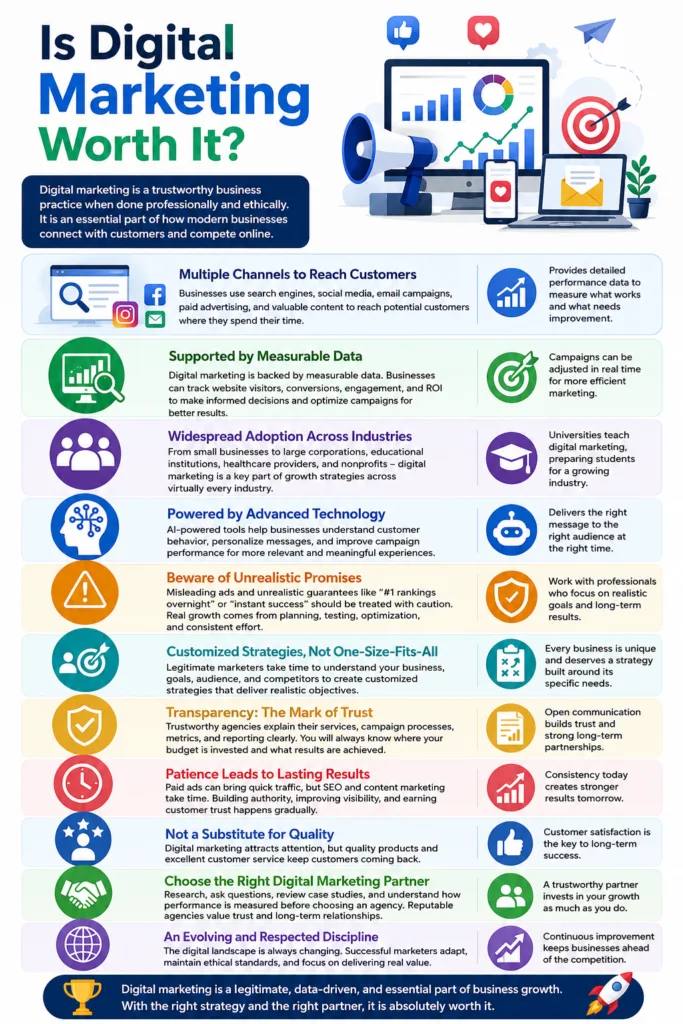
Despite these advantages, some people still question whether digital marketing is legitimate because they have encountered misleading advertisements or agencies making unrealistic promises. Claims such as guaranteed first page rankings within days or overnight business success should always be treated with caution. Sustainable business growth requires planning, testing, optimization, and consistent effort.
Legitimate digital marketing professionals understand that every business is different. They take time to learn about a company’s goals, target audience, competitors, and industry before recommending a strategy. Rather than offering identical solutions to every client, they create customized plans designed to achieve realistic objectives.
Transparency: Characteristic of trustworthy digital marketing
Reliable agencies clearly explain what services they provide, how campaigns will be managed, what metrics will be measured, and how progress will be reported. Clients should always know where their marketing budget is being invested and what results are being achieved.
Trustworthy agencies also communicate openly about timelines. While paid advertising may generate traffic quickly, other strategies such as search engine optimization and content marketing require patience. Building authority, improving search visibility, and earning customer trust happen gradually through consistent work.
Businesses should also remember that digital marketing is not a replacement for a quality product or excellent customer service. Marketing attracts attention, but customer satisfaction determines whether people become loyal customers. If a business delivers poor experiences, even the best marketing campaigns cannot create lasting success.
Choosing a reputable digital marketing partner requires careful research. Looking at previous client success stories, asking detailed questions, reviewing communication practices, and understanding how performance will be measured can help businesses make informed decisions. Reliable agencies welcome these conversations because they value long term relationships built on trust.
The digital landscape continues to evolve as customer expectations change and technology advances. Successful marketers adapt their strategies while maintaining ethical standards and focusing on delivering genuine value. This commitment to continuous improvement has helped digital marketing become one of the most respected business disciplines available today.
When viewed objectively, the evidence is clear. Digital marketing is a legitimate profession supported by education, technology, measurable performance, and widespread business adoption. The occasional bad experience with unethical providers should not define an entire industry that helps countless businesses grow every day.
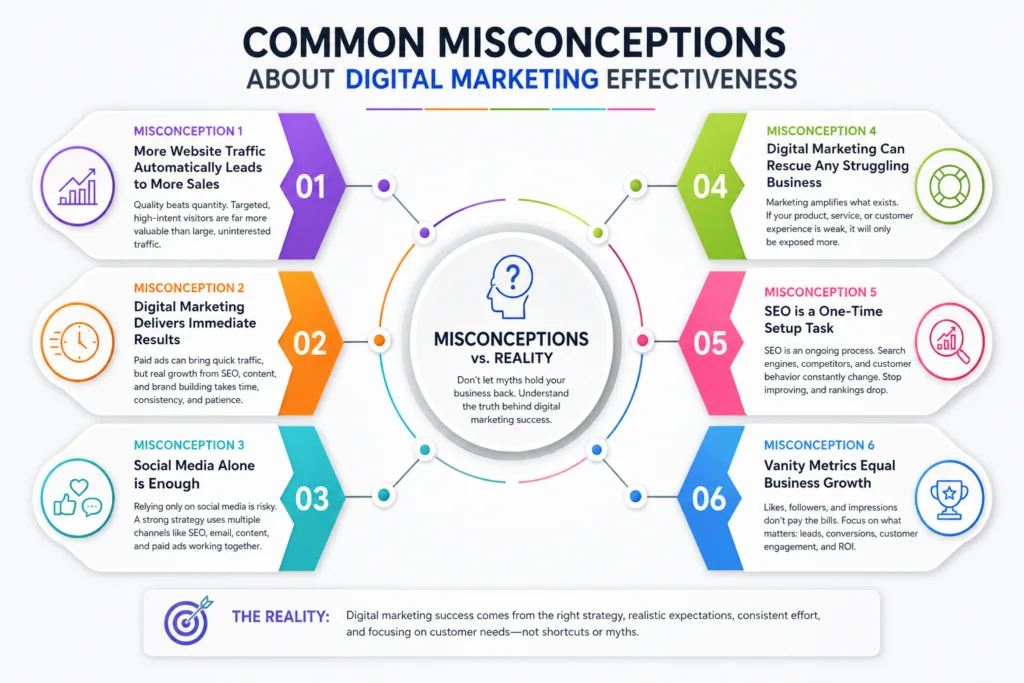
What Are Common Misconceptions About Digital Marketing Effectiveness?
Many people develop unrealistic expectations because they misunderstand how digital marketing actually works. These misconceptions often lead businesses to judge campaigns too quickly or invest in the wrong strategies. Understanding the reality behind these myths can help businesses make smarter marketing decisions and achieve better long term results.
One of the most common misconceptions is that more website traffic automatically leads to more sales. At first glance, this seems logical. If thousands of people visit a website, sales should naturally increase. In reality, traffic alone means very little if those visitors are not genuinely interested in the products or services being offered.
A business is far better off attracting a smaller number of highly interested visitors than thousands of people who leave the website within seconds. Quality always matters more than quantity. Successful digital marketing focuses on reaching the right audience instead of simply increasing visitor numbers.
Digital marketing delivers immediate results
Since the internet operates quickly, many people assume business growth should happen just as fast. While paid advertising can generate traffic almost immediately, sustainable success usually takes time.
Search engine optimization, content creation, and brand building require consistent effort over several months. Businesses must publish valuable content, improve their websites, earn customer trust, and refine their strategies based on performance data. Expecting instant success often leads to disappointment because meaningful growth is built gradually.
Many businesses also believe that maintaining active social media accounts is enough to succeed online. Social media certainly plays an important role, but focusing on it alone creates unnecessary risk. Platform algorithms change frequently, reducing the visibility of content without warning.
An effective digital marketing strategy combines multiple channels that work together. Search engine optimization improves organic visibility, email marketing nurtures existing customers, valuable content builds authority, and paid advertising expands reach. Each channel supports the others, creating a stronger overall marketing strategy.
Digital marketing can rescue any struggling business
Some business owners believe increasing advertising budgets will automatically solve declining sales or customer dissatisfaction.
In reality, digital marketing amplifies what already exists. If a business offers valuable products, excellent customer service, and a clear value proposition, marketing helps more people discover those strengths. However, if a business has poor customer service or products that fail to meet expectations, marketing simply exposes those weaknesses to a larger audience.
Search engine optimization is also frequently misunderstood. Some people believe SEO only needs to be completed once. They assume adding keywords to a website guarantees permanent search rankings.
SEO requires continuous improvement because search engines regularly update their algorithms, competitors publish new content, and customer search behavior evolves over time. Websites that stop improving often lose visibility as more active competitors continue optimizing their content says leading freelance SEO consultant.
Another misconception: focuses on vanity metrics
Businesses sometimes celebrate large follower counts, thousands of likes, or impressive impression numbers without considering whether these figures contribute to actual business growth.
While these metrics may appear encouraging, they do not necessarily indicate success. A campaign should ultimately be evaluated by meaningful outcomes such as qualified leads, customer engagement, repeat business, conversion rates, and overall return on investment. These measurements provide a much clearer picture of whether marketing efforts are achieving business goals.
Understanding these misconceptions helps businesses approach digital marketing with realistic expectations. Success comes from consistent effort, careful analysis, continuous improvement, and strategies designed around customer needs rather than short term excitement.
What Are the Signs of a Reputable Digital Marketing Company?
Finding the right digital marketing company can make a significant difference in your business growth. While many agencies claim to deliver exceptional results, not all of them operate with the same level of professionalism and integrity. Understanding the qualities of a reputable agency helps you invest your marketing budget wisely and build a long term partnership that supports your business goals.
One of the first signs of a trustworthy digital marketing company is transparency. A reliable agency is open about its services, pricing, processes, and reporting methods. Instead of using confusing technical language or hiding important details, they explain exactly how your marketing budget will be used and what activities they will perform. You should always know where your money is going and how your campaigns are progressing.
Clear communication is equally important
A reputable agency treats clients as partners rather than simply customers. They provide regular updates, answer questions promptly, and explain campaign performance in a way that is easy to understand. This ongoing communication creates trust and allows both parties to stay focused on achieving shared business objectives.
A proven track record is another strong indicator of credibility. Experienced agencies can demonstrate their expertise through successful projects, client testimonials, and measurable case studies. Instead of making vague claims about being the best, they provide evidence that shows how they have helped businesses generate leads, improve visibility, and increase revenue over time.
Every business is unique, which means marketing strategies should never be identical for every client. A reputable digital marketing company takes time to understand your industry, competitors, target audience, and business goals before recommending a strategy. They recognize that what works for one company may not produce the same results for another. Customized planning shows that the agency is committed to achieving meaningful outcomes instead of following a generic template.
Adaptability is another quality that separates professional agencies from average ones
The digital world changes constantly as search engines update their algorithms, customer preferences evolve, and new technologies emerge. A reputable agency monitors these changes closely and adjusts strategies whenever necessary. Rather than continuing with outdated methods, they remain flexible and proactive to keep your business competitive.
An experienced agency also brings together specialists from different areas of digital marketing. Search engine optimization, paid advertising, content creation, analytics, social media management, and website optimization all require different skills. Having experts in multiple disciplines allows campaigns to work together more effectively and creates a stronger online presence.
Another important characteristic is a focus on measurable business results instead of impressive looking numbers. While high follower counts and large impression numbers may seem exciting, they do not always contribute to business growth. A reputable agency pays closer attention to qualified leads, conversion rates, customer engagement, repeat business, and return on investment. These measurements provide a far more accurate picture of campaign success.
Problem solving is another valuable quality
Every marketing campaign encounters challenges at some point. Search rankings may fluctuate, advertisements may require optimization, or customer behavior may change unexpectedly. Professional agencies respond quickly by identifying the issue, testing solutions, and making improvements before small problems become larger ones.
Accessibility also plays an important role in building trust. Clients should never struggle to reach their marketing team. Reliable agencies are responsive, approachable, and willing to discuss campaign performance whenever needed. Knowing that your agency is available to answer questions creates confidence throughout the partnership.
It is equally important to recognize warning signs before signing a contract. Agencies that promise guaranteed overnight success, instant search rankings, or unrealistic revenue increases should be approached with caution. Digital marketing is based on continuous improvement, testing, and adaptation. Honest professionals understand that meaningful growth takes time and avoid making promises they cannot control.
Vague reporting is another concern
If an agency cannot clearly explain what work has been completed or how success is being measured, it becomes difficult to evaluate performance. Reputable companies provide detailed reports that show meaningful progress and explain the next steps in the strategy.
Businesses should also be cautious of agencies that rely heavily on aggressive sales tactics. A trustworthy company focuses on understanding your needs, answering your questions, and recommending solutions that genuinely fit your objectives. High pressure sales conversations often indicate that closing the deal is more important than building a successful long term relationship.
Also read: SEO vs SEA: Critical Differences That Impact Your Digital Growth
Before hiring any agency, spend time researching their reputation. Read client reviews, examine their previous work, ask for examples of successful campaigns, and discuss how they measure results. These conversations provide valuable insight into whether the company values transparency, accountability, and long term success.
The best digital marketing companies understand that trust is earned through consistent performance. They communicate honestly, adapt to industry changes, provide measurable results, and remain committed to helping their clients grow. When these qualities are present, businesses can feel confident that their investment is supporting sustainable growth rather than empty promises.
Conclusion
So, is digital marketing legit? The answer is clearly yes. Digital marketing is a legitimate, trusted, and highly effective business practice that helps companies reach customers, strengthen their brands, and generate measurable business growth. It has become an essential part of modern business because it combines technology, data, creativity, and customer understanding to produce meaningful results.
The doubts surrounding digital marketing usually come from unethical individuals or agencies that make unrealistic promises. These bad experiences should not overshadow the fact that thousands of businesses achieve success every day through well planned and professionally managed digital marketing strategies.
Understanding common misconceptions also helps set realistic expectations. More website visitors do not automatically mean more sales, social media alone is not enough, search engine optimization requires ongoing effort, and meaningful business growth takes consistency rather than overnight success. Businesses that understand these realities are more likely to see lasting results.
Choosing the right digital marketing company is equally important. Agencies that communicate openly, provide customized strategies, demonstrate proven success, and focus on measurable outcomes are far more likely to deliver value. Taking time to research potential partners can help businesses avoid scams while building relationships based on trust and accountability.
Digital marketing continues to evolve as technology and customer behavior change. Businesses that remain patient, focus on long term strategies, and work with experienced professionals are well positioned to achieve sustainable growth. Rather than asking whether digital marketing is legitimate, the better question is whether you are choosing the right strategy and the right partner to help your business succeed.
References:
Is Digital Marketing Legit? Everything You Need to Know
Why Digital Marketing is Legit: Key Insights from Industry Experts
Frequently Asked Questions
Is digital marketing legit for small businesses?
Yes. Digital marketing is a legitimate way for small businesses to reach their target audience, build brand awareness, generate leads, and increase sales using measurable online strategies.
Can digital marketing guarantee instant results?
No. While paid advertising can generate traffic quickly, long term strategies such as search engine optimization and content marketing require consistent effort and patience.
Why do some people think digital marketing is a scam?
Some people have worked with unethical agencies or individuals who made unrealistic promises or delivered poor quality services. These experiences do not represent the digital marketing industry as a whole.
How can I choose a trustworthy digital marketing agency?
Look for agencies that are transparent, communicate clearly, provide customized strategies, share client success stories, and focus on measurable business results.
Is search engine optimization a one time process?
No. Search engine optimization is an ongoing process because search algorithms, competitors, and customer search behavior continually change.
Are social media platforms enough for digital marketing?
No. Social media is only one part of a successful digital marketing strategy. Combining search engine optimization, content marketing, email marketing, and paid advertising creates better long term results.
What metrics should businesses focus on?
Businesses should focus on conversion rates, qualified leads, customer engagement, repeat customers, and return on investment rather than follower counts or impressions alone.
Does digital marketing work for every industry?
Yes. Businesses across many industries use digital marketing successfully. The key is developing a customized strategy that aligns with specific business goals and target audiences.
Also read: The Power of Guest Blog Posting Services for SEO

Dony Garvasis is the founder of Search Ethics, a freelance SEO consultant, and a passionate technology blogger. With over 8 years of experience in SEO, blogging and content marketing, I provide expert content on Tech, digital marketing, SEO, Artificial intelligence, gadgets, science, automobiles, lifestyle, tips, tutorials and much more. My mission is simple: Ethical Search, Genuine Results! I will make sure people everywhere get trustworthy and helpful information.