Now Reading: I Tested the Best AI Tools for Interior Design, Here Are My Top Picks
-
01
I Tested the Best AI Tools for Interior Design, Here Are My Top Picks

I Tested the Best AI Tools for Interior Design, Here Are My Top Picks
If you’re looking for the best AI tools for interior design, tools like RoomGPT, Planner 5D, Spacely AI, and Decor8 AI can help you create room layouts, arrange furniture, choose paint colors, and visualize renovations before spending money. These tools make home design easier, faster, and much less stressful.
If you’ve ever spent hours searching for decorating ideas or wondered whether a certain sofa or paint color would actually look good in your home, you’re definitely not alone. Designing a space sounds fun at first, but once you start making decisions, things can become confusing pretty quickly.
The good news is that artificial intelligence is making the whole process much easier. Instead of relying on imagination alone, you can now upload a photo of your room and instantly see different layouts, styles, and color combinations.
One of the things I really like about these tools is that they make interior design more accessible. You no longer need years of experience or expensive consultations just to explore ideas. Whether you’re updating your bedroom, renovating your kitchen, or planning an entire home makeover, AI tools can help you feel much more confident about your decisions.
I tested some of the most popular AI tools for interior design to see which ones truly deliver useful results. In this guide, I’ll share my top picks, explain how each tool works, and show how they can help homeowners, interior designers, and real estate professionals create better spaces with less effort.
What Are AI Interior Design Tools?
Think of AI interior design tools as a digital assistant for your home projects.
These platforms use artificial intelligence to analyze rooms and provide suggestions for layouts, furniture placement, styles, and colors. Most tools work by asking you to upload a photo of your room or provide a floor plan.
From there, the AI studies the space and generates ideas based on the information it sees.
Some tools focus on room layouts, while others specialize in paint colors, virtual staging, or renovation planning. The goal is simple. Help people make better design decisions without all the guesswork.
How AI Is Changing Home Design
Not too long ago, redesigning a room often meant drawing rough sketches or hiring professionals to visualize your ideas.
Today, things are very different.
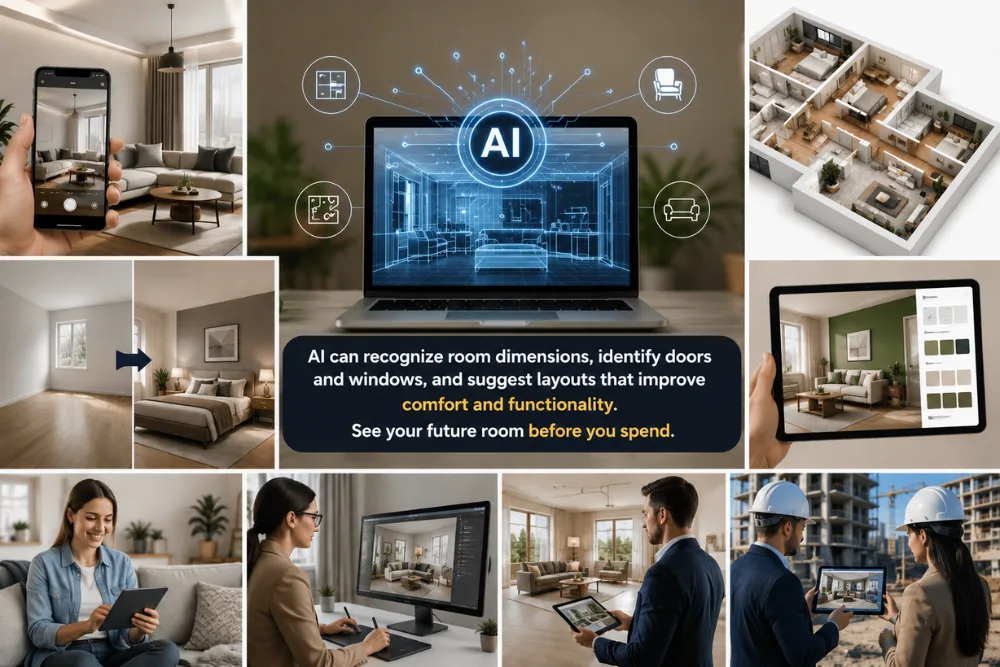
AI can recognize room dimensions, identify doors and windows, and suggest layouts that improve comfort and functionality. Instead of imagining how a room might look after a renovation, you can actually see it before spending money.
Another great advantage is speed. Tasks that once took hours or even days can now be completed within minutes.
Many people use AI simply because it helps them avoid costly mistakes. Rather than buying furniture that does not fit or choosing paint colors that do not match, they can experiment virtually first.
Who Can Benefit From AI Design Platforms?
One of the best things about AI interior design tools is that they are useful for almost everyone.
Homeowners
If you’re renovating your home or simply refreshing a room, AI tools can provide inspiration and help you test ideas before making purchases.
Interior Designers
Professionals can speed up their workflow and create realistic visualizations for clients much faster than traditional methods.
Real Estate Agents
Virtual staging helps agents showcase empty properties and attract more buyer interest.
Property Developers
Developers can present properties more effectively by helping potential buyers visualize completed spaces.
Even if you have no design experience at all, most platforms are easy enough for beginners to use.
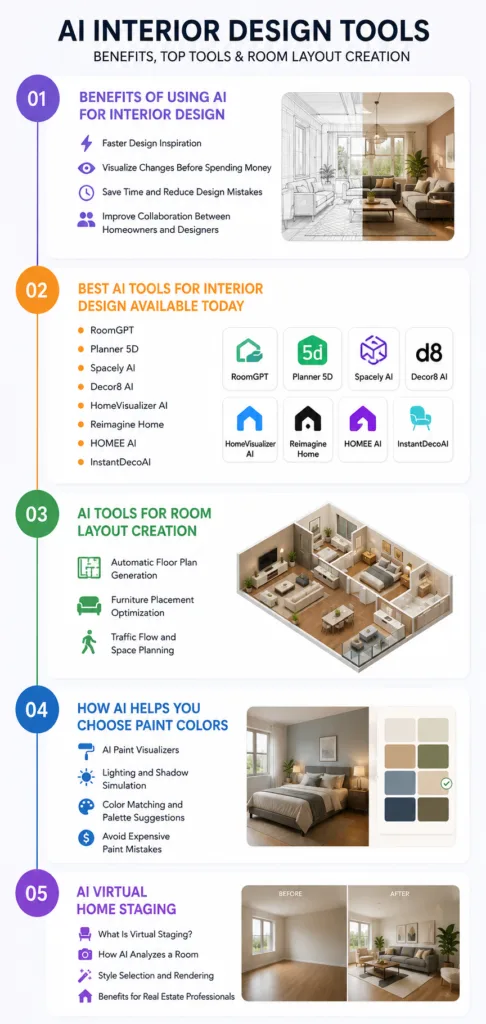
Benefits of Using AI for Interior Design
If you’re wondering why so many people are using AI for home projects, the answer is actually pretty simple.
These tools save time, reduce stress, and make decision making much easier.
Faster Design Inspiration
Coming up with ideas can sometimes be the hardest part of decorating a home.
AI tools help by generating multiple design concepts within seconds. Instead of spending hours looking for inspiration, you can quickly explore different themes and styles.
This makes the creative process feel much more enjoyable.
Visualize Changes Before Spending Money
One of my favorite benefits is being able to see changes before committing to them.
You can upload a photo of your room and instantly preview possible transformations. Whether you’re considering new furniture, different paint colors, or a complete remodel, you get a realistic idea of the final result.
That confidence can save both time and money.
Save Time and Reduce Design Mistakes
Let’s be honest. Home renovation mistakes can become expensive.
AI allows you to test ideas before buying materials or furniture. If something does not look right, you can simply try another option.
This approach helps prevent unnecessary expenses and gives you peace of mind.
Improve Collaboration Between Homeowners and Designers
Sometimes homeowners and designers have completely different ideas in mind.
AI makes communication easier because everyone can look at the same visual concepts and discuss them together.
Instead of endless revisions, decisions become much quicker and smoother.
Best AI Tools for Interior Design Available Today
Now let’s talk about some of the most popular AI interior design platforms available today.
Each tool offers something different, so the best choice depends on your needs.
RoomGPT
RoomGPT has become one of the most popular AI interior design tools in the world.
Used by millions of people, this platform allows you to upload a room photo and instantly see different design styles.
If you’re someone who struggles with decorating decisions, RoomGPT can be incredibly helpful because it lets you compare multiple looks before making changes.
Many homeowners use it simply for inspiration.
Planner 5D
Planner 5D is one of the most complete AI interior design platforms available today.
Its AI furniture placement tool analyzes room dimensions and generates multiple layout suggestions. The platform also considers doors, windows, and traffic flow to create spaces that are both beautiful and practical.
Another feature people love is AI floor plan recognition.
Planner 5D is suitable for beginners, DIY users, and professionals who want realistic visualizations without complicated software.
Spacely AI
If realistic rendering is important to you, Spacely AI is worth considering.
This platform can create photorealistic room images very quickly. Users can modify lighting, furniture, materials, and layouts without starting over from scratch.
Because of its professional quality visuals, Spacely AI is especially popular among interior designers and architects.
Decor8 AI
Decor8 AI focuses on fast room transformations.
After uploading a photo, users can explore dozens of design styles and visualize different paint colors and cabinet options.
Another reason Decor8 AI stands out is its virtual staging capability. Real estate professionals often use it to make properties look more appealing to potential buyers.
HomeVisualizer AI
HomeVisualizer AI is designed for people who want realistic room renderings.
It helps homeowners and design enthusiasts experiment with different concepts and better understand how design elements work together.
Seeing ideas visually often makes decision making much easier.
Reimagine Home
Reimagine Home helps users transform ordinary spaces into personalized environments.
People who enjoy exploring new ideas often appreciate the flexibility this platform provides.
Instead of starting with a blank canvas, users can quickly generate inspiration and build from there.
HOMEE AI
HOMEE AI uses smartphone based room scanning to provide personalized recommendations.
The platform can suggest furniture layouts based on both your style preferences and your budget.
This makes it especially useful for people who want practical advice without hiring a professional designer.
InstantDecoAI
InstantDecoAI focuses on quick room updates and furniture suggestions.
Homeowners and real estate professionals often use the platform to improve property presentations and visualize refreshed interiors.
Its simplicity makes it a convenient option for users who want fast results.
AI Tools for Room Layout Creation
Have you ever walked into a room and felt like something just did not seem right, even though all the furniture looked great? Most of the time, the issue is not the furniture itself. It is the layout.
A good layout can make a room feel larger, more comfortable, and easier to use. Thankfully, AI tools are making room planning much simpler than it used to be.
Instead of guessing where everything should go, these platforms analyze your space and provide suggestions that make sense.
Automatic Floor Plan Generation
Creating floor plans used to require technical knowledge and specialized software.
Now, AI can do much of the work for you.
Many modern platforms can generate floor plans quickly, allowing homeowners, designers, and real estate professionals to visualize spaces without spending hours creating layouts manually.
This is especially useful if you’re planning a renovation and want to see how different room arrangements might work before making permanent changes.
Furniture Placement Optimization
Let’s be honest. Moving furniture around repeatedly can become exhausting.
AI tools help solve this problem by analyzing the dimensions of your room and suggesting furniture arrangements that maximize available space.
Planner 5D, for example, uses artificial intelligence to study room shapes and create multiple layout suggestions. It considers both style and functionality, helping users create spaces that feel balanced and practical.
Instead of relying on trial and error, you can explore different arrangements within seconds.
Traffic Flow and Space Planning
One thing people often overlook is traffic flow.
A room might look beautiful, but if people cannot move comfortably around it, the space quickly becomes frustrating to use.
AI platforms consider doors, windows, and walking paths when creating layouts. This helps ensure that furniture placement does not block important areas or create awkward spaces.
The result is a room that feels both attractive and functional.
How AI Helps With Furniture Arrangement
Furniture arrangement is one of the biggest challenges in interior design.
You might have beautiful pieces, but knowing exactly where they should go is another story.
That is where AI becomes incredibly helpful.
Smart Furniture Suggestions
AI platforms can recommend furniture arrangements based on the size and shape of your room.
Rather than placing items randomly, the software creates layouts that work naturally with the available space.
This can help prevent overcrowding and improve overall comfort.
Multiple Layout Variations
One thing I really like about AI tools is that they do not force you into a single design.
Instead, many platforms provide several layout options.
This gives you the freedom to compare different arrangements and choose the one that fits your lifestyle best.
Sometimes the layout you originally had in mind turns out not to be the most practical. Having alternatives can be surprisingly helpful.
Personalized Style Recommendations
Many AI tools also recommend styles based on your preferences.
If you prefer modern interiors, the software can generate ideas that match that look. If you like something more cozy or classic, the AI adjusts accordingly.
This personalized approach helps users feel more connected to the final design.
How AI Helps You Choose Paint Colors
Choosing paint colors sounds simple until you actually have to do it.
Many people spend hours comparing samples and still feel uncertain about their final decision.
Thankfully, AI paint visualizers have made this process much easier.
AI Paint Visualizers
These tools allow you to upload a photo of your room and instantly apply different paint colors.
Instead of imagining how a color might look, you can see realistic previews before purchasing anything.
This removes much of the uncertainty that comes with painting projects.
Lighting and Shadow Simulation
One interesting thing about paint colors is that they can look completely different depending on lighting conditions.
AI tools account for this by simulating shadows and different light sources.
Some platforms even show how colors may appear during the day and in the evening.
This gives homeowners a much more accurate understanding of the final result.
Color Matching and Palette Suggestions
AI can also recommend colors that complement your existing furniture and decor.
Some platforms provide access to large libraries of paint colors from major brands and help users discover combinations that work well together.
This makes it easier to create a cohesive look throughout the home.
Avoiding Expensive Paint Mistakes
Nobody wants to repaint an entire room because the chosen color looked different than expected.
AI helps reduce this risk by allowing unlimited experimentation before making a purchase.
In many cases, this saves both money and frustration.
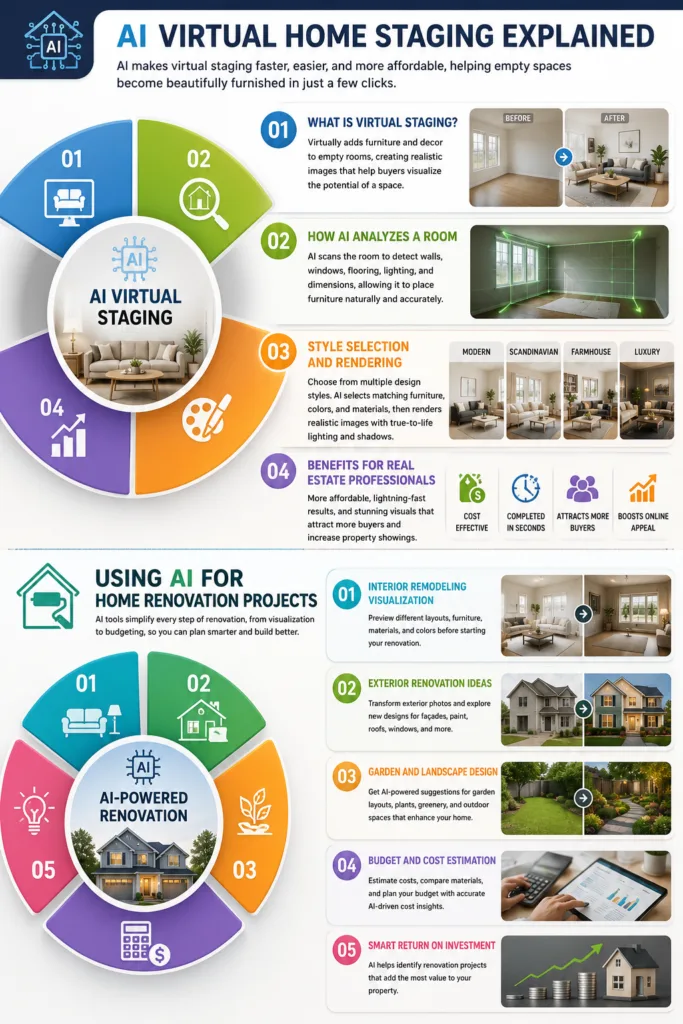
AI Virtual Home Staging Explained
If you’ve ever looked at an empty room and struggled to imagine how it could look furnished, you’re not alone.
That is exactly why virtual staging has become so popular.
AI makes the process faster and more affordable than traditional staging methods.
What Is Virtual Staging?
Virtual staging is the process of digitally adding furniture and decor to photographs of empty spaces.
Instead of physically moving furniture into a property, AI creates realistic images that help people visualize the potential of a room.
This approach is widely used in real estate marketing.
Also read: Secret Power of an AI Chatbot that Sends Pictures
How AI Analyzes a Room
Before generating staged images, AI first studies the room.
It identifies walls, windows, flooring, lighting conditions, and overall room dimensions.
This analysis allows the software to place furniture naturally inside the space.
Style Selection and Rendering
Many virtual staging platforms allow users to choose design styles.
Whether someone prefers modern, Scandinavian, or farmhouse interiors, the AI selects furniture and colors that match the chosen style.
The final images include realistic shadows, lighting effects, and materials that make the room feel authentic.
Benefits for Real Estate Professionals
Virtual staging offers several advantages for real estate agents.
First, it is significantly more affordable than traditional staging.
Second, it can be completed within seconds instead of days.
Most importantly, staged images help buyers imagine themselves living in the property, which often leads to increased interest and more showings.
Properties with attractive visuals tend to stand out online, making virtual staging an extremely valuable marketing tool.
Using AI for Home Renovation Projects
Home renovations can feel overwhelming because there are so many decisions involved.
From flooring and furniture to exterior upgrades and landscaping, every choice affects the final outcome.
AI tools help simplify the entire process.
Interior Remodeling Visualization
One of the biggest benefits of AI is being able to preview changes before work begins.
Homeowners can upload photos and instantly see different renovation ideas.
This makes it easier to decide which styles and materials feel right.
Exterior Renovation Ideas
AI is not limited to indoor spaces.
Many platforms can also transform exterior photographs and provide ideas for updating the outside appearance of a home.
Seeing these possibilities beforehand can help homeowners make more confident decisions.
Garden and Landscape Design
Outdoor spaces are becoming increasingly important, and AI can help there as well.
Some platforms provide layout suggestions for gardens and landscaping projects.
This allows homeowners to create personalized outdoor areas that match their overall design goals.
Budget and Cost Estimation
Renovation costs can add up quickly.
Some AI platforms help users estimate expenses and compare different material options.
They can also identify renovation projects that may provide stronger returns on investment.
Having access to this information makes budgeting much easier and helps homeowners avoid unnecessary spending.
Features to Look for in an AI Interior Design Platform
With so many AI tools available today, choosing the right one can feel overwhelming.
You might be wondering which features actually matter and which ones are simply nice extras.
The truth is that the best platform depends on your goals. Some people want quick inspiration, while others need professional quality renderings and advanced planning tools.
Here are some features worth paying attention to.
Photorealistic Rendering
One of the biggest advantages of AI is the ability to create realistic images.
Photorealistic rendering allows you to see how furniture, materials, and colors may look inside your space before making any purchases.
This feature is especially valuable when planning expensive renovations because it helps reduce uncertainty.
Style Libraries and Customization
Everyone has different tastes.
Some people love modern interiors, while others prefer classic or cozy spaces.
Many AI tools provide access to multiple design styles, allowing users to explore various looks and customize ideas based on their preferences.
This flexibility makes it easier to create a home that feels personal.
Floor Plan Recognition
Creating floor plans manually can be difficult for beginners.
AI powered floor plan recognition simplifies this process by automatically analyzing spaces and generating layouts.
This feature saves time and makes planning much easier.
Smart Layout Suggestions
A beautiful room should also be practical.
Smart layout tools analyze room dimensions, furniture sizes, and traffic flow to suggest arrangements that improve comfort and functionality.
These recommendations help users avoid awkward layouts and maximize available space.
Collaboration Tools
Home projects often involve multiple people.
Whether you’re working with family members, designers, or contractors, collaboration becomes much easier when everyone can view the same visual concepts.
Instant feedback also helps speed up decision making.
Brand and Asset Management
Some advanced platforms help maintain consistency by organizing design assets and preserving visual guidelines.
This feature is particularly useful for professionals who work on multiple projects.
Accessibility and Quality Checks
Certain AI tools can identify issues related to readability and visual quality.
These checks help ensure that designs remain both attractive and user friendly.
AI Interior Design for Different Users
One thing I appreciate about AI design tools is that they are not built for just one type of person.
Whether you’re renovating your own home or working with clients every day, there is usually a platform that fits your needs.
Homeowners
For homeowners, AI tools provide inspiration and confidence.
Instead of guessing how a room might look, you can test different ideas before spending money.
This makes decorating much less stressful.
Interior Designers
Design professionals can use AI to speed up repetitive tasks and provide realistic presentations for clients.
Rather than spending hours creating concepts manually, designers can focus more on creativity and communication.
Real Estate Agents
Real estate professionals benefit greatly from virtual staging.
Attractive images help properties stand out online and encourage buyers to schedule viewings.
Even empty spaces become easier to market with the help of AI.
Property Developers
Developers can use AI visualizations to showcase projects and help potential buyers understand the final vision.
This creates a more engaging experience for clients and investors.
Limitations of AI Interior Design Tools
As impressive as AI has become, it is important to remember that no technology is perfect.
Understanding the limitations can help you set realistic expectations.
Limited Manual Control
Some AI platforms do not provide complete control over every design detail.
Users may not always be able to adjust individual furniture sizes, colors, or exact placements.
For highly customized projects, this can sometimes be frustrating.
Accuracy Challenges
AI interpretations are not always perfect.
Occasionally, images may contain minor inconsistencies or unexpected results.
Different photographs of the same room may also produce slightly different outputs.
Because of this, AI should be viewed as a helpful assistant rather than a perfect replacement for human expertise.
Why Human Expertise Still Matters
Artificial intelligence is excellent for inspiration, planning, and visualization.
However, professional designers still bring creativity, experience, and practical knowledge that technology cannot fully replace.
For complex projects or luxury spaces, human guidance remains extremely valuable.
That is why many people use AI and professional expertise together rather than choosing one over the other.
Are AI Interior Design Tools Worth It?
In my opinion, the answer is yes.
If you’ve ever struggled with decorating decisions or worried about making expensive mistakes, AI tools can make the process much easier.
They help you visualize ideas, experiment with layouts, compare paint colors, and plan renovations without unnecessary stress.
For homeowners, these platforms provide inspiration and confidence.
For designers, they improve efficiency.
Also read: The Hidden Negative Impact of Artificial Intelligence on Society
For real estate professionals, they create better marketing materials.
Of course, AI is not perfect, and it cannot replace human creativity completely.
Still, as a planning and visualization tool, it offers tremendous value.
The best part is that you no longer have to rely entirely on imagination. You can actually see possibilities before making important decisions.
Final Thoughts
If you’re planning to redesign a room, renovate your home, or simply explore fresh ideas, AI interior design tools are definitely worth trying.
What I like most about these platforms is that they remove much of the uncertainty that usually comes with decorating. Instead of hoping your ideas will work, you can actually see them before making expensive decisions.
Whether you’re a homeowner, a designer, or someone preparing a property for sale, AI can help turn ideas into realistic visualizations and make the entire process much more enjoyable.
At the end of the day, great design is all about creating spaces that feel comfortable and reflect your personality. AI simply makes that journey easier.
Frequently Asked Questions
Which AI tool is best for interior design?
Some of the most popular AI interior design tools include RoomGPT, Planner 5D, Spacely AI, Decor8 AI, HomeVisualizer AI, Reimagine Home, HOMEE AI, and InstantDecoAI. The best choice depends on your specific needs.
Can AI create room layouts automatically?
Yes. Many AI platforms analyze room dimensions and generate layout suggestions automatically. They also consider furniture placement and traffic flow to improve functionality.
Can AI help choose paint colors?
Absolutely. AI paint visualizers allow users to preview colors on their walls and explore combinations before purchasing paint.
Are AI interior design tools free?
Some platforms offer free features, while others provide premium options with advanced capabilities and additional customization.
Can AI replace interior designers?
Not completely.
AI is excellent for inspiration and visualization, but professional designers still provide experience, creativity, and personalized guidance that technology cannot fully replace.
Which AI tool is best for home renovation projects?
Planner 5D, RoomGPT, Decor8 AI, and Spacely AI are among the most useful tools for homeowners planning renovations because they provide realistic visualizations and layout suggestions.
Related searches:
Best AI for Studying That Helps You Learn 10X Faster
What Is a Rewriting Sentences Tool? Best AI Tools and Usage Guide
These AI Rewording Tools Make Academic Writing Faster
Students Are Loving These AI Essay Writing Tools, Here’s Why
Best AI Tools for Academic Research and Literature Review

Dony Garvasis is the founder of Search Ethics, a freelance SEO consultant, and a passionate technology blogger. With over 8 years of experience in SEO, blogging and content marketing, I provide expert content on Tech, digital marketing, SEO, Artificial intelligence, gadgets, science, automobiles, lifestyle, tips, tutorials and much more. My mission is simple: Ethical Search, Genuine Results! I will make sure people everywhere get trustworthy and helpful information.