Now Reading: Joseph Gordon Levitt Says the Real AI Threat Is Not Killer Robots
-
01
Joseph Gordon Levitt Says the Real AI Threat Is Not Killer Robots
Joseph Gordon Levitt Says the Real AI Threat Is Not Killer Robots
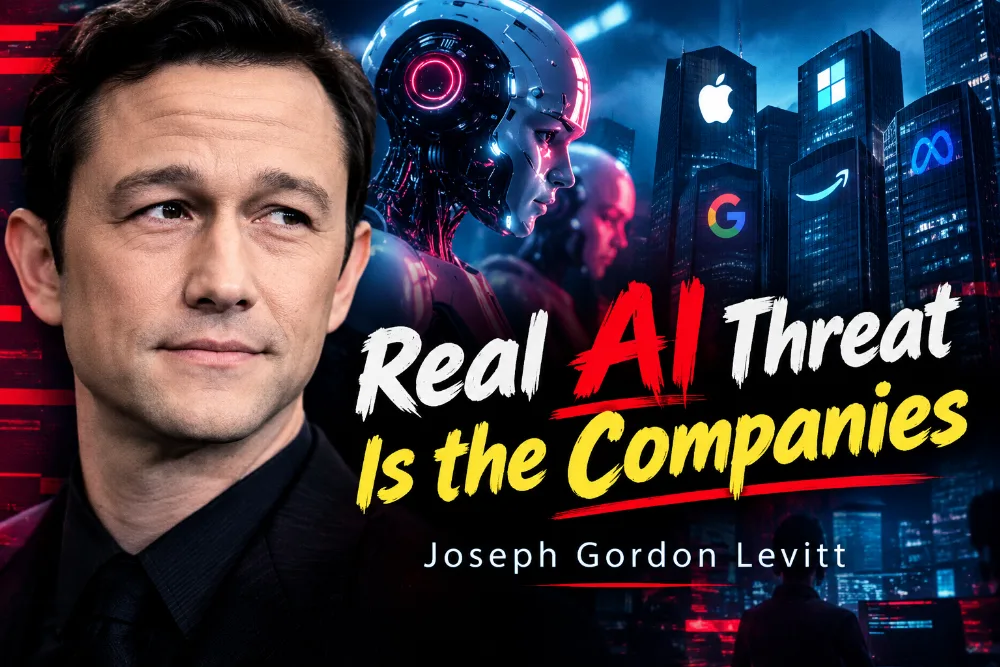
Joseph Gordon Levitt believes the danger in artificial intelligence has little to do with machines turning on humanity. He argues the risk lies with the small group of companies that build, train and deploy the technology, and with the public’s limited say in how they do it.
As he put it in a New York Times video, “We shouldn’t be scared of an A.I.” Instead, he said, we should be concerned about the people building it. You can watch the video down while scrolling.
That is an unusual message from an actor whose industry gave us so many of our mental pictures of rogue machines. It is worth understanding, because it shifts the question from “what will AI do?” to “who decides what AI does?”
Why an Actor Is Speaking at the United Nations
Gordon Levitt is not simply sharing opinions from the sidelines. The United Nations appointed him as its first Global Advocate for Human Centric Digital Governance, a title he himself admitted is a mouthful. The idea behind it is simple enough. Digital technology should be governed by people and for people, rather than shaped mainly by whoever builds it fastest.
Follow Gordon Levitt on Twitter
His video followed his work at the UN, and it is where he laid out the argument that has since drawn attention. Watch what he says;
The Problem of Concentrated Power
Think about how many ordinary activities now pass through products built by a few firms. Search, workplace software, entertainment, education and communication are all being reshaped by private companies. Gordon Levitt’s concern is that training, deployment and oversight of the most powerful systems sit with the same small group.
His fear is a public that is confused or apathetic while “very fast moving businesses design the future by themselves,” in his words, driven by their own profits. He went further and said these firms are betting they can take over the entire economy, a scenario he called totalitarianism that “would be really bad.”
Also read:
The Hidden Negative Impact of Artificial Intelligence on Society
It helps to read that carefully. He framed it as a warning about where concentrated power could lead, not as something that has already happened. The reasoning is straightforward. When a handful of organisations hold this much influence over how people work, find information and create, the usual checks of transparency, accountability and public oversight matter far more.
When a Chatbot Starts to Feel Like a Friend
One of his sharper points concerns emotion. Gordon Levitt has said these models are being trained to “hijack your intimacy,” to befriend users and even get them to fall in love with the product.
Have you ever noticed how a chatbot keeps asking follow up questions? That is not always accidental. The more a chatbot prompts you to continue, the longer you are likely to stay engaged, and engagement is valuable to the company that built it.
None of this makes warm, personal AI useless. An assistant that remembers details about your life can be genuinely helpful. The point is that the same qualities deserve closer scrutiny once a product starts to feel like a confidant. If you use memory or personalization features, it is sensible to check what those settings actually store, and to think about the company’s business model before sharing sensitive details.
Creators, Data and the Idea of Residuals
Gordon Levitt is also pushing for what he calls “residuals for data.” The concept borrows from the entertainment world, where performers are paid again when their work is reused. Applied to AI, it would give creators a share of the profits when their writing, images and performances are used to train commercial models.
The financial stakes are not small. Creative generative tools are projected to reach $14.03 billion by 2030. UNESCO, the United Nations Educational, Scientific and Cultural Organization, says artists’ income could fall by 2028, with routine creative work likely to be hit first.
Reference:
Generative AI in Creative Industries Market Report 2026
Critics raise a wider concern too. Perspectives outside the West, other sectors that supply training data, and smaller companies risk being squeezed out simply because building large models is so expensive.
A Regulatory Picture That Is Still Unfinished
The fight over rules is already visible. The United States still has no full federal AI law. The European Union has introduced risk based rules, yet questions about creator pay and data use remain unresolved. Meanwhile, chatbot designs that keep users engaged through behavioural nudges continue to spread.
So the questions Gordon Levitt raises are not theoretical. They sit inside live debates about who benefits from AI and who carries the cost.
An Honest Answer About a Slow Moving System
Gordon Levitt does not claim to have a neat solution. Asked how a slow moving UN could make fast moving Silicon Valley companies follow its rules, he said, “I don’t know the answer.” He did not suggest that international agreement would arrive quickly.
His case is about timing instead. Even if an internationally agreed AI framework takes seven years to build, he said, “seven years from now, we’ll be glad that we started now.”
What This Means for Everyday AI Users
You do not need to accept every part of his argument to find it useful. AI companies want more of our work, our information and our trust. A reasonable response is to pay attention to what you receive in return.
That might mean noticing how much of your daily workflow depends on one provider, reviewing what personalization settings store about you, and thinking twice before treating a friendly chatbot as a private confidant.
Questions Readers Are Asking
What is Joseph Gordon Levitt’s role at the United Nations?
He serves as the UN’s first Global Advocate for Human Centric Digital Governance. The role centres on the principle that digital technology should be governed by people and for people.
Does he think AI itself is dangerous?
His argument points the other way. He says people should not be scared of AI itself, and should focus on the people and companies building it and the power they could gather.
What does “residuals for data” mean?
It is his proposal that creators receive a share of profits when their writing, images or performances are used to train commercial AI models, similar to residual payments in the entertainment industry.
Why does he describe concentrated AI power as close to totalitarianism?
He argues that if a few firms succeed in taking over the entire economy, the result would be a level of control he calls totalitarianism. He presented this as a warning about where concentrated power could lead, and did not say it has already happened.
Why do chatbots keep asking me follow up questions?
Gordon Levitt’s concern is that this can be deliberate. The more a chatbot keeps the conversation going, the longer you are likely to stay engaged, which benefits the company behind it.
Has he explained how global AI rules could be enforced?
No. He openly said he does not know how a slow moving UN could make fast moving technology companies comply. His view is that starting the work now is worth it, even if a framework takes years.
How can I protect myself when using AI memory features?
Check what those settings store, and consider the company’s business model before sharing sensitive details, especially when a product starts to feel like a confidant.
Also read:
Is Satya Nadella’s AI Safety Warning Real? Here’s What He Actually Said

Dony Garvasis is the founder of Search Ethics, a freelance SEO consultant, and a passionate technology blogger. With over 8 years of experience in SEO, blogging and content marketing, I provide expert content on Tech, digital marketing, SEO, Artificial intelligence, gadgets, science, automobiles, lifestyle, tips, tutorials and much more. My mission is simple: Ethical Search, Genuine Results! I will make sure people everywhere get trustworthy and helpful information.