Now Reading: AI Can Write Code, But Will Programmers Be Replaced by AI?
-
01
AI Can Write Code, But Will Programmers Be Replaced by AI?
No, AI powered coding tools are not likely to replace human programmers completely. In my opinion, AI will change how software is built, automate many repetitive coding tasks, and improve developer productivity, but human programmers will remain essential for problem solving, decision making, creativity, system design, and understanding business needs.
Artificial intelligence is transforming almost every industry, and software development is one of the biggest examples. Over the last few years, AI coding assistants have evolved from simple autocomplete tools into powerful systems capable of generating code, fixing bugs, writing documentation, and even creating complete applications.
As a result, many developers are asking an important question. Will AI powered coding tools replace human programmers?
It is a reasonable concern. When people see AI generating hundreds of lines of code within seconds, it is easy to assume that programming jobs may eventually disappear. However, the reality is much more complex than that.
In my opinion, we are not witnessing the end of programming careers. Instead, we are witnessing the beginning of a new era where developers work alongside AI tools to build software faster and more efficiently.
The future belongs to programmers who learn how to use AI effectively, rather than those who ignore it. Understanding what AI can do, what it cannot do, and how developers can adapt is the key to staying competitive in the years ahead.
Let us explore the future of software development and discover whether AI is truly a threat to programmers or simply the next powerful tool in a developer’s toolkit.
The Rise of AI Powered Coding Tools
Artificial intelligence has changed dramatically in a very short period of time. Just a few years ago, coding assistants were limited to basic code suggestions. Today, AI systems can generate entire functions, create applications, explain complex algorithms, and help developers solve difficult programming challenges.
This rapid advancement has led many people to believe that programming may soon become fully automated.
While AI has certainly become more capable, understanding what these tools actually do is important before making predictions about the future.
What Are AI Coding Assistants?
AI coding assistants are software tools that use machine learning and large language models to help developers write code. These tools analyze vast amounts of programming knowledge and use that information to generate relevant code suggestions based on user requests.
Instead of manually writing every line of code, developers can describe what they want, and the AI generates a solution.
For example, a programmer might ask an AI tool to create a login system, build a database connection, or generate a responsive webpage. Within seconds, the AI can produce working code that would otherwise take much longer to create manually.
The goal of these tools is not necessarily to replace developers. Instead, they are designed to increase productivity and reduce repetitive work.
How AI Is Changing Software Development
The traditional software development process often involves many repetitive tasks. Developers spend significant amounts of time creating boilerplate code, writing documentation, fixing common bugs, and performing routine testing.
AI can handle many of these responsibilities quickly. As a result, programmers can focus more on solving business problems, designing systems, improving user experiences, and building innovative products.
In my opinion, this is one of the most positive aspects of AI adoption. Technology should remove repetitive work so humans can focus on higher value activities. Instead of spending hours writing basic code structures, developers can invest more time understanding customer needs and creating better software solutions.
The Most Popular AI Coding Tools in 2026
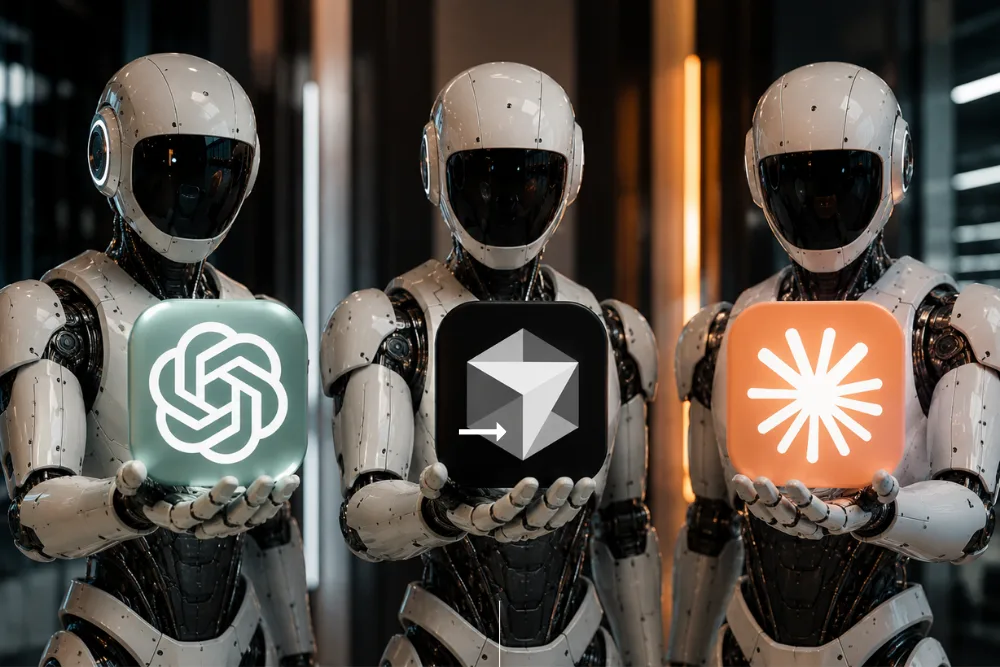
Several AI coding tools have become widely adopted across the software industry. ChatGPT helps developers generate code, explain concepts, and troubleshoot programming issues.
Also read: Best AI like Chatgpt for Customer Support
GitHub Copilot provides intelligent code suggestions directly inside development environments. Cursor offers an AI focused coding experience designed specifically for developers. Claude assists with complex reasoning, code analysis, and large project understanding. Windsurf provides AI enhanced development workflows that streamline coding tasks.
Also read: Claude Mythos Leads Project Glasswing to Protect Critical Systems
These tools continue improving at a rapid pace, making software development faster and more accessible than ever before. However, speed alone does not determine whether AI can replace human programmers. To answer that question, we must understand the strengths and limitations of artificial intelligence.
Can AI Really Replace Human Programmers?
This is the question that generates the most debate. Every time a new AI model is released, headlines often suggest that programmers are about to become obsolete. Social media discussions frequently predict that coding jobs will disappear within a few years.
While these predictions attract attention, they often overlook the realities of software engineering. Programming involves much more than writing code. In my opinion, this distinction is what many people fail to recognize when discussing AI and developer careers.
What AI Can Do Better Than Humans
Artificial intelligence excels at certain tasks. AI can generate code extremely quickly.
- It can search large knowledge bases instantly.
- It can identify common coding patterns.
- It can automate repetitive programming tasks.
- It can generate documentation and test cases.
- It can assist with debugging simple issues.
For straightforward programming problems, AI often produces solutions much faster than a human developer. This efficiency creates enormous productivity gains for software teams. A developer who understands how to use AI effectively can accomplish significantly more work than someone relying entirely on manual coding methods.
What AI Still Cannot Do
Despite its impressive capabilities, AI has major limitations. Artificial intelligence does not truly understand business goals the way humans do.
- It does not possess real world experience.
- It cannot fully understand customer emotions, company politics, market conditions, or organizational priorities.
- AI generates outputs based on patterns found in training data. It does not think independently or exercise genuine judgment.
For example, a business may need a software platform that balances security, performance, cost, scalability, and user experience. Choosing the right solution often involves tradeoffs. These decisions require context, experience, and strategic thinking. AI can suggest options, but humans must decide which path is best.
Also read: Top 6 AI Like Claude for Business Automation
Why Human Judgment Remains Essential
Software projects rarely fail because developers cannot write code. Most failures occur because requirements are unclear, communication breaks down, priorities change, or business goals are misunderstood. Human programmers play a critical role in navigating these challenges. Developers communicate with stakeholders.
- They translate business requirements into technical solutions.
- They make architectural decisions.
- They evaluate risks.
- They balance competing priorities.
- They collaborate with designers, managers, executives, and customers.
These responsibilities cannot simply be automated through code generation. In my opinion, as AI becomes better at coding, human judgment becomes even more valuable. The ability to understand people, solve ambiguous problems, and make informed decisions will continue separating skilled engineers from automated systems.
Which Programming Tasks Are Most Vulnerable to AI?
Although programmers are unlikely to disappear, certain programming tasks are becoming increasingly automated. Understanding these changes can help developers prepare for the future.
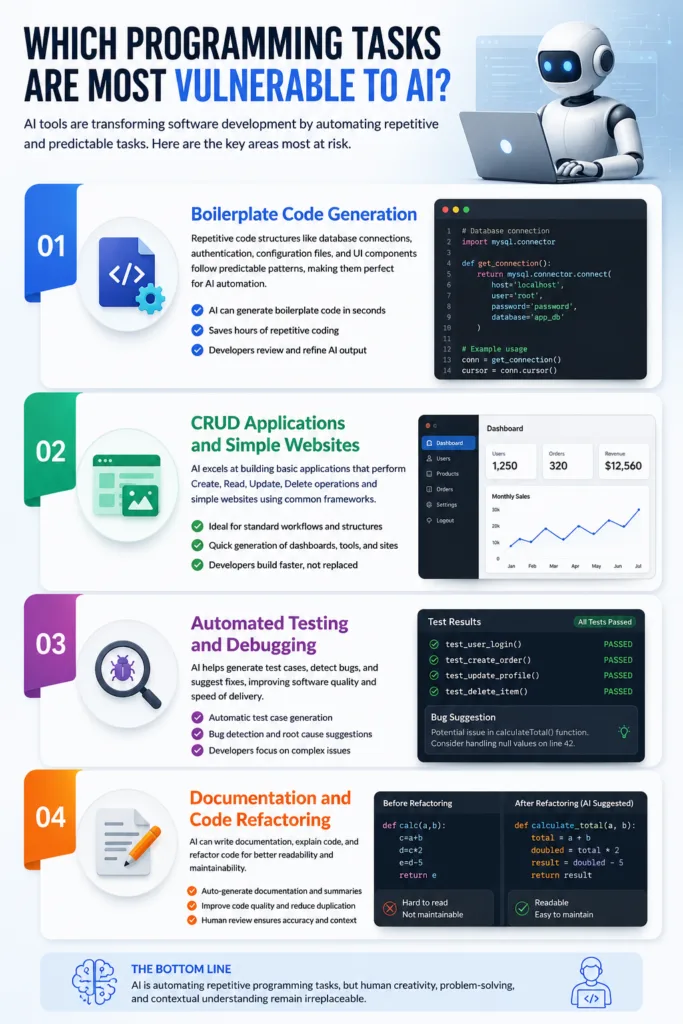
Boilerplate Code Generation
Boilerplate code refers to repetitive code structures that appear across many projects. Examples include database connections, authentication systems, configuration files, and standard user interfaces. These tasks follow predictable patterns, making them ideal candidates for AI automation.
Today, AI can generate much of this code within seconds. Developers no longer need to spend hours creating basic structures from scratch. Instead, they can review and refine AI generated outputs.
CRUD Applications and Simple Websites
Many beginner programming projects involve creating applications that perform basic operations such as creating, reading, updating, and deleting data. These projects often follow established frameworks and predictable workflows. AI performs surprisingly well in these scenarios. Simple websites, dashboards, internal business tools, and basic applications can often be generated quickly using modern AI tools. This does not mean developers are unnecessary. It simply means that developers can build these projects much faster than before.
Automated Testing and Debugging
Testing is a critical part of software development. AI can assist by generating test cases, identifying common bugs, and suggesting fixes. Many development teams already use AI to improve software quality.
By automating portions of the testing process, developers can spend more time focusing on complex issues that require deeper investigation. In my suggestion, programmers should embrace these capabilities rather than fear them. Testing automation allows developers to focus on creating more reliable and innovative software.
Documentation and Code Refactoring
Writing documentation is essential but often unpopular among developers. AI can automatically generate documentation, explain code functionality, and summarize technical implementations.
Similarly, AI can help refactor code by improving readability, reducing duplication, and suggesting better structures. These capabilities save time and improve maintainability. However, human review remains essential because documentation and refactoring decisions often require contextual understanding that AI lacks.
Which Software Engineering Jobs Are Safest From AI?
Not all programming roles face the same level of automation risk. Some positions involve responsibilities that extend far beyond writing code. These careers are likely to remain highly valuable in the coming years.
System Architects
System architects design the overall structure of software systems. They make decisions about scalability, security, performance, reliability, and technology selection. These decisions involve balancing business goals, technical constraints, and future growth requirements.
AI can provide recommendations, but architecture requires strategic thinking and long term planning. In my opinion, architecture skills will become even more valuable as AI handles more routine coding tasks.
AI and Machine Learning Engineers
Ironically, the rise of AI is increasing demand for professionals who build AI systems. Organizations need experts who understand machine learning, data engineering, model deployment, and AI infrastructure. As artificial intelligence becomes more integrated into business operations, demand for these specialists is expected to grow significantly.
Also read: Best AI Tools for Automating Customer Support in Small Businesses
Cybersecurity Specialists
Security remains one of the most important aspects of software development. Protecting systems from cyber threats requires continuous analysis, monitoring, risk assessment, and strategic decision making. While AI can help identify vulnerabilities, human experts remain essential for understanding complex attack scenarios and developing effective defense strategies.
DevOps and Cloud Engineers
Modern software relies heavily on cloud infrastructure and deployment pipelines. DevOps engineers manage these environments and ensure systems remain reliable, scalable, and secure.
These responsibilities require broad technical knowledge and operational expertise that extend beyond code generation. As software ecosystems become increasingly complex, demand for skilled infrastructure professionals is likely to remain strong.
Which Programming Jobs Face the Greatest Risk?
While AI is unlikely to eliminate software engineering as a profession, some roles are certainly more vulnerable to automation than others. The common pattern is simple. Jobs that involve repetitive and predictable tasks face greater pressure from AI tools.
In my opinion, understanding which roles may change the most can help developers make smarter career decisions and focus on building skills that remain valuable in the future.
Entry Level Developers
One of the biggest concerns in the software industry is the impact of AI on entry level programming jobs. Traditionally, junior developers learned by handling relatively simple tasks. They fixed minor bugs, created basic features, wrote documentation, and worked on smaller components of larger projects.
Many of these responsibilities can now be completed by AI tools in a matter of minutes. This does not mean junior developers are no longer needed. Companies still require new talent to build future engineering teams. However, expectations are changing.
New developers may need stronger problem solving abilities, better communication skills, and a deeper understanding of software fundamentals than previous generations. In my suggestion, beginners should focus on learning how software works rather than simply memorizing syntax. Understanding systems, databases, networking, and architecture will provide a stronger foundation than relying entirely on AI generated code.
Basic QA and Testing Roles
Quality assurance has already experienced significant automation over the years. AI is accelerating this trend by generating test cases, identifying defects, and automating repetitive validation processes.
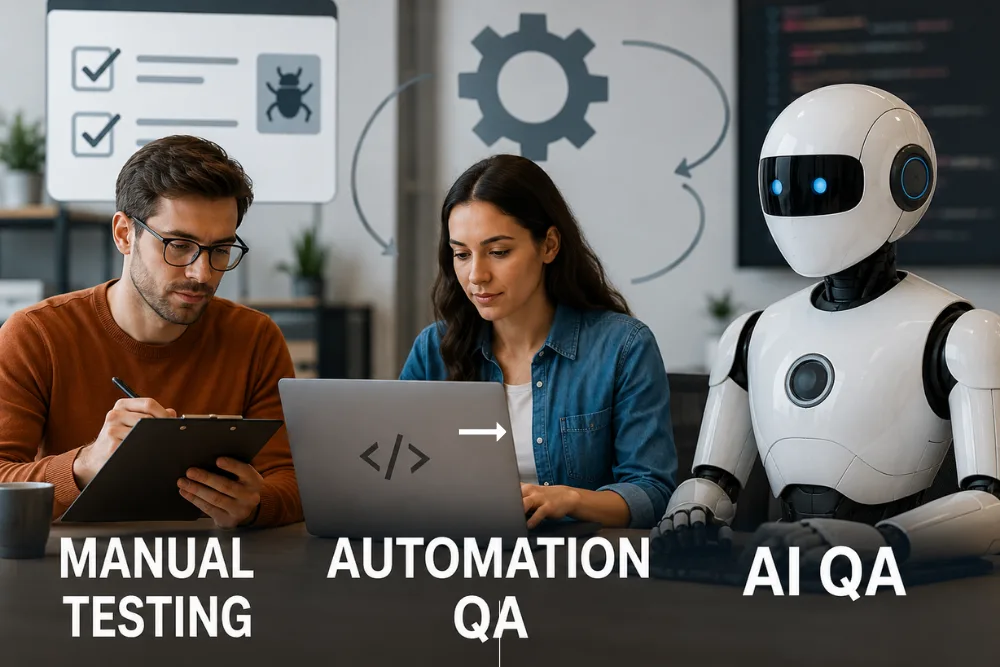
Manual testing roles that focus solely on executing predefined test cases may become less common. However, complex testing scenarios still require human expertise. Exploratory testing, user experience evaluation, security testing, and strategic quality planning remain difficult to automate completely. The future of quality assurance will likely involve professionals working alongside AI tools rather than competing against them.
Low Complexity Web Development
Basic websites and simple business applications are becoming easier to create through AI assisted development platforms. Tasks such as creating landing pages, contact forms, dashboards, and simple content management systems can often be completed with minimal manual coding.
As a result, developers who specialize exclusively in simple website creation may face increasing competition from AI powered solutions. The opportunity lies in moving beyond basic implementation and focusing on custom solutions, performance optimization, user experience, scalability, and business strategy.
Freelance Commodity Coding Projects
Freelance platforms have traditionally offered many projects involving simple coding tasks. Examples include small website modifications, basic application development, and straightforward automation scripts.
These projects are increasingly vulnerable because AI can complete much of the work quickly and at lower cost. Freelancers who succeed in the future will likely focus on specialized expertise, consulting, architecture, strategy, and solving unique business challenges. Clients are often willing to pay for expertise and results, not simply code.
Can AI Build and Deploy Entire Applications Without Humans?
One of the most fascinating questions in technology today is whether AI can independently create complete software applications. The answer is more nuanced than many headlines suggest.
What AI Can Build Today
Modern AI tools are capable of building surprisingly sophisticated applications. Developers can describe an application idea, and AI can generate user interfaces, database structures, backend functionality, and deployment instructions.
For simple projects, this process can be remarkably effective. Examples include internal business tools, portfolio websites, productivity applications, educational projects, and simple ecommerce solutions. The speed at which AI can create these applications is impressive and continues to improve.
Also read: Best Web Hosting Providers for Small Business Websites Explained
The Limits of Autonomous Coding Agents
Despite these advances, fully autonomous software development remains difficult. Software projects often involve changing requirements, conflicting stakeholder expectations, integration challenges, compliance considerations, and unexpected technical issues.
AI struggles when faced with ambiguity. If requirements are unclear or business objectives change, human guidance becomes essential. Real software development is rarely a straightforward process. It involves constant adaptation and decision making. In my opinion, this is one of the biggest reasons why programmers remain valuable despite rapid AI advancements.
Security, Compliance, and Business Risks
Software applications often handle sensitive customer information, financial transactions, healthcare records, and business critical operations. Mistakes can have serious consequences. AI generated code may contain vulnerabilities, inefficient logic, or compliance issues that are not immediately obvious. Organizations cannot simply trust every line of generated code without review. Human developers must evaluate security implications, ensure regulatory compliance, and verify that systems operate safely and reliably.
Why Human Oversight Is Still Required
Even when AI generates excellent code, someone must verify that the solution aligns with business goals. Developers review outputs, validate assumptions, test edge cases, and ensure long term maintainability. In many ways, programmers are evolving from code writers into technology decision makers. The ability to guide AI effectively may become just as important as writing code manually.
Real Examples of AI Assisted Software Development
The adoption of AI in software engineering is no longer a future prediction. It is already happening across organizations of all sizes.
How Microsoft Uses AI Coding Tools
Microsoft has invested heavily in AI assisted development technologies. Developers use intelligent coding assistants to accelerate software creation, improve productivity, and reduce repetitive work.
These tools help teams write code faster while maintaining quality standards. The goal is not to eliminate developers but to enable them to focus on higher value work.
AI Adoption at Google
Google continues integrating artificial intelligence throughout its development processes. Engineers use AI to assist with coding, testing, debugging, and documentation.
By automating routine tasks, developers can dedicate more time to innovation and solving challenging technical problems. This trend demonstrates an important reality. Leading technology companies are using AI to enhance developer capabilities rather than replace engineering teams.
Startup Teams Building With AI
Startups often embrace new technologies quickly because speed is critical to success. Many small teams now use AI tools to accomplish work that previously required much larger engineering departments.
A team of a few skilled developers can create products faster than ever before. However, these teams still require experienced professionals who understand architecture, business strategy, and customer needs. AI increases leverage, but it does not eliminate the need for expertise.
What Developers Report After Using AI Daily
Many developers report substantial productivity improvements after integrating AI into their workflows. They spend less time writing repetitive code and more time solving meaningful problems.
At the same time, most developers recognize that AI outputs require review and validation. The consensus among experienced engineers is clear. AI is a powerful assistant, but it is not a replacement for human expertise.
The Long Term Impact of AI on Software Developer Jobs
The software industry will undoubtedly change as AI becomes more capable. The important question is not whether change will happen. The question is how developers can prepare for it.
The Future of Junior Developers
Entry level roles will likely evolve significantly. Companies may expect junior developers to become productive more quickly because AI can assist with routine tasks.
This creates both challenges and opportunities. New developers who learn to collaborate effectively with AI tools may achieve career growth faster than previous generations. Those who rely entirely on AI without understanding underlying concepts may struggle.
The Future of Senior Engineers
Senior engineers are likely to become even more valuable. Their experience enables them to evaluate tradeoffs, make architectural decisions, manage risk, and lead technical initiatives.
As AI handles routine implementation work, organizations will place greater emphasis on strategic thinking and leadership. In my opinion, senior engineers who embrace AI will become significantly more productive and influential.
Salary Trends in an AI Driven Industry
Some routine programming tasks may become less valuable as automation increases. However, professionals with advanced technical expertise, leadership skills, and AI knowledge may see growing demand. The market often rewards individuals who can solve complex problems and create business value. As a result, highly skilled engineers are likely to remain well compensated.
Software Engineering Employment Outlook Through 2030
Despite fears of widespread job losses, software development is expected to remain an important profession. Technology continues expanding into nearly every industry.
Businesses need software to operate, compete, and innovate. While specific responsibilities may change, demand for talented engineers is likely to remain strong. The most successful developers will be those who continuously learn and adapt.
How Programmers Can Adapt and Stay Competitive
The best response to technological change is preparation. Fortunately, there are many practical steps developers can take today.
Learn AI Assisted Development Workflows
Developers should become comfortable using AI coding tools as part of their daily workflow. Understanding how to create effective prompts, evaluate outputs, and collaborate with AI systems can significantly improve productivity.
Strengthen Computer Science Fundamentals
Fundamentals remain extremely important. Knowledge of algorithms, data structures, networking, operating systems, and databases provides a foundation that AI cannot replace. Developers who understand why solutions work are better equipped to evaluate AI generated code.
Improve System Design Skills
System design is becoming increasingly valuable. Organizations need professionals who can create scalable, reliable, and secure architectures. These skills require experience and strategic thinking that extend beyond code generation.
Develop Product and Business Thinking
Software exists to solve business problems. Developers who understand customer needs, market dynamics, and business objectives can create more valuable solutions. In my suggestion, programmers should invest time learning about products and business strategy, not just technology.
Build Leadership and Communication Skills
Technical expertise alone is no longer enough. Communication, collaboration, mentoring, and leadership are becoming increasingly important. These human centered skills are difficult for AI to replicate and will remain highly valuable throughout the coming decade.
The Most Future Proof Programming Languages
One question that many developers ask is which programming languages will remain valuable as AI becomes more powerful.
The truth is that no programming language is completely protected from automation. AI can generate code in almost every major language. However, some languages are closely tied to industries and applications that require deep expertise, making them highly valuable for the foreseeable future.
| Programming Language | Primary Use Cases | Why It Remains Valuable in the AI Era |
|---|---|---|
| Python | Artificial intelligence, machine learning, automation, data science, backend development | Python remains one of the most versatile programming languages. While AI can generate Python code easily, organizations still need skilled developers to build reliable systems, manage data pipelines, and deploy AI solutions effectively. |
| TypeScript | Web applications, frontend development, enterprise software | TypeScript helps developers create reliable and maintainable applications through strong typing. As AI generated code becomes more common, businesses increasingly value structured and dependable software. |
| Java | Enterprise applications, banking systems, healthcare platforms, government software | Java continues to power many mission critical systems that require security, stability, and long term maintenance. Experienced Java developers remain highly valuable in large organizations. |
| Go | Cloud computing, infrastructure management, distributed systems, backend services | Go offers excellent performance and simplicity, making it a preferred choice for modern cloud architectures. Growing cloud adoption ensures continued demand for Go developers. |
| SQL | Database management, data analysis, reporting, business intelligence | Data remains one of the most important business assets. SQL skills are essential for accessing, organizing, and analyzing data that powers applications and AI systems. |
| C++ | Robotics, gaming, finance, embedded systems, AI infrastructure | C++ is critical for high performance applications where speed and efficiency matter. Specialized industries continue to rely on developers with advanced C++ expertise. |
In my opinion, developers should focus less on finding the perfect programming language and more on becoming excellent problem solvers. They should build strong problem solving skills, system design knowledge, business understanding, and the ability to work effectively with AI tools.
AI Coding Tools Versus Human Developers
Many people frame the future as a competition between AI and programmers. In reality, the most successful outcomes usually involve collaboration rather than competition.
Speed Comparison
AI can generate code much faster than most humans. Tasks that once required hours can often be completed within minutes. This speed advantage is one of the primary reasons AI tools have become so popular. However, speed alone does not guarantee quality.
Accuracy Comparison
AI can produce accurate code for many common scenarios. At the same time, it can generate incorrect solutions, misunderstand requirements, or introduce subtle bugs. Human developers provide the critical review process that ensures software works as intended.
Creativity and Problem Solving
Creativity remains one of humanity’s greatest strengths. Developers often solve problems that have no obvious solution. They balance competing priorities, evaluate tradeoffs, and create innovative approaches based on unique circumstances. AI can assist with these activities, but it does not replace genuine human creativity.
Security and Reliability
Software security requires careful analysis and risk assessment. Developers must consider potential vulnerabilities, compliance requirements, and operational risks. AI can help identify issues, but human expertise remains essential for protecting systems and users.
Cost Considerations
Some organizations adopt AI because it reduces development costs. However, poorly designed software can become extremely expensive over time. The cost of mistakes often exceeds the cost of hiring skilled professionals. In my opinion, businesses will continue investing in talented developers because expertise delivers long term value.
Will Computer Science Degrees Still Matter?
As AI becomes more capable, some people question whether formal education is still worthwhile. The answer depends on how education is viewed.
Why Fundamentals Matter More Than Ever
AI can generate code, but understanding how systems work remains critical. Developers who understand algorithms, networking, operating systems, databases, and software architecture can evaluate AI generated solutions more effectively. Fundamentals provide the knowledge required to make informed technical decisions.
The Difference Between Coders and Engineers
There is an important distinction between someone who writes code and someone who engineers solutions. Engineering involves planning, design, analysis, communication, and decision making. As AI automates routine coding tasks, engineering skills become even more important.
What Employers Are Looking for Now
Employers increasingly value adaptability, problem solving abilities, communication skills, and business awareness. Technical knowledge remains important, but organizations also want professionals who can collaborate effectively and contribute to strategic objectives. A degree can provide valuable foundations, but continuous learning is equally important.
What Software Development Could Look Like in 2030
Predicting the future is never easy, but current trends provide useful clues.
AI Agents as Development Partners
By 2030, AI assistants will likely become even more capable. Developers may interact with AI systems throughout the entire software lifecycle. These tools could help with planning, coding, testing, deployment, monitoring, and maintenance. Rather than replacing developers, AI may function as a highly capable partner.
Smaller Teams Building Bigger Products
AI is already increasing productivity. As these tools improve, smaller teams may accomplish work that once required much larger organizations.
This could create exciting opportunities for startups and entrepreneurs. A handful of skilled professionals may be able to build products that previously required dozens of engineers.
The Evolution of Programming Careers
Programming careers will likely become more strategic. Developers may spend less time manually writing code and more time understanding customer needs, designing systems, and guiding AI tools.
The profession may evolve, but it is unlikely to disappear.
Will Humans Still Write Code?
Yes, humans will probably continue writing code. However, the amount of manual coding may decrease over time. Developers will focus more on reviewing, refining, and directing AI generated outputs. In my opinion, coding will remain an important skill, but understanding systems and solving problems will become even more valuable.
Key Takeaways
AI Will Replace Some Tasks, Not Programmers
Artificial intelligence is highly effective at automating repetitive development activities. However, software engineering involves much more than generating code. Human judgment, creativity, and decision making remain essential.
Adaptability Will Determine Career Success
The developers who thrive in the future will be those who embrace change. Learning how to work effectively with AI tools can create significant career advantages.
Human Creativity Remains the Competitive Advantage
Technology continues advancing, but creativity, empathy, leadership, and strategic thinking remain uniquely human strengths. These qualities will continue creating opportunities for skilled professionals.
Frequently Asked Questions
Will AI replace programmers completely?
No. AI can automate certain coding tasks, but human programmers remain essential for architecture, problem solving, communication, security, and strategic decision making.
Will coding still be a good career in 2030?
Yes. Software development is expected to remain an important profession. The responsibilities may evolve, but demand for skilled engineers is likely to continue.
Can ChatGPT create a complete application?
ChatGPT can help generate significant portions of an application. However, human oversight is still required for planning, testing, security, deployment, and maintenance.
Should beginners still learn programming?
Absolutely. Learning programming develops logical thinking and problem solving abilities. These skills remain valuable even as AI becomes more capable.
Which programming language is safest from AI automation?
No language is completely protected from automation. However, Python, Java, TypeScript, Go, SQL, and C++ remain highly valuable because of their widespread use in important industries.
Will AI reduce software developer salaries?
Some routine roles may experience increased pressure. However, highly skilled engineers with expertise in architecture, leadership, and AI integration are likely to remain in strong demand.
Can AI replace full stack developers?
AI can assist full stack developers significantly, but it cannot fully replace the broad technical knowledge and decision making required for complex projects.
What skills should programmers learn to stay relevant?
Developers should focus on system design, computer science fundamentals, AI assisted workflows, communication skills, leadership, and business understanding.
Are software engineering jobs disappearing?
No. The nature of software engineering is evolving, but technology continues creating demand for talented professionals.
Will AI make computer science degrees obsolete?
No. Strong fundamentals remain extremely valuable. Understanding how systems work helps developers evaluate and improve AI generated solutions.
Can AI write production ready code?
Sometimes AI can generate code that is close to production quality. However, thorough testing, review, and validation are still necessary.
How accurate are AI coding assistants?
AI coding assistants can be highly accurate for common tasks, but they can also make mistakes. Human review remains essential.
Which developer roles will grow because of AI?
Roles involving artificial intelligence, machine learning, cybersecurity, cloud infrastructure, architecture, and technical leadership are expected to experience strong growth.
What is the future of software engineering in an AI driven world?
The future involves collaboration between humans and AI. Developers will focus more on strategy, architecture, and problem solving while AI handles many routine tasks.
References used:
Will AI Replace Programmers? An Honest Conversation
When AI writes almost all code, what happens to software engineering?
Is AI Able to Fully Code Without Human Intervention, or is This Just Another Trend?
Will AI Make Software Engineers Obsolete? Here’s the Reality
How AI Affects Careers in Computing
AI vs Gen Z: How AI has changed the career pathway for junior developers
Conclusion
So, will AI powered coding tools replace human programmers?
The most realistic answer is no.
Artificial intelligence is transforming software development at an extraordinary pace. It can generate code, automate repetitive tasks, assist with testing, and dramatically improve productivity. These capabilities will undoubtedly change how programmers work.
However, software engineering is not simply about writing code. It is about understanding people, solving business problems, designing reliable systems, managing risk, and making informed decisions.
AI can assist with these activities, but it cannot fully replace the human qualities that drive successful software projects.
In my opinion, the future belongs to developers who view AI as an opportunity rather than a threat. The programmers who learn how to work alongside AI, strengthen their foundational knowledge, and develop strong communication and leadership skills will remain highly valuable for years to come.
Technology will continue evolving. Programming careers will continue evolving as well. But the need for talented people who can turn ideas into meaningful solutions is unlikely to disappear anytime soon.
You may also read: The Hidden Negative Impact of Artificial Intelligence on Society

Dony Garvasis is the founder of Search Ethics, a freelance SEO consultant, and a passionate technology blogger. With over 8 years of experience in SEO, blogging and content marketing, I provide expert content on Tech, digital marketing, SEO, Artificial intelligence, gadgets, science, automobiles, lifestyle, tips, tutorials and much more. My mission is simple: Ethical Search, Genuine Results! I will make sure people everywhere get trustworthy and helpful information.