Now Reading: Meet Trionda World Cup Ball, The Smartest Football Ever Created
-
01
Meet Trionda World Cup Ball, The Smartest Football Ever Created

Hey football fever is here! The FIFA World Cup 2026 is set to be the biggest tournament in football history, featuring 48 teams, 104 matches, and three host nations;
- Canada
- Mexico
- United States
Do you know the official match ball of FIFA World Cup 2026? Meet Trionda, the smartest ball ever created!
At the center of every match will be the official tournament ball, Trionda, a football that combines innovative design, advanced technology, and symbolic meaning.
Developed by Adidas in partnership with FIFA, Trionda is far more than a traditional match ball. It incorporates real-time tracking technology, advanced aerodynamics, and a unique four-panel construction designed to improve consistency and performance on the pitch.
What Is the Trionda World Cup Ball?
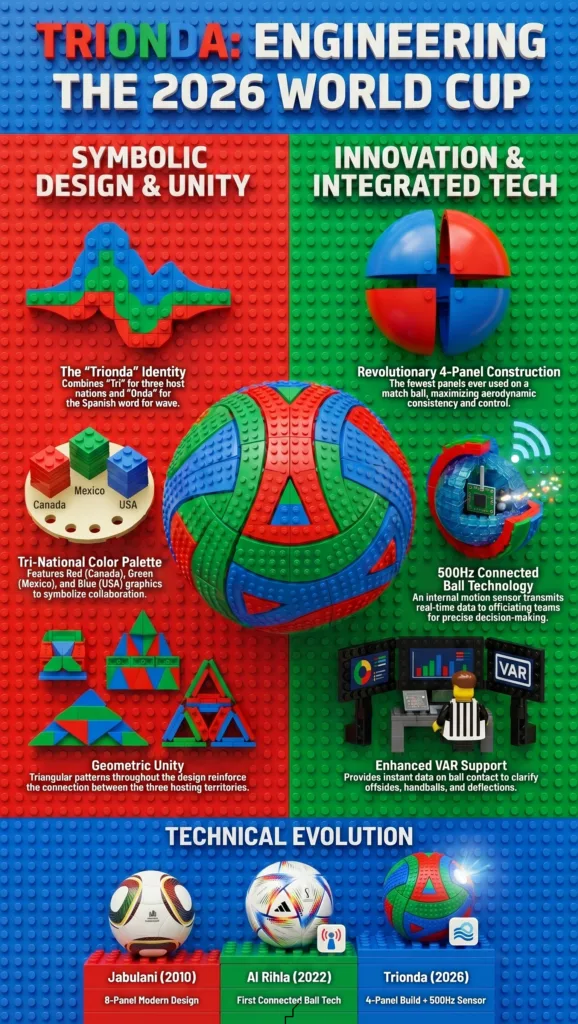
Trionda is the official match ball of the FIFA World Cup 2026. The name combines “Tri,” representing the tournament’s three host countries, and “Onda,” a Spanish word meaning wave or vibe.
The ball symbolizes the collaboration between Canada, Mexico, and the United States while showcasing the next generation of football technology.
Design Inspired by Three Nations
The Trionda ball features a predominantly white surface accented by flowing red, green, and blue graphics.
- Red represents Canada and its iconic maple leaf.
- Green reflects Mexico and its national identity.
- Blue symbolizes the United States and the stars on its flag.
Trionda: The Aerodynamic Future of World Cup Football
A triangular pattern appears throughout the design, reinforcing the unity of the three host nations and connecting directly to the ball’s name.
Revolutionary Four-Panel Construction
One of the most significant innovations in Trionda is its four-panel design.
This is the fewest number of panels ever used in a FIFA World Cup match ball. By reducing seams, Adidas aims to create a more stable flight path and greater aerodynamic consistency.
The deeper seam structure helps maintain balanced airflow around the ball, reducing unpredictable movement and providing greater control for players.
Why the Adidas Trionda Ball Needs Charging Before Every Match
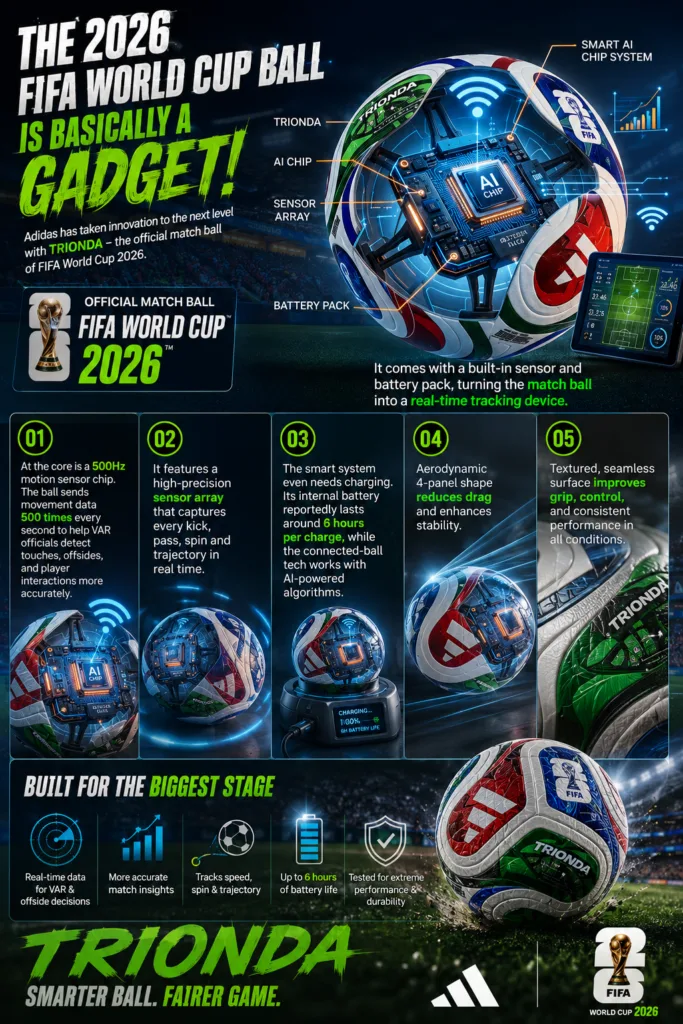
The Adidas Trionda football features advanced connected-ball technology with a built-in motion sensor that tracks ball movements in real time. To ensure accurate performance data during matches, the sensor must be fully charged before kickoff. The collected information helps match officials make faster and more precise decisions using VAR and semi-automated offside technology.
| Feature | Details |
|---|---|
| Technology | Built-in electronic motion sensor chip |
| Sensor Weight | 14 grams |
| Data Collection Rate | 500 times per second |
| Tracks | Ball speed, spin, and trajectory |
| Charging Time | Approximately 90 minutes (wireless charging) |
| Battery Life | Up to 6 hours on a full charge |
| Purpose | Supports VAR and offside decision-making |
| Power Saving Feature | Automatic hibernation mode when the ball is not in play |
| Match Readiness | Recommended to be fully charged before every game |
The charging requirement ensures the sensor operates continuously throughout the match, providing reliable tracking data while maintaining optimal battery efficiency through its intelligent hibernation feature.
Adidas Connected Ball Technology
Trionda includes Adidas Connected Ball Technology, an advanced system featuring a built-in 500Hz motion sensor.
The sensor continuously collects movement and contact data during matches. This information is transmitted in real time to FIFA’s officiating systems, allowing referees and VAR teams to make faster and more accurate decisions.
The technology can identify the exact moment a player touches the ball, which is particularly useful when reviewing:
- Offside decisions
- Handball incidents
- Deflections
- Player contact situations
This system builds on the technology first introduced during the FIFA World Cup Qatar 2022 but has been further enhanced for the larger 2026 tournament.
Checkout the adidas World Cup 2026 Trionda Pro Ball
How Trionda Helps VAR
Video Assistant Referee (VAR) technology has become an essential part of modern football. Trionda takes officiating support to a new level. The embedded sensor provides precise ball-contact information, enabling officials to determine exactly when a pass is made or a player touches the ball. Combined with FIFA’s advanced tracking systems, this data helps reduce decision times and improves overall accuracy.
Related search: VAR Football Technology Explained to Fans Across the Globe
Trionda vs Previous World Cup Balls
Trionda follows a long tradition of iconic FIFA World Cup match balls. Notable predecessors include:
- Telstar (1970)
- Teamgeist (2006)
- Jabulani (2010)
- Brazuca (2014)
- Telstar 18 (2018)
- Al Rihla (2022)
Some fans have compared Trionda to the Jabulani ball used in South Africa 2010 due to its modern appearance and reduced panel count.
However, Adidas states that extensive testing has been conducted to ensure greater stability, predictability, and player confidence.
Can Fans Buy the Trionda Ball?
Yes. Adidas has released official versions of Trionda for public purchase.
Fans can buy match-quality and replica versions, allowing them to experience the same design and technology featured at the FIFA World Cup 2026.
Pricing varies by market, with premium match versions typically positioned as high-end football products.
The Future of Football Technology
Trionda represents more than a football. It demonstrates how technology is becoming deeply integrated into modern football, helping players perform better, officials make faster decisions, and fans gain deeper insights into the game.
With smart sensors, AI-powered officiating tools, advanced analytics, and immersive viewing experiences, FIFA World Cup 2026 may become the most technologically advanced tournament ever staged. As football enters a new era, Trionda will be at the heart of every pass, shot, save, and goal throughout the competition.
Lenovo’s AI Partnership Is Powering FIFA World Cup 2026 Innovation
Lenovo’s partnership with FIFA goes far beyond sponsorship, positioning the company as the Official Technology Partner for FIFA World Cup 2026. Through advanced AI infrastructure, analytics platforms, player tracking systems, and broadcast technologies, Lenovo is helping FIFA create the most technologically advanced tournament in football history.
Key innovations include Football AI Pro, AI powered 3D player avatars, enhanced Referee View cameras, and intelligent data platforms that support all 48 participating teams equally. These technologies aim to improve officiating accuracy, enhance fan engagement, and provide deeper match analysis throughout the tournament.
FIFA World Cup 2026 Technologies Powered by Lenovo
| Innovation | Purpose | Benefit |
|---|---|---|
| Football AI Pro | AI powered match analysis platform | Provides tactical insights and performance analytics to all 48 teams |
| AI Powered 3D Player Avatars | Digital player modeling | Improves offside decisions and enhances broadcast visuals |
| Enhanced Referee View | AI stabilized referee camera footage | Delivers clearer first person match perspectives for fans |
| Advanced Data Infrastructure | Real time data processing | Supports officiating, broadcasting, and tournament operations |
| AI Driven Broadcast Systems | Intelligent content delivery | Creates richer viewing experiences for global audiences |
| Real Time Match Analytics | Performance tracking and analysis | Helps coaches and analysts make informed decisions |
These innovations demonstrate how Lenovo is helping FIFA modernize football through artificial intelligence, data analytics, and advanced computing infrastructure. The partnership supports everything from officiating and team analysis to fan experiences, making FIFA World Cup 2026 a showcase for the future of sports technology.
How Technology Is Changing Modern Football
Football today is very different from the game played decades ago. Technology has become an essential part of player development, tactical preparation, performance monitoring, injury prevention, and match officiating. Clubs and national teams increasingly rely on data to make informed decisions, while governing bodies use technology to improve fairness and consistency.
Artificial intelligence has emerged as one of the most influential developments in modern football. AI systems can analyze thousands of actions during a match, identify patterns, and provide valuable insights that would be difficult for humans to detect in real time. Coaches use these tools to study opponents, optimize tactics, and improve player performance.
Officiating has also benefited from technological advancement. Goal line technology, VAR, and semi automated offside systems have transformed the way critical decisions are made. Although debates continue regarding the role of technology in sport, there is little doubt that it has significantly improved the accuracy of important calls.
As football continues to evolve, FIFA World Cup 2026 will showcase the latest stage of this technological journey, demonstrating how innovation can support both competitive integrity and entertainment value.
Advanced Semi Automated Offside Technology Explained
One of the most important innovations at FIFA World Cup 2026 is the next generation of advanced semi automated offside technology. Offside decisions have historically been among the most controversial aspects of football because they often involve extremely fine margins. FIFA’s latest system aims to make these decisions faster, more accurate, and easier to understand.
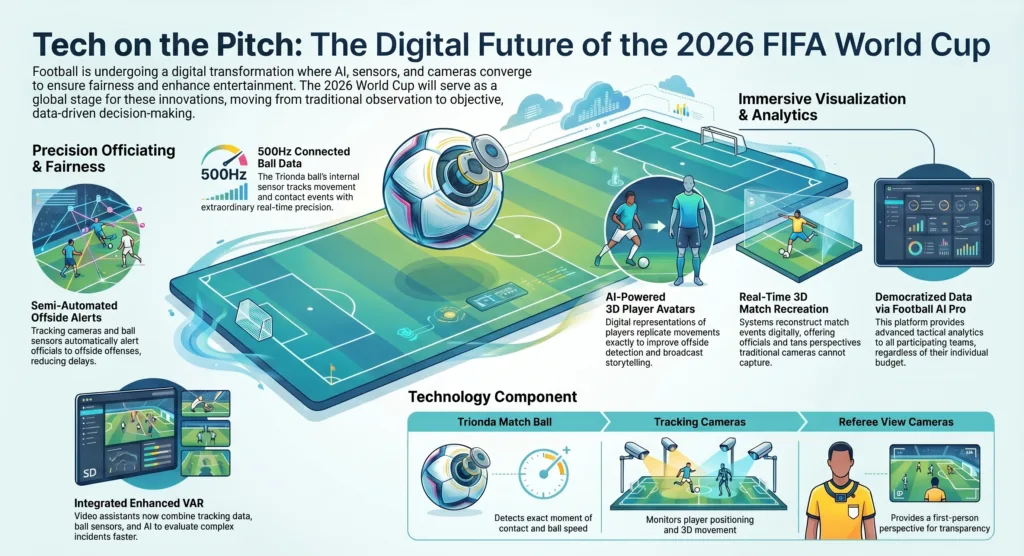
The technology uses multiple tracking cameras positioned throughout the stadium to monitor player movements continuously. These cameras collect precise positional data from every player on the field and combine it with information gathered from the match ball. The result is a detailed digital model of the game that can identify offside situations almost instantly.
Unlike earlier systems, the new version can automatically alert assistant referees when a clear offside offense occurs. This significantly reduces delays and allows officials to make decisions more efficiently. While human referees remain responsible for final judgments, technology provides valuable support that minimizes the risk of error.
The implementation of advanced semi automated offside technology demonstrates FIFA’s commitment to improving fairness while preserving the flow of the game. Faster decisions mean fewer interruptions, creating a smoother experience for players and spectators alike.
AI Powered 3D Player Avatars
Another remarkable innovation planned for FIFA World Cup 2026 is the use of AI powered 3D player avatars. This technology involves creating highly accurate digital representations of players before the tournament begins.
The process starts with rapid body scanning that captures detailed information about each player’s physical characteristics. Artificial intelligence then uses this data to generate realistic digital avatars capable of replicating player movements with exceptional accuracy.
The Digital Pitch: Technological Innovation in Modern Football
These avatars play an important role in improving offside detection and match visualization. Because the digital models precisely represent each player, officiating systems can make more accurate calculations regarding positioning and movement. This enhances the reliability of technology assisted decisions.
For broadcasters and fans, AI powered avatars create exciting opportunities for storytelling and analysis. Complex incidents can be recreated visually, allowing viewers to understand decisions more clearly. The technology also enables broadcasters to present detailed breakdowns of player movements and tactical situations in ways that were previously impossible.
As digital visualization becomes more sophisticated, AI powered avatars may become a standard feature of major football tournaments around the world.
Trionda Connected Ball Technology
The official FIFA World Cup 2026 match ball, Trionda, represents one of the most visible examples of football innovation. While its design reflects the three host nations, its most significant features are hidden beneath the surface.
Trionda contains advanced connected ball technology that includes an embedded motion sensor capable of transmitting data in real time. This sensor tracks the ball’s movement with extraordinary precision, providing information about speed, direction, rotation, and contact events.
The connected ball plays a crucial role in supporting officiating systems. By recording the exact moment when a player touches the ball, the sensor helps officials evaluate incidents involving offsides, handballs, and deflections. This level of precision improves decision making and reduces uncertainty during critical moments.
The technology also contributes to broader data collection efforts. Information generated by the ball can be combined with player tracking systems to create a comprehensive picture of match activity. This data supports analysis, enhances broadcasts, and contributes to ongoing research into football performance.
Trionda demonstrates how even a traditional piece of equipment can become a sophisticated technological tool when combined with modern innovation.
Out of Bounds Detection Technology
Determining whether the ball has fully crossed the touchline or goal line can sometimes be challenging, especially during fast moving situations. FIFA is exploring advanced out of bounds detection technology to improve the accuracy of these decisions.
The system uses tracking sensors and camera networks to monitor the ball continuously throughout the match. By analyzing the ball’s position in relation to field boundaries, the technology can identify precisely when it leaves the field of play.
This innovation has the potential to reduce disputes regarding goals, corners, throw ins, and goal kicks. Officials receive accurate information quickly, allowing them to make confident decisions without unnecessary delays.
The technology also enhances consistency across different matches and venues. Rather than relying solely on visual observation, referees can benefit from objective data that supports their judgments.
As football becomes increasingly data driven, out of bounds detection systems may become an important component of future competitions.
Real Time 3D Match Recreation
Real time 3D match recreation represents one of the most exciting developments for both officiating and broadcasting. This technology creates digital reconstructions of match events using data collected from cameras, sensors, and tracking systems.
When a controversial incident occurs, officials can review a detailed three dimensional recreation that provides perspectives unavailable through traditional video footage. This helps them understand player positioning, movement, and interactions more clearly.
For broadcasters, real time 3D recreation transforms the viewing experience. Complex decisions can be explained visually, making them easier for audiences to understand. Fans gain access to insights that reveal the tactical and technical aspects of the game in greater detail.
The technology also serves educational purposes. Coaches, analysts, and players can use recreated scenarios to study performance and identify areas for improvement. This combination of officiating support and analytical value makes 3D recreation one of the most versatile innovations planned for FIFA World Cup 2026.
Referee View Cameras
Referee cameras offer fans a unique perspective on the game by showing events directly from the official’s point of view. FIFA continues to refine this technology, recognizing its potential to enhance transparency and engagement.
By providing a first person perspective, referee cameras allow viewers to appreciate the challenges officials face during matches. Decisions that may seem simple from a television angle often appear far more complex when viewed through the referee’s eyes.
The footage can also contribute to training and development programs for officials. Reviewing decisions from a referee perspective helps identify areas for improvement and supports the education of future referees.
For fans, referee cameras create a deeper connection to the match experience. They provide a level of immersion that traditional broadcasts cannot replicate, making the game feel more immediate and authentic.
Football AI Pro: FIFA’s New AI Analytics Platform
Football AI Pro represents FIFA’s commitment to using artificial intelligence for performance analysis and strategic development. The platform collects and analyzes vast amounts of data, providing teams with detailed insights into player performance, tactical patterns, and match dynamics.
One of the platform’s primary objectives is to make advanced analytics more accessible. Historically, elite clubs with significant resources enjoyed advantages in data analysis. Football AI Pro aims to provide participating teams with access to sophisticated tools regardless of their size or budget.
The system can identify trends, evaluate tactical effectiveness, and generate recommendations based on objective data. Coaches gain valuable information that supports preparation and decision making.
Beyond the tournament itself, Football AI Pro reflects the growing influence of artificial intelligence throughout the football industry. As data becomes increasingly important, platforms like this are likely to shape the future of coaching and performance management.
Know more about Football AI Pro
Enhanced VAR Tools at FIFA World Cup 2026
Video Assistant Referee technology has already transformed football, but FIFA World Cup 2026 introduces additional improvements designed to increase efficiency and accuracy.
Enhanced VAR tools combine data from multiple sources, including tracking cameras, connected ball technology, and artificial intelligence systems. This integrated approach allows officials to evaluate incidents more comprehensively.
Faster processing capabilities help reduce delays, ensuring that decisions can be communicated quickly. Improved visualization tools also make it easier for referees to understand complex situations and explain decisions when necessary.
The objective is not to remove human judgment but to support it with reliable information. By providing officials with better tools, FIFA hopes to improve confidence in decision making while maintaining the authority of match referees.
Reference Links:
- FIFA Official Announcement: TRIONDA Match Ball Launch
- BBC Sport: New Offside Technology for World Cup 2026
- 2026 FIFA World Cup Ball Runs on a Battery
- FIFA Innovation Hub: Advanced Semi-Automated Offside Technology
- Euronews: AI Avatars and Smart Footballs at World Cup 2026
- Lenovo FIFA Partnership Overview
Conclusion
FIFA World Cup 2026 is set to become a landmark event in the history of football technology. Beyond the Trionda match ball, the tournament will introduce advanced offside systems, AI powered player avatars, connected ball technology, real time 3D recreation, referee cameras, Football AI Pro analytics, and enhanced VAR tools.
Together, these innovations demonstrate FIFA’s commitment to improving accuracy, fairness, and fan engagement. As football embraces a more data driven future, World Cup 2026 will showcase how technology can support the game while preserving the excitement and passion that make it the world’s most popular sport.
Frequently Asked Questions
What is the biggest technology innovation at FIFA World Cup 2026?
The tournament combines multiple innovations, including advanced offside technology, AI powered player avatars, and the Trionda connected match ball.
What is Trionda?
Trionda is the official FIFA World Cup 2026 match ball featuring connected ball technology and real time motion tracking sensors.
How does advanced semi automated offside technology work?
The system uses tracking cameras and ball data to identify offside situations quickly and accurately.
What are AI powered player avatars?
They are digital representations of players created through body scanning and artificial intelligence technology.
How long does the Adidas Trionda ball stay charged?
The Adidas Trionda ball can operate for up to six hours on a full charge. This is enough to cover pre-match warm-ups, the full 90-minute game, extra time, and penalty shootouts while continuously transmitting tracking data.
How does Trionda help VAR?
The embedded sensor records precise ball contact information, helping officials review offsides, handballs, and other incidents.
What happens if the Trionda ball runs out of battery during a match?
The sensor would no longer be able to transmit real-time movement data used by VAR and semi-automated offside systems. To prevent this, match officials fully charge the ball before kickoff, and the ball also uses an automatic hibernation mode when not in play to conserve battery life.
What is Football AI Pro?
Football AI Pro is FIFA’s advanced analytics platform that provides tactical insights and performance data.
Will referee cameras be used during World Cup 2026?
FIFA is expanding the use of referee view cameras to enhance fan engagement and officiating analysis.
What is real time 3D match recreation?
It is a technology that creates digital reconstructions of match incidents using tracking and sensor data.
How is World Cup 2026 different from Qatar 2022?
World Cup 2026 introduces more advanced AI systems, improved officiating tools, and enhanced data integration technologies.
Will these technologies replace referees?
No. The technologies are designed to assist referees and improve decision making, while final judgments remain with match officials.

Dony Garvasis is the founder of Search Ethics, a freelance SEO consultant, and a passionate technology blogger. With over 8 years of experience in SEO, blogging and content marketing, I provide expert content on Tech, digital marketing, SEO, Artificial intelligence, gadgets, science, automobiles, lifestyle, tips, tutorials and much more. My mission is simple: Ethical Search, Genuine Results! I will make sure people everywhere get trustworthy and helpful information.