Now Reading: This Humanoid Robot Breaks Half Marathon World Record in Beijing
-
01
This Humanoid Robot Breaks Half Marathon World Record in Beijing
This Humanoid Robot Breaks Half Marathon World Record in Beijing
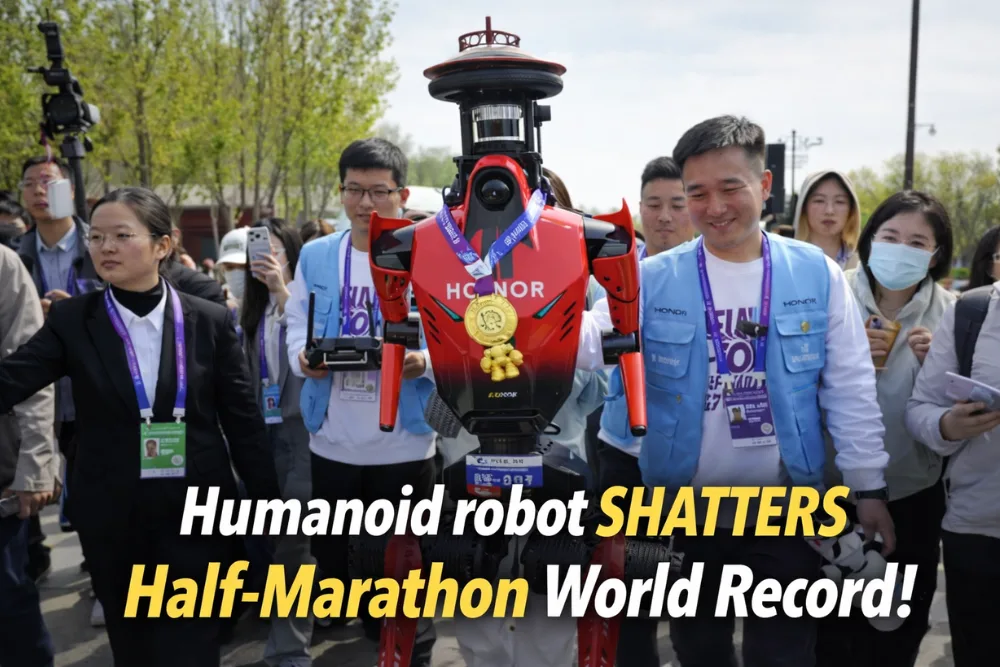
A humanoid robot developed by Honor has officially broken the half marathon world record in Beijing, completing the 21 km race in just 50 minutes and 26 seconds. This remarkable achievement places robots ahead of elite human runners, highlighting rapid advancements in artificial intelligence, robotics, and autonomous navigation.
Related search: HONOR Advances Its AI Vision
A Historic Race Where Machines Outpaced Humans
The Beijing half marathon in Yizhuang became a defining moment in the evolution of robotics, as humanoid machines competed alongside human runners in a carefully structured event. Separate lanes ensured safety, while allowing both groups to perform at their best without interference. Spectators gathered in large numbers, witnessing a scene that once belonged only to science fiction.
The winning humanoid robot demonstrated exceptional speed and coordination, completing the race significantly faster than the top human competitor. Its performance also surpassed the official men’s world record of 57 minutes and 20 seconds, currently held by Jacob Kiplimo. This comparison underscores not only the robot’s speed but also the scale of technological progress achieved within a short period.
How the Winning Humanoid Robot Achieved This Feat
The record breaking robot was powered by an advanced autonomous navigation system, enabling it to analyze its surroundings, maintain balance, and optimize movement in real time.
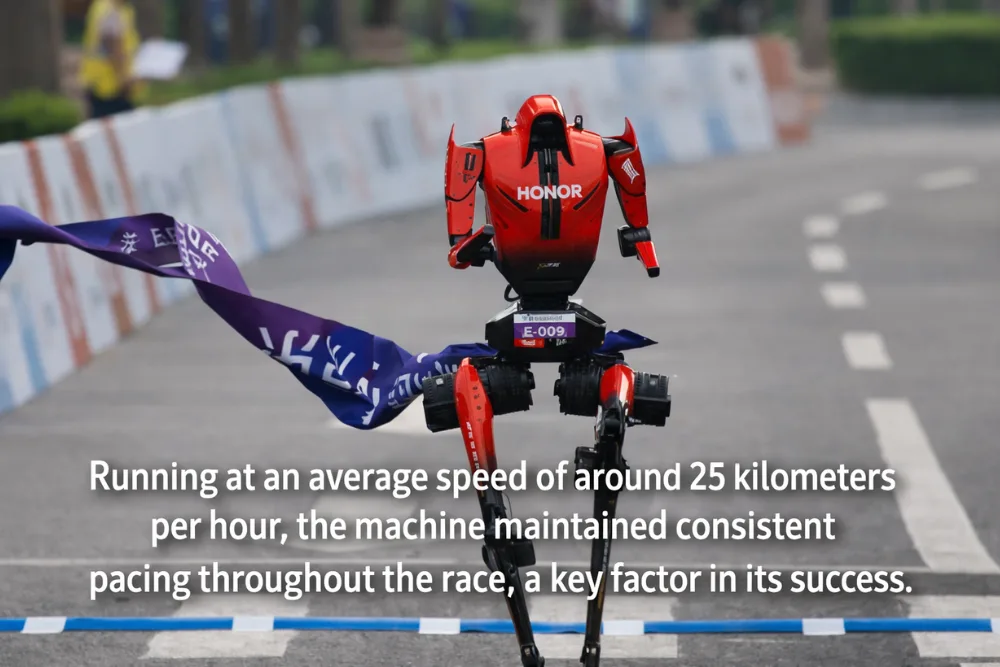
Unlike traditional robots that rely heavily on pre programmed instructions, this humanoid operated with adaptive intelligence. It could respond to environmental changes instantly, adjust stride efficiency, and maintain stability across the entire course. Such capabilities represent a major leap in robotics engineering, particularly in the integration of artificial intelligence with physical mobility.
Rapid Progress Compared to Previous Years
The achievement becomes even more impressive when compared to results from the previous year. Earlier humanoid robots struggled to complete the same race, often falling during the run, and taking more than 2 hours and 40minutes to finish. The dramatic improvement in both speed and reliability highlights how quickly the field is evolving.
Participation levels also reflect this growth. The number of humanoid robots entering the race increased from about 20 in the previous year to over 100 in the current edition. This surge indicates rising interest, increased investment, and growing confidence in humanoid robotics as a transformative technology.
Public Reactions Reflect Excitement and Concern
The event drew strong reactions from spectators, capturing both enthusiasm and unease. Many observers expressed excitement at witnessing such a technological breakthrough, describing the race as a glimpse into the future. The speed and agility of the robots left a lasting impression, with some even comparing their movements to legendary athletes like Usain Bolt.
Related search: World’s First Humanoid Robot Football Match
At the same time, concerns about the broader implications of such advancements were evident. Some spectators voiced worries about the potential impact on jobs, especially as artificial intelligence continues to become more capable. The idea that machines could outperform humans in physical as well as cognitive tasks raises important questions about the future of work and economic stability.
The Growing Role of Humanoid Robots in Daily Life
Humanoid robots are no longer confined to research labs or experimental demonstrations. In China, they are increasingly visible in public spaces, media coverage, and real world applications. Experts and observers believe that these machines could soon become part of everyday life, assisting with tasks such as household chores, elderly care, and basic caregiving.
Their potential extends beyond convenience. Humanoid robots could play a crucial role in high risk environments, including firefighting and disaster response. By taking on dangerous tasks, they can help protect human lives while improving efficiency in critical operations. This shift signals a future where humans and robots work side by side in complementary roles.
Investment and Innovation Driving the Industry Forward
The rapid progress seen in the Beijing race is supported by significant financial investment and technological innovation. In 2025 alone, China invested approximately 73.5 billion yuan in robotics and embodied artificial intelligence. This level of funding reflects a strategic focus on becoming a global leader in advanced robotics.
Such investments are not only accelerating research and development but also enabling large scale production and commercialization. As a result, humanoid robots are transitioning from experimental prototypes to practical tools with real world applications. The Beijing half marathon serves as a powerful demonstration of what this investment can achieve.
What This Means for Humanity and Technology
The success of humanoid robots in a competitive sporting event represents more than just a technical milestone. It challenges long held assumptions about human superiority in physical performance. For centuries, humans have been at the top of the natural hierarchy, but advancements in robotics are beginning to reshape that perspective.
While some view this shift with concern, others see it as an opportunity to expand human potential. Technology has consistently driven progress, enabling new forms of creativity, productivity, and innovation. The rise of humanoid robots may ultimately lead to a future where humans focus on higher level tasks, while machines handle repetitive or physically demanding work.
Other Latest Humanoid Robot News
| Company / Region | Key Developments | Impact / Significance |
|---|---|---|
| Boston Dynamics + Hyundai Motor Company | Scaling production of Atlas robot; targeting tens of thousands of units annually by 2028 | Transition from research to large-scale real-world industrial deployment |
| Unitree Robotics | Shipped thousands of humanoid robots; building advanced datasets for AI and teleoperation | Faster innovation cycles and improved robot intelligence |
| Agility Robotics | Deploying Digit robot in logistics and manufacturing (linked to Toyota Motor Corporation) | Demonstrates real-world industrial efficiency and safety benefits |
| Humanoid (UK) + Siemens + Nvidia AI | Tested HMND 01 robot in factory logistics tasks | Strong example of human-robot collaboration in Europe |
| Figure AI & 1X Technologies | Developing large-scale production and consumer-focused humanoid robots | Expanding use cases from industrial automation to home environments |
| NEURA Robotics | Introduced cognitive humanoid robots for industrial and daily assistance | Focus on safe interaction and enhancing human capabilities |
| China (Market Leader) | Holds ~90% of global humanoid robotics market; driven by companies like Unitree | Dominates mass production and adoption with strong government support |
Also read: Secret Power of an AI Chatbot that Sends Pictures
Conclusion
The record breaking performance of a humanoid robot in the Beijing half marathon marks a turning point in the evolution of robotics and artificial intelligence. By surpassing human capabilities in a demanding physical challenge, this achievement highlights the extraordinary pace of technological advancement. At the same time, it raises important questions about the future relationship between humans and machines.
As investment continues to grow and innovation accelerates, humanoid robots are likely to become an integral part of modern society. Their potential to improve efficiency, enhance safety, and transform industries is immense. The challenge lies in ensuring that this progress benefits humanity as a whole, balancing technological advancement with ethical considerations and social impact.
Frequently Asked Questions
What record did the humanoid robot break in Beijing
The humanoid robot broke the half marathon world record by completing the race in 50 minutes and 26 seconds, surpassing the previous human record.
Who developed the record breaking robot
The robot was developed by Honor, a Chinese smartphone manufacturer, showcasing its advancements in robotics and artificial intelligence.
How fast did the robot run
The robot maintained an average speed of about 25 kilometers per hour throughout the race.
Why is this achievement important
It demonstrates significant progress in robotics, particularly in autonomous navigation and physical performance, and signals a shift toward real world applications.
Are humanoid robots already being used in industries
Yes, companies worldwide are deploying humanoid robots in logistics, manufacturing, and other sectors, where they improve efficiency and safety.
Will robots replace human jobs
While robots may take over certain tasks, they are also expected to create new opportunities and work alongside humans in many fields.
Also read: Top 6 AI Like Claude for Business Automation

Dony Garvasis is the founder of Search Ethics, a freelance SEO consultant, and a passionate technology blogger. With over 8 years of experience in SEO, blogging and content marketing, I provide expert content on Tech, digital marketing, SEO, Artificial intelligence, gadgets, science, automobiles, lifestyle, tips, tutorials and much more. My mission is simple: Ethical Search, Genuine Results! I will make sure people everywhere get trustworthy and helpful information.