Now Reading: Google CEO Says Search Will Soon Act Like an AI Agent Manager
-
01
Google CEO Says Search Will Soon Act Like an AI Agent Manager
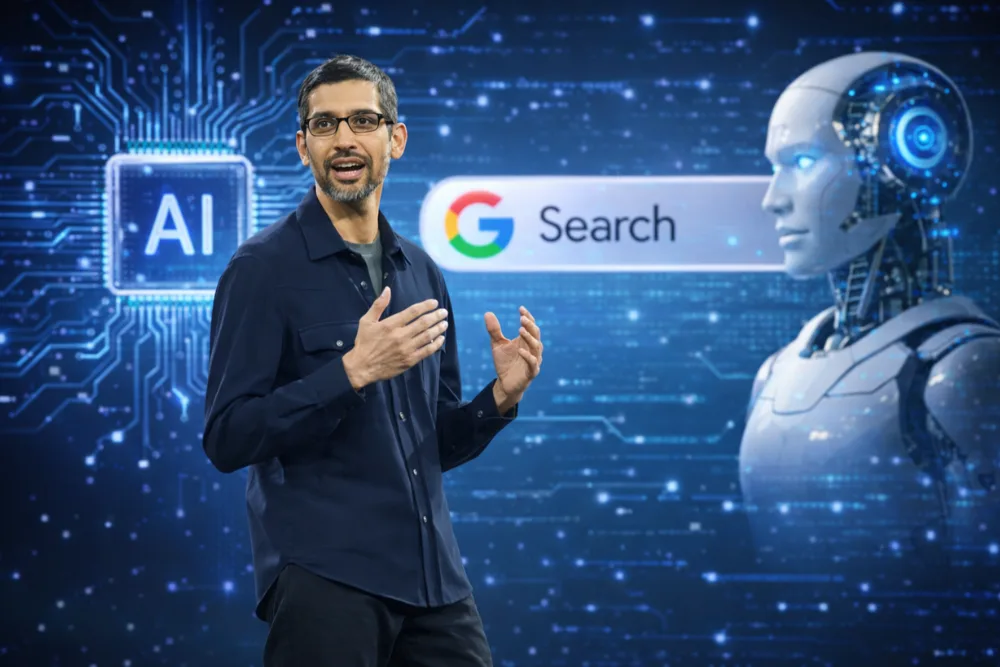
Google’s CEO, Sundar Pichai, has revealed that search is evolving into an AI driven agent manager, where information seeking queries are handled as tasks rather than simple results. In the near future, search will not just display links, it will coordinate multiple AI agents to plan, execute, and complete user requests, fundamentally transforming how people interact with information online.
The Shift From Search Engine To Agentic System
In a recent interview, Sundar Pichai outlined a significant transformation in how users interact with search. The discussion revolved around a fundamental question, whether search will remain a product or evolve into something entirely new as artificial intelligence systems gain the ability to act, plan, and execute tasks independently.
Pichai emphasized that search is not being replaced, but rather expanded. According to him, every technological shift, whether mobile or AI, has historically increased the capabilities of search. As user expectations evolve, search adapts by integrating new functionalities. This ongoing evolution ensures that search remains relevant, even as its role becomes more complex and dynamic.
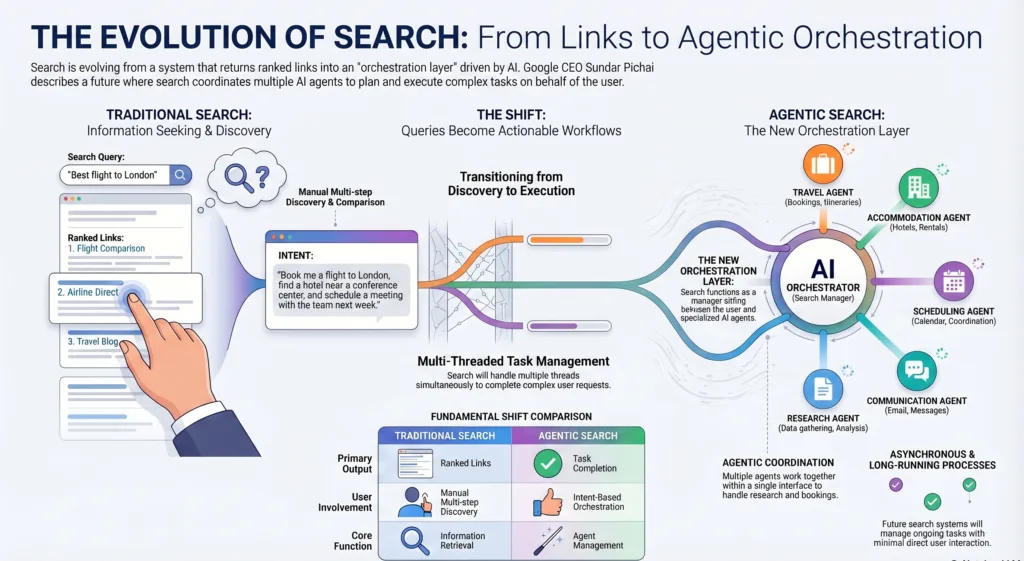
He explained that many traditional information seeking queries will transition into what he described as agentic search. In this model, users will no longer simply receive answers, instead, they will initiate processes where AI systems handle multiple steps simultaneously, effectively completing tasks on their behalf.
In a conversation with John and Elad Gil, Sundar Pichai discusses Google’s AI resurgence, future search evolution, massive investments, infrastructure challenges, and how AI will drive economic growth while reshaping innovation and internal culture.
Here’s the conversion video podcast;
Information Seeking Queries Are Becoming Tasks
One of the most important insights shared by Sundar Pichai is the transformation of information queries into actionable workflows. Traditionally, search engines returned ranked lists of web pages in response to user queries. However, with the rise of advanced AI, this paradigm is shifting toward execution rather than retrieval.
Pichai illustrated this change by explaining that users will have multiple threads running at once. Instead of manually searching, comparing, and deciding, users will rely on AI systems to perform these steps automatically. This marks a significant departure from the conventional search experience, where the user is actively involved in every stage of information discovery.
In this new framework, search becomes less about presenting information and more about orchestrating actions. AI agents will interpret intent, gather relevant data, and execute tasks across different platforms, all within a unified system.
Search As An AI Agent Manager
Looking ahead, Sundar Pichai described search as an agent manager, a system that coordinates multiple AI agents working together. This concept represents a major leap in how digital interactions are structured.
Instead of acting as a gateway to websites, search will function as an orchestration layer. It will sit between the user and a network of AI agents, each responsible for specific tasks. These agents could handle research, bookings, content generation, or other complex processes, all managed through a single interface.
The Architecture of Agentic Search
Pichai noted that users are already adapting to early versions of this model. Features like deep research queries demonstrate how people are beginning to engage with more complex, multi step interactions within search environments. Over time, these interactions are expected to become more sophisticated and seamless.
Will Search Exist In Ten Years
When asked whether search will still exist in a decade, Sundar Pichai avoided giving a definitive answer. Instead, he highlighted the rapid pace of technological change, suggesting that predicting the exact form of search even five years into the future is increasingly difficult.
He reiterated that search will continue to evolve, potentially taking on roles that extend far beyond its current capabilities. In his vision, search will manage long running tasks, support asynchronous processes, and enable users to accomplish more with less direct interaction.
This perspective reflects a broader trend in AI development, where systems are designed not just to respond, but to act. As a result, the traditional concept of a search box returning links may gradually give way to more interactive and autonomous systems.
The Role Of AI And Rapid Technological Change
A key theme in Sundar Pichai’s remarks is the unprecedented speed of innovation in artificial intelligence. He pointed out that models are improving so rapidly that long term predictions have become less practical. Instead, companies must focus on short term adaptability and continuous innovation.
Also read: Best SEO Tools for Keyword Research and Competitor Analysis
According to Pichai, this is an expansionary moment rather than a zero sum game. The capabilities of AI are growing at an extraordinary rate, enabling users to achieve more than ever before. However, this growth also creates challenges for businesses that fail to keep pace with technological advancements.
By embracing uncertainty and focusing on agility, organizations can position themselves to benefit from these changes rather than be disrupted by them. This approach is central to Google’s strategy as it continues to զարգ its search and AI offerings.
The Overlap Between Search And AI Systems
Another critical aspect of Pichai’s vision is the relationship between search and AI systems like Google’s Gemini. He explained that these systems will both overlap and diverge in meaningful ways.
On one hand, search will incorporate AI capabilities to enhance its functionality. On the other hand, dedicated AI platforms will continue to evolve independently, offering specialized features and experiences. This dual approach allows Google to explore multiple pathways for innovation while maintaining its leadership in both search and AI.
The integration of these systems will create new opportunities for users, enabling more personalized and efficient interactions. However, it also raises important questions about how information is sourced, processed, and presented.
The Missing Role Of Websites In The Conversation
One of the most notable aspects of the interview is what was not discussed. Despite the central role of websites in the current search ecosystem, Sundar Pichai made almost no reference to them.
Web pages were mentioned only briefly, and not in the context of being primary sources of information. Instead, the focus was on how AI systems interpret and utilize data. This shift suggests that websites may increasingly be treated as data inputs rather than destinations.
For publishers, businesses, and the SEO community, this raises significant concerns. If search evolves into an agent driven system, the visibility and importance of traditional web pages could diminish. This potential shift underscores the need for new strategies and approaches in digital content creation.
Implications For SEO And Online Businesses
The transformation of search into an AI agent manager has profound implications for SEO and online businesses. As Google redefines how information is accessed, traditional optimization techniques may become less effective.
Related search: SEO vs SEA: Critical Differences That Impact Your Digital Growth
Instead of focusing solely on rankings and keywords, businesses may need to adapt to a landscape where AI systems prioritize structured data, context, and usability. Content will need to be designed not just for human readers, but for AI agents that interpret and act on information.
This shift also highlights the importance of competitive agility. Companies that embrace change and invest in innovation will be better positioned to thrive in this new environment. Conversely, those that rely on outdated strategies may struggle to maintain their relevance.
A Strategic Embrace Of Uncertainty
At its core, Sundar Pichai’s vision reflects a strategic embrace of uncertainty. Rather than attempting to predict the distant future, Google is focusing on continuous evolution and adaptability.
This approach allows the company to remain at the forefront of technological innovation while responding to changing user needs. By integrating AI into search and exploring new interaction models, Google is positioning itself to lead the next phase of digital transformation.
For the broader industry, this serves as a reminder that change is inevitable. Success will depend on the ability to adapt, innovate, and rethink traditional assumptions about how information is created and consumed.
Final Thoughts
Google’s vision of search as an AI agent manager marks a turning point in the evolution of digital information access. As explained by Sundar Pichai, the shift from information retrieval to task execution represents a fundamental change in how users interact with technology.
While the exact future of search remains uncertain, one thing is clear, it will continue to evolve in response to advances in artificial intelligence. For businesses, publishers, and users alike, this transformation presents both challenges and opportunities. Adapting to this new reality will be essential for staying relevant in an increasingly AI driven world.
Frequently Asked Questions
What did Google’s CEO say about the future of search
Sundar Pichai said that search will evolve into an AI agent manager, where information queries are handled as tasks by AI systems.
What is agentic search
Agentic search refers to AI driven systems that can plan, execute, and complete tasks instead of simply returning search results.
Will traditional search engines disappear
Not necessarily, but they are expected to evolve significantly, incorporating AI to handle more complex and multi step interactions.
How will this affect SEO
SEO will shift toward optimizing content for AI systems, focusing on structured data, context, and usability rather than just rankings.
Why were websites not mentioned in the discussion
The focus was on AI systems and their capabilities, suggesting a shift toward treating web content as data rather than destinations.
What is Google’s strategy moving forward
Google is focusing on innovation, adaptability, and integrating AI into search to stay competitive in a rapidly changing landscape.
Also read: How to Choose an SEO Platform for Small Business Websites

Dony Garvasis is the founder of Search Ethics, a freelance SEO consultant, and a passionate technology blogger. With over 8 years of experience in SEO, blogging and content marketing, I provide expert content on Tech, digital marketing, SEO, Artificial intelligence, gadgets, science, automobiles, lifestyle, tips, tutorials and much more. My mission is simple: Ethical Search, Genuine Results! I will make sure people everywhere get trustworthy and helpful information.