Now Reading: How to Sign Off a Professional Email
-
01
How to Sign Off a Professional Email
Knowing how to sign off a professional email is essential for creating a strong final impression, maintaining professionalism, and encouraging clear communication. The right closing reflects respect, reinforces your message, and guides the recipient toward the next step, making your emails more effective and impactful in any professional setting.
Why Learning How to Sign Off a Professional Email Matters
Understanding how to sign off a professional email is more important than many people realize, because the closing is often the last thing your recipient reads and remembers. A well crafted email sign off can reinforce your professionalism, clarify your intent, and leave a positive impression that encourages future communication.
In professional environments, communication is not just about sharing information, but also about building relationships. Every email you send represents your personal or company brand, and your closing plays a key role in shaping how others perceive you. When you consistently use appropriate and thoughtful sign offs, you demonstrate attention to detail, respect for the recipient, and strong communication skills.
Another reason why learning how to sign off a professional email matters is that it helps guide the recipient’s response. A clear and polite closing can signal whether you expect a reply, confirm next steps, or simply express appreciation. This clarity reduces misunderstandings and ensures smoother communication, especially in business contexts where time and efficiency are critical.

Moreover, different situations require different tones, and mastering email sign offs allows you to adapt accordingly. Whether you are writing to a new client, a colleague, or a senior executive, choosing the right closing helps you strike the perfect balance between professionalism and warmth. This adaptability is essential in today’s fast paced work environment, where emails remain one of the primary forms of communication.
Ultimately, learning how to sign off a professional email is a small but powerful skill that can significantly improve your communication effectiveness. It enhances your credibility, strengthens relationships, and ensures your message ends on a positive and purposeful note.
Also read: Zoho Mail vs Gmail: Which Email Platform Is Better
Match the Tone to Your Relationship and Context
One of the most important principles in understanding how to sign off a professional email is matching the tone of your closing to your relationship with the recipient and the context of your message. Not all emails are the same, and using a one size fits all approach can lead to awkward or inappropriate communication.
For first time interactions or formal situations, it is best to use more traditional and respectful closings. Phrases such as Sincerely, Best regards, Kind regards, or Respectfully convey professionalism and show that you value the recipient’s time and position. These sign offs are particularly suitable when reaching out to new clients, applying for jobs, or communicating with senior stakeholders.
On the other hand, when you have an established relationship with the recipient, you can adopt a slightly warmer tone while still maintaining professionalism. Closings like Best, Thanks, Warm regards, or Looking forward to hearing from you strike a balance between friendliness and professionalism. These are commonly used in ongoing collaborations, team communications, or client relationships that have developed over time.
Context also plays a crucial role in determining the appropriate tone. For example, an email discussing a serious matter or a formal agreement may require a more traditional closing, even if you have a friendly relationship with the recipient. Conversely, a quick update or follow up email may allow for a more relaxed sign off.
Learning how to sign off a professional email involves being mindful of these nuances. By carefully considering your relationship and the purpose of your message, you can choose a closing that feels natural, respectful, and appropriate. This attention to detail helps you communicate more effectively and ensures that your emails are received in the intended manner.
Include a Clear Call to Action Before Signing Off
Another essential aspect of how to sign off a professional email is including a clear and polite call to action before your closing. This step ensures that your email is not only professional but also purposeful, guiding the recipient on what to do next.
A call to action can take many forms, depending on the context of your email. For example, you might ask the recipient to provide feedback, confirm availability, or review a document. Simple phrases such as Please let me know if you have any questions, Looking forward to your response, or Kindly confirm your availability help clarify expectations and encourage timely replies.
Including a call to action also demonstrates professionalism and organization. It shows that you have a clear objective for your communication and respect the recipient’s time by making your request straightforward. Without this clarity, the recipient may be unsure how to respond or whether a response is needed at all.
In addition, a well placed call to action creates a smoother communication flow. It reduces back and forth emails, minimizes misunderstandings, and helps both parties stay aligned on next steps. This is especially important in professional settings where efficiency and clarity are highly valued.
When learning how to sign off a professional email, it is important to remember that the closing is not just about ending the message. It is an opportunity to reinforce your purpose and guide the conversation forward. By combining a clear call to action with an appropriate sign off, you create a more effective and impactful email.
Maintain Professionalism and Warmth in Your Closing
Maintaining the right balance between professionalism and warmth is a key element in mastering how to sign off a professional email. While it is important to remain respectful and formal, your closing should also feel human and approachable.
Professionalism ensures that your email is taken seriously and reflects positively on you or your organization. It involves using appropriate language, avoiding slang, and choosing sign offs that align with the context of your message. Closings such as Best regards or Sincerely are widely accepted because they convey respect without sounding overly rigid.
At the same time, warmth adds a personal touch to your communication. It helps build rapport, fosters positive relationships, and makes your emails more engaging. Simple phrases like Thank you, Warm regards, or Looking forward to your response can make your message feel more genuine and friendly.
However, it is important to avoid overly casual or ambiguous closings, especially in professional settings. Phrases like Cheers or Later may be appropriate in informal conversations, but they can appear unprofessional or unclear in business communication. Understanding how to sign off a professional email means knowing when to keep things formal and when a touch of warmth is appropriate.
Striking the right balance between professionalism and warmth ensures that your emails are both respectful and relatable. This combination enhances your communication style and helps you build stronger, more positive connections with your recipients.
Examples of professional email closings
Examples of Professional Email Closings
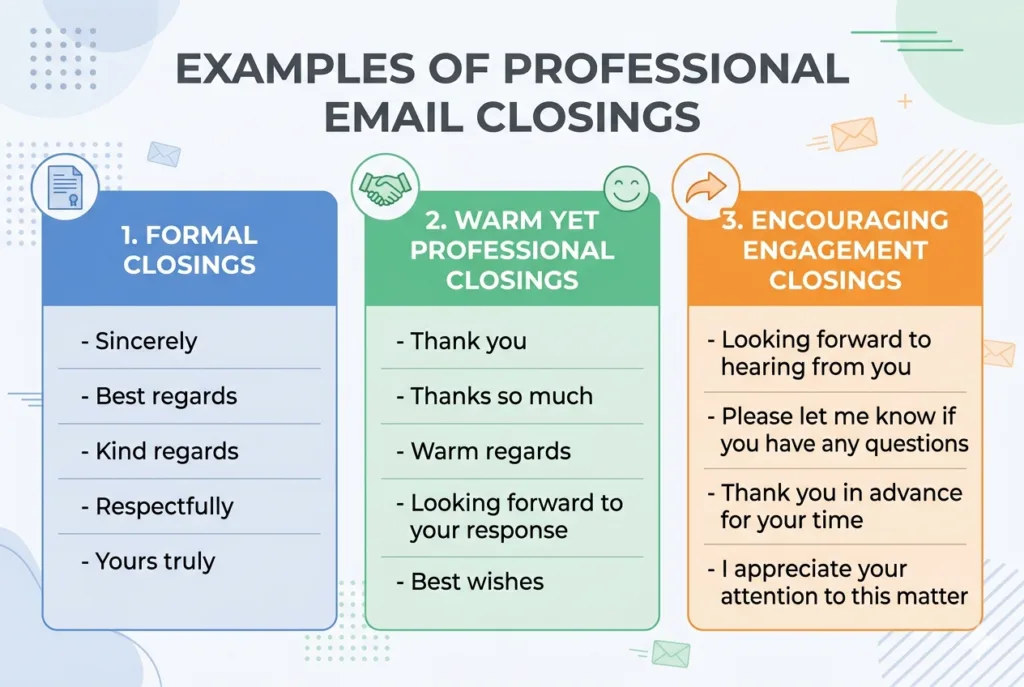
Learning how to sign off a professional email becomes easier when you have a variety of examples to choose from. Different situations call for different types of closings, and having a clear understanding of these options allows you to adapt your communication effectively.
Formal closings are ideal for situations that require a high level of professionalism. Examples include Sincerely, Best regards, Kind regards, Respectfully, and Yours truly. These phrases are commonly used in formal business communication, job applications, and initial outreach emails.
Warm yet professional closings are suitable for ongoing relationships and less formal interactions. Examples include Thank you, Thanks so much, Warm regards, Looking forward to your response, and Best wishes. These sign offs maintain professionalism while adding a friendly tone to your message.
When you expect a reply or action, it is helpful to include closings that encourage engagement. Examples include Looking forward to hearing from you, Please let me know if you have any questions, Thank you in advance for your time, and I appreciate your attention to this matter. These phrases clearly communicate your expectations and make it easier for the recipient to respond.
By familiarizing yourself with these examples, you can confidently choose the right closing for any situation. Understanding how to sign off a professional email involves selecting phrases that align with your message, relationship, and desired outcome.
The Importance of a Strong Email Signature
A professional email sign off is not complete without a well structured email signature. Your signature provides essential information about you and makes it easy for the recipient to contact you, reinforcing your credibility and professionalism.
An effective email signature typically includes your full name, job title, company name, and contact details such as your email address and phone number. This information ensures that the recipient can easily identify you and follow up if needed.
In addition to providing contact information, your signature also serves as a branding tool. It reflects your professionalism and helps create a consistent image for you or your organization. A clean and well designed signature leaves a positive impression and enhances the overall quality of your communication.
When learning how to sign off a professional email, it is important to treat your signature as an integral part of the closing. It should be clear, concise, and aligned with the tone of your email. Avoid cluttering your signature with unnecessary details, and focus on including only the most relevant information.
A strong email signature not only complements your closing but also strengthens your professional identity. It ensures that your emails are complete, informative, and easy to follow up on.
How To Write a Professional Email with Example
Writing a professional email involves following a clear structure and using polite, concise language. A well structured email typically includes a subject line, salutation, body, closing, and signature. Each of these elements plays a crucial role in ensuring effective communication and demonstrating professionalism.
The subject line should be brief and clearly indicate the purpose of the email. A concise subject line helps the recipient understand the context of your message and prioritize their response. The salutation sets the tone for your email, and it should be polite and appropriate for the level of formality required. Common options include Hello followed by the recipient’s name or Dear followed by their title and last name.
The body of the email should be clear, focused, and to the point. Begin with a polite opening, state your main message or request, and include any necessary details without overwhelming the reader. Keeping your message concise shows respect for the recipient’s time and improves readability.
The closing is where understanding how to sign off a professional email becomes essential. Choose a courteous closing phrase that matches the tone of your message, such as Best regards, Sincerely, or Thank you. This reinforces your professionalism and leaves a positive impression.
Finally, include a signature with your full name and relevant contact information. This ensures that the recipient can easily identify and contact you.
Here is an example of a professional email:
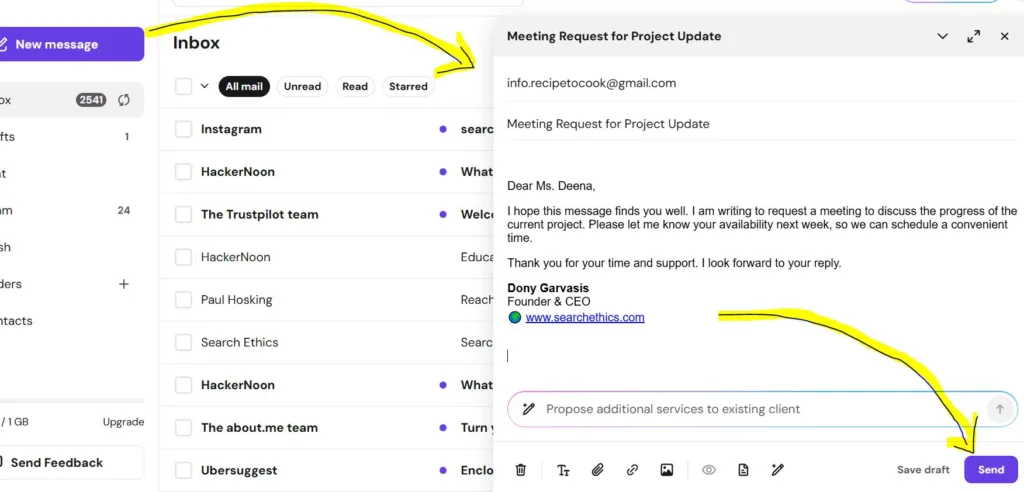
This example demonstrates a clear structure, polite tone, and effective closing, making it a strong model for professional communication.
When to Use Best Regards vs Sincerely in Professional Emails
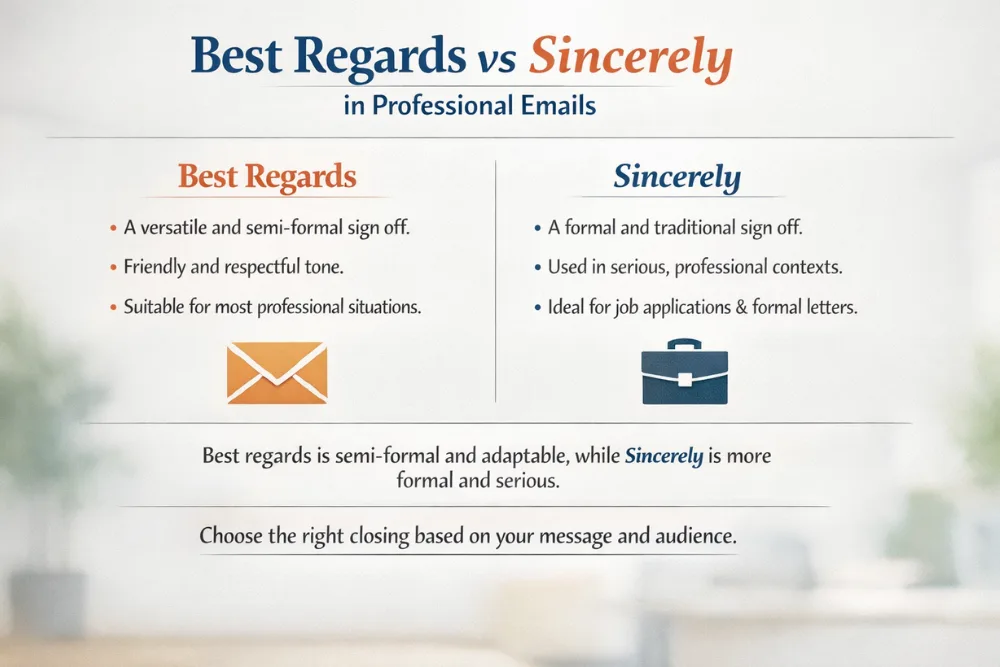
Choosing between Best regards and Sincerely is a common challenge when learning how to sign off a professional email. Both are widely used, but they convey slightly different levels of formality and tone.
Best regards is a versatile and commonly used sign off that works well in most professional situations. It is considered semi formal and expresses respect while maintaining a friendly tone. This makes it suitable for a wide range of contexts, including communication with colleagues, clients, and supervisors. If you are unsure which closing to use, Best regards is often a safe and appropriate choice.
Best regards vs sincerely in emails
Sincerely, on the other hand, is more formal and traditional. It is typically used in situations that require a higher level of professionalism, such as job applications, formal letters, or initial outreach to potential clients. Using Sincerely signals that your message is serious and reinforces a formal tone.
The key difference between these two options lies in their level of formality. While both are professional, Sincerely is more formal, whereas Best regards is slightly more relaxed and adaptable. Understanding this distinction helps you choose the right closing based on your message and audience.
Ultimately, mastering how to sign off a professional email involves being flexible and mindful of context. By selecting the appropriate closing, you can ensure that your email conveys the right tone and leaves a positive impression.
Which Email Signature Tools Help Automate Professional Sign Offs
As businesses grow and communication becomes more complex, many professionals turn to tools that automate email signatures and ensure consistency across all communications. These tools simplify the process of how to sign off a professional email while maintaining a polished and professional appearance.
CodeTwo Email Signatures for Microsoft 365
It is a powerful solution that offers centralized management and automatic signature insertion across all devices. CodeTwo Email Signatures for Microsoft 365 allows organizations to maintain consistent branding and personalize signatures with user details, making it a reliable choice for large teams.
WiseStamp
It is another popular option that provides easy to use templates and centralized control. WiseStamp integrates seamlessly with major platforms and allows marketing teams to update signatures without relying on technical support. This flexibility makes it ideal for organizations that want to maintain a consistent and professional image.
Exclaimer
It is designed to reduce the workload on IT teams by enabling non technical users to manage email signatures. Exclaimer offer features such as role based access, customizable templates, and analytics to track performance, making it a comprehensive solution for businesses.
Newoldstamp and BulkSignature
They are also effective tools, particularly for small to medium sized teams. Newoldstamp and BulkSignature offers customization, automation, and integration features that help maintain consistency and professionalism in email communication.
Using these tools can significantly enhance your approach to how to sign off a professional email. They ensure that every email you send includes a consistent and well designed signature, saving time and improving overall communication quality.
Final Thoughts
Mastering how to sign off a professional email is a crucial skill that enhances your communication, strengthens relationships, and leaves a lasting impression. By choosing the right tone, including a clear call to action, maintaining professionalism and warmth, and using an effective signature, you can ensure that your emails are both impactful and respectful. Whether you are communicating with clients, colleagues, or stakeholders, a thoughtful email closing reflects your professionalism and helps you achieve your communication goals.
Frequently Asked Questions
What is the best way to sign off a professional email
The best way to sign off a professional email is to use a closing that matches your tone and relationship, such as Best regards, Sincerely, or Thank you, followed by your name and signature.
How many times should I use how to sign off a professional email in content
Using how to sign off a professional email naturally throughout your content helps with SEO, but it should be integrated smoothly without overuse.
Is Best regards better than Sincerely
Best regards is more versatile and slightly less formal, while Sincerely is more formal and suited for serious or official communication.
Should I always include a signature in emails
Yes, including a signature with your name, title, and contact details is essential for professionalism and easy communication.
Can I use casual sign offs in professional emails
Casual sign offs can be used only when you have an established informal relationship, but it is generally safer to stick with professional options.
What should I avoid when signing off an email
Avoid overly casual phrases, unclear closings, or missing signatures, as these can reduce professionalism and clarity.
Why is a call to action important before closing
A call to action helps guide the recipient on what to do next, making your email more effective and ensuring clear communication.

Dony Garvasis is the founder of Search Ethics, a freelance SEO consultant, and a passionate technology blogger. With over 8 years of experience in SEO, blogging and content marketing, I provide expert content on Tech, digital marketing, SEO, Artificial intelligence, gadgets, science, automobiles, lifestyle, tips, tutorials and much more. My mission is simple: Ethical Search, Genuine Results! I will make sure people everywhere get trustworthy and helpful information.