Now Reading: The Soyuz 11 Mystery That Shocked the World
-
01
The Soyuz 11 Mystery That Shocked the World
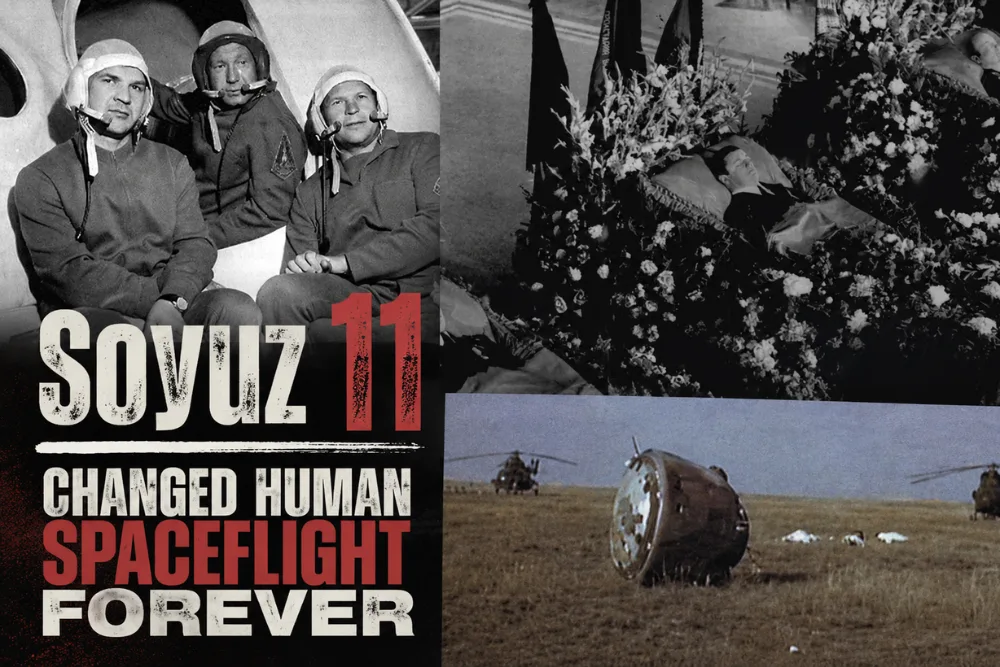
The Soyuz 11 disaster was a tragic Soviet space mission in 1971 that ended with the deaths of all three crew members after their spacecraft lost cabin pressure during reentry.
Although the capsule landed successfully on Earth, the crew had already died from rapid depressurization, making Soyuz 11 the only mission in history in which humans are known to have died in space.
Space exploration has always been associated with extraordinary achievements, scientific breakthroughs, and human courage.
However, it has also been marked by moments of tragedy that have shaped the future of space travel. Among the most heartbreaking incidents in space history is the Soyuz 11 disaster, a mission that successfully completed its objectives but ended with the loss of its entire crew.
The event shocked the Soviet Union, stunned the international scientific community, and led to significant improvements in spacecraft design and astronaut safety procedures. More than five decades later, the lessons learned from Soyuz 11 continue to influence modern space missions, including the latest Soyuz spacecraft preparations for journeys to the International Space Station.
What Was Soyuz 11?
Soyuz 11 was a Soviet crewed space mission launched on June 6, 1971. The mission’s primary objective was to transport a crew to Salyut 1, the world’s first space station.
At the time, the Soviet Union and the United States were competing intensely in the Space Race, and the successful operation of a space station represented a major technological achievement.
The mission was designed to demonstrate that humans could live and work in space for extended periods. It also aimed to gather scientific data that would support future long duration space missions. Soyuz 11 successfully achieved these objectives and became one of the most significant missions of its era, before ending in tragedy during its return to Earth.
Meet the Three Cosmonauts of Soyuz 11
The Soyuz 11 crew consisted of Georgi Dobrovolsky, Vladislav Volkov, and Viktor Patsayev. Each member brought valuable experience and expertise to the mission. Georgi Dobrovolsky served as the mission commander and was responsible for leading the crew throughout the flight. Vladislav Volkov was an experienced cosmonaut who had previously flown on Soyuz 7. Viktor Patsayev was a flight engineer and became the first person to operate a telescope outside Earth’s atmosphere.
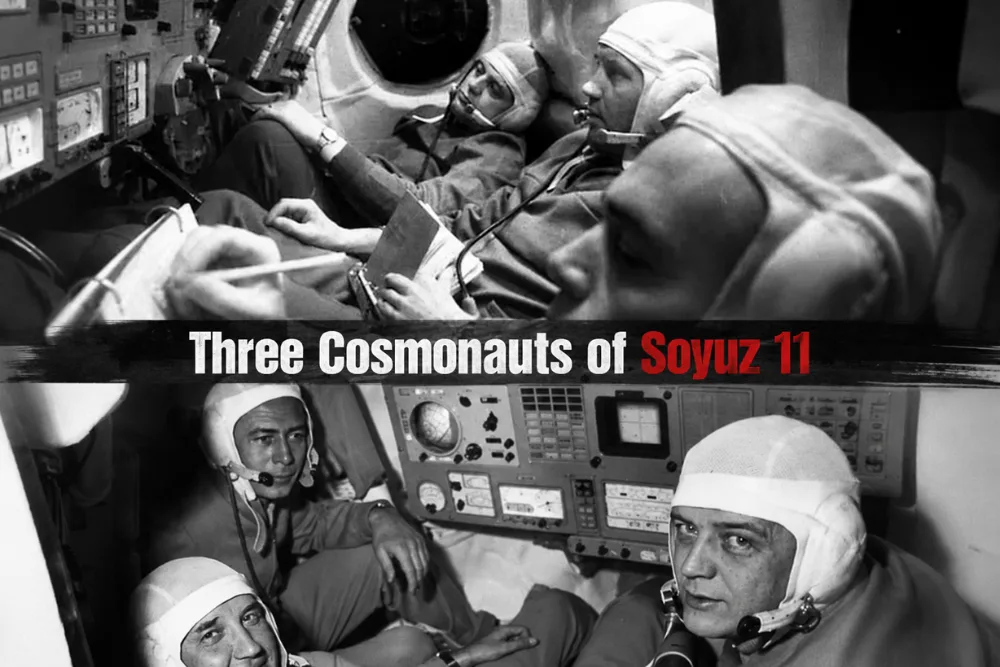
Together, these three men spent more than three weeks aboard Salyut 1, conducting experiments, monitoring the station’s systems, and contributing valuable knowledge to the growing field of human spaceflight.
Also read: Who is Sunita Williams and What are Her Major Achievements
Why the Original Crew Never Flew
One of the most remarkable aspects of the Soyuz 11 story involves the crew that never launched. Originally, another team had been selected for the mission. However, during routine medical examinations, doctors discovered a suspicious spot on the lung of cosmonaut Valeri Kubasov.
Concerned that the finding could indicate a serious illness, mission officials removed the entire primary crew from the flight. The backup crew, consisting of Dobrovolsky, Volkov, and Patsayev, was assigned to the mission instead.
Later investigations revealed that the lung abnormality was not a serious disease but likely an allergic reaction caused by pesticide exposure. This unexpected medical decision ultimately saved the lives of the original crew while placing the backup team on the historic but doomed mission.
Soyuz 11’s Historic Journey to the World’s First Space Station
The spacecraft launched successfully from the Baikonur Cosmodrome and began its journey toward Salyut 1. After reaching orbit, the crew successfully docked with the space station and entered what would become a landmark chapter in space exploration. During their stay aboard Salyut 1, the cosmonauts conducted numerous scientific experiments and engineering tests.
They studied the effects of prolonged weightlessness on the human body and gathered valuable data about living conditions in space. The mission lasted 23 days, setting a new endurance record for human spaceflight at the time. The crew demonstrated that humans could remain productive in orbit for extended periods, providing important insights for future space stations and long duration missions.
The Return Journey That Turned Into a Nightmare
After completing their mission objectives, the crew prepared to return home. They undocked from Salyut 1 and began the standard procedures required for reentry into Earth’s atmosphere. Everything appeared normal during the initial stages of the return journey. Communication with mission control continued, and there were no indications that a catastrophic failure was about to occur.
One of the most memorable moments from the mission involved Vladislav Volkov’s cheerful farewell message to ground personnel.
He reportedly told them to prepare cognac because they would meet again the next day. Those words would become some of the final known remarks from the crew. Unknown to mission controllers, a deadly sequence of events was about to unfold inside the spacecraft.
What Happened During Reentry?
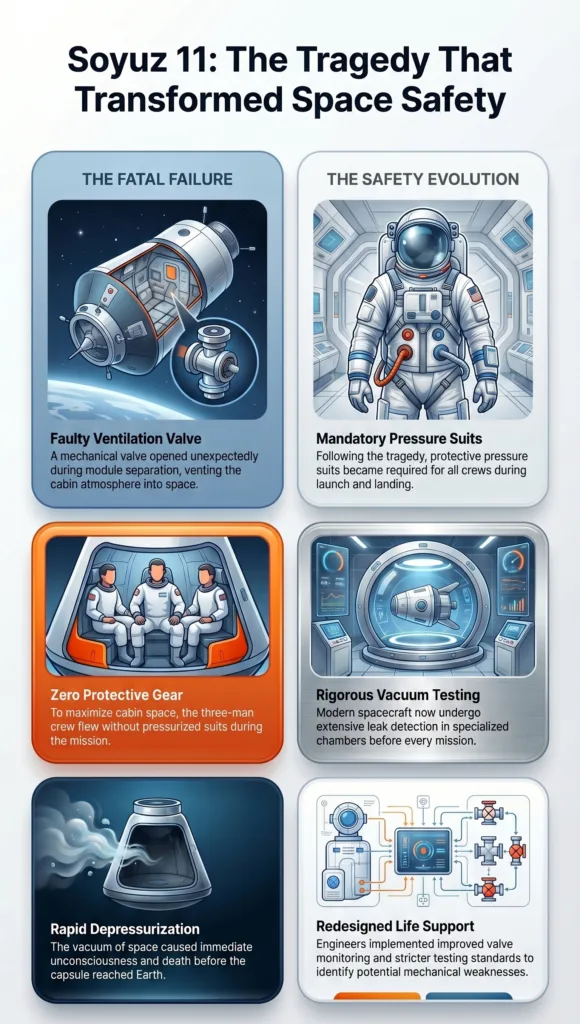
As part of the standard reentry process, the Soyuz spacecraft separated into different modules. During this procedure, a ventilation valve unexpectedly opened when it should have remained sealed. The malfunction created a direct path between the spacecraft cabin and the vacuum of space. Air began escaping rapidly from the capsule.
The depressurization occurred at an altitude where there was virtually no atmospheric pressure outside the spacecraft. Within seconds, the cabin environment became fatal for the crew.
Investigators later determined that the valve had opened prematurely because of mechanical forces generated during module separation. Although the event was extremely rare, it exposed a critical vulnerability in the spacecraft’s design.
Why Did the Soyuz 11 Crew Die?
The three cosmonauts died from exposure to the vacuum of space after the cabin lost pressure. Medical analysis indicated that the crew attempted to respond to the emergency, but the depressurization happened so quickly that they had little chance of survival. When humans are exposed to a vacuum without adequate protection, oxygen levels drop rapidly, causing unconsciousness within a very short period. The body cannot function without sufficient oxygen, and death follows quickly if pressure is not restored.
Investigators found evidence suggesting that the crew recognized the problem and attempted to close the faulty valve. However, the available time was simply too short to prevent the loss of life. The tragedy remains unique because it represents the only confirmed instance of humans dying directly in the environment of outer space.
The Chilling Discovery After Landing
One of the most haunting aspects of the Soyuz 11 disaster is that the spacecraft completed its descent and landing sequence successfully. Recovery teams arrived at the landing site expecting to greet the returning heroes. The capsule appeared normal from the outside, and there were no visible signs of a catastrophic failure.
The Soyuz 11 Tragedy and the Evolution of Space Saf
However, when rescuers opened the hatch, they found all three crew members motionless in their seats. Attempts were made to revive the cosmonauts, but it quickly became clear that they had died before the spacecraft reached Earth. The discovery shocked recovery personnel and immediately transformed what should have been a celebration into a national tragedy.
Investigation Into the Soyuz 11 Disaster
Following the accident, Soviet authorities launched an extensive investigation. Engineers carefully examined every component of the spacecraft to determine the exact cause of the depressurization. The inquiry identified the faulty ventilation valve as the source of the accident. The valve had opened unexpectedly during module separation, allowing the cabin atmosphere to escape.
Investigators reconstructed the sequence of events and confirmed that the spacecraft itself remained structurally intact.
The disaster was not caused by a collision, explosion, or major structural failure. Instead, a relatively small mechanical component triggered a fatal chain of events. The findings provided critical information that would guide future spacecraft safety improvements.
Why Were the Cosmonauts Not Wearing Spacesuits?
One question frequently asked about Soyuz 11 concerns the absence of pressure suits. At the time, Soviet spacecraft were designed to carry three crew members in a confined cabin. To maximize available space, the crew flew without pressure suits during launch and landing. Mission planners believed the spacecraft’s systems provided adequate protection against depressurization events.
Unfortunately, the Soyuz 11 accident revealed the risks associated with that decision.
Had the crew been wearing fully pressurized suits, they likely would have survived the sudden loss of cabin pressure. The tragedy demonstrated the importance of providing astronauts with independent life support protection during critical mission phases.
Changes Made After the Soyuz 11 Tragedy
The loss of the Soyuz 11 crew led to major design changes within the Soviet space program. Engineers redesigned key systems to improve safety and reduce the likelihood of similar failures. Most importantly, pressure suits became mandatory during launch and landing operations. Future Soyuz spacecraft were modified to accommodate crew members wearing protective suits.
Additional safety features were introduced, including improvements to valves, pressure monitoring systems, and emergency procedures. Engineers also implemented more rigorous testing standards to identify potential weaknesses before flight. These changes significantly enhanced crew safety and remain part of modern spaceflight practices.
How Modern Soyuz Missions Prevent Similar Accidents
Today’s Soyuz spacecraft are far safer than their early predecessors. Modern vehicles undergo extensive inspections and testing before every mission. One of the most important procedures involves leak detection and pressure integrity testing. Engineers place spacecraft in specialized chambers and use advanced techniques to identify even the smallest leaks.
For example, preparations for the Soyuz MS 29 mission include comprehensive vacuum and leak testing at the Baikonur Cosmodrome.
Specialists verify the airtight integrity of the spacecraft and confirm that all systems operate according to strict safety standards. Modern crews also wear pressure suits during critical phases of flight, providing an additional layer of protection should an emergency occur. The lessons learned from Soyuz 11 continue to shape every aspect of spacecraft safety today.
How Soyuz 11 Changed Human Spaceflight Forever
The impact of Soyuz 11 extended far beyond the Soviet Union. The tragedy prompted engineers, scientists, and space agencies around the world to reevaluate safety procedures. The accident highlighted the importance of redundancy, emergency preparedness, and rigorous engineering standards.
t also demonstrated that even successful missions can contain hidden risks that require continuous attention. Many of the safety principles now considered standard in human spaceflight can trace their origins to lessons learned from Soyuz 11. The mission helped establish a culture of safety that continues to protect astronauts and cosmonauts today.
Are the Soyuz 11 Crew Still the Only People to Die in Space?
Yes, the Soyuz 11 crew remain the only people known to have died directly in outer space. Other famous space disasters, including the Challenger and Columbia accidents, occurred within Earth’s atmosphere during launch or reentry. Because the Soyuz 11 depressurization took place above the atmosphere, the deaths of Dobrovolsky, Volkov, and Patsayev are considered unique in the history of human spaceflight.
Their sacrifice serves as a reminder of the risks involved in exploring beyond our planet and the importance of continuous advancements in spacecraft safety.
Also read: Astronauts of SpaceX Crew 12 Mission to the ISS
Frequently Asked Questions About Soyuz 11
How long was the Soyuz 11 mission?
The mission lasted 23 days and set a new human spaceflight endurance record at the time.
What caused the Soyuz 11 disaster?
A ventilation valve opened unexpectedly during module separation, causing rapid cabin depressurization.
How did the crew die?
The crew died from exposure to the vacuum of space after the spacecraft lost cabin pressure.
Why were they not wearing spacesuits?
The spacecraft was designed to carry three crew members without pressure suits due to limited cabin space.
Could the crew have survived?
Many experts believe they might have survived if they had been wearing pressurized suits.
What changes were made after the accident?
Mandatory pressure suits, improved spacecraft systems, enhanced testing procedures, and stronger safety protocols were introduced.
Is Soyuz still used today?
Yes, Soyuz spacecraft continue to transport crews to and from the International Space Station.
What is Soyuz MS 29?
Soyuz MS 29 is a modern crewed spacecraft scheduled to carry astronauts to the International Space Station after undergoing extensive safety testing.
References
- Popular Mechanics – The Spacecraft That Landed on Earth With Its Entire Crew Dead
- Times of India – The Space Tragedy That Shocked the World: Remembering Soyuz 11 as Soyuz MS 29 Prepares to Fly
- Zamin.uz – Soyuz MS 29 Spacecraft Undergoes Leak Testing at Baikonur
Remembering the Legacy of Soyuz 11
The Soyuz 11 disaster remains one of the most significant events in the history of human space exploration. What began as a groundbreaking mission to the world’s first space station ended in tragedy, yet its legacy continues to protect astronauts and cosmonauts decades later.
The deaths of Georgi Dobrovolsky, Vladislav Volkov, and Viktor Patsayev led to critical safety improvements that transformed spacecraft design and operational procedures. Their mission demonstrated both the immense promise and the inherent dangers of space travel. Today, every successful Soyuz launch and every safe return from orbit serves as a lasting tribute to the lessons learned from Soyuz 11 and to the courage of the three men who made the ultimate sacrifice in humanity’s quest to explore the cosmos.

Dony Garvasis is the founder of Search Ethics, a freelance SEO consultant, and a passionate technology blogger. With over 8 years of experience in SEO, blogging and content marketing, I provide expert content on Tech, digital marketing, SEO, Artificial intelligence, gadgets, science, automobiles, lifestyle, tips, tutorials and much more. My mission is simple: Ethical Search, Genuine Results! I will make sure people everywhere get trustworthy and helpful information.