Now Reading: Artemis II Launch, Mission Goals, and Crew Details
-
01
Artemis II Launch, Mission Goals, and Crew Details

The Artemis II mission (NASA moon mission) is NASA’s first crewed lunar flyby in over 50 years, aiming to test the Orion spacecraft and Space Launch System with astronauts aboard, ensuring safety for future Moon landings. Scheduled for April 1, 2026, this mission will send four astronauts on a 10 day journey around the Moon and back to Earth.
What Is the Primary Mission Objective of Artemis II
The core objective of Artemis II is to demonstrate that humans can safely travel beyond low Earth orbit once again, marking a historic return to deep space exploration. Led by NASA, this mission focuses on testing critical systems of the Orion spacecraft while carrying astronauts on a real lunar trajectory. Unlike previous uncrewed tests, Artemis II will validate life support, navigation, propulsion, and communication systems in actual deep space conditions.
The mission will follow a free return trajectory, meaning the spacecraft will loop around the Moon and naturally return to Earth without requiring complex propulsion adjustments. This trajectory is essential for ensuring crew safety, as it provides a built in contingency path in case of system failures. During the journey, engineers and scientists will closely monitor how Orion performs under the intense conditions of deep space, including radiation exposure, extreme temperatures, and communication delays.
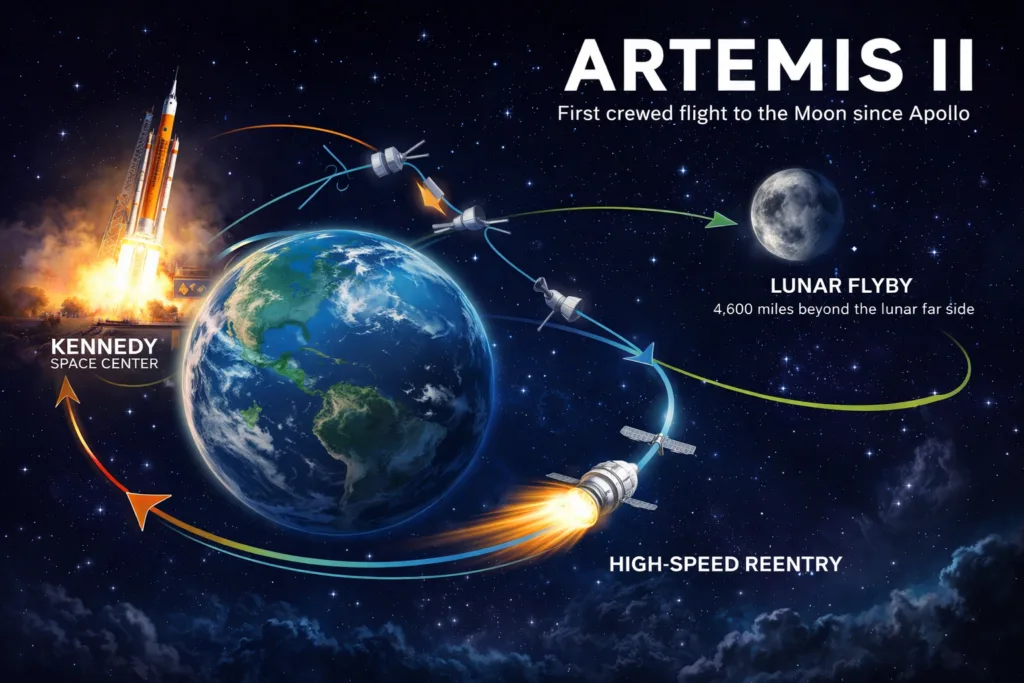
Artemis II will send four astronauts on a 10 day lunar flyby, testing Orion systems during deep space travel and high speed reentry.
Another crucial objective is to evaluate the spacecraft’s heat shield during reentry into Earth’s atmosphere. This phase is one of the most dangerous parts of any mission, as the spacecraft must withstand extremely high temperatures generated by atmospheric friction. Artemis II will provide real world data to confirm that Orion can protect astronauts during this critical phase.
Ultimately, Artemis II serves as a stepping stone toward future missions that aim to land humans on the lunar surface and establish a sustained presence there. By proving that all systems function as intended with a crew onboard, NASA will gain the confidence needed to proceed with Artemis III and beyond.
Learn more about Artemis III mission
Artemis II Crew and Their Roles
The Artemis II mission will carry a diverse and highly experienced crew of four astronauts, each assigned specific roles to ensure mission success. The crew includes Reid Wiseman as commander, Victor Glover as pilot, Christina Koch as mission specialist, and Jeremy Hansen as mission specialist representing Canada.
Reid Wiseman, as commander, will be responsible for the overall success of the mission, including decision making and crew coordination. His leadership will be critical during both routine operations and any unexpected situations that may arise. Victor Glover, serving as pilot, will assist with spacecraft navigation and control, ensuring that Orion follows its planned trajectory around the Moon.
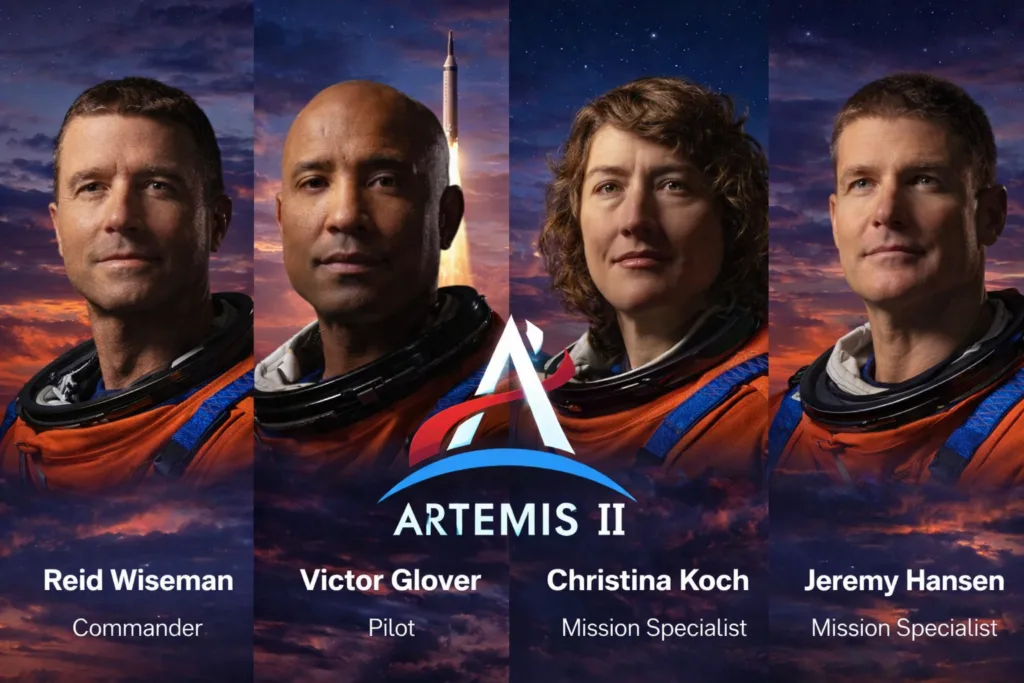
Christina Koch will play a key role in monitoring onboard systems and conducting mission tasks related to scientific observations and system performance. Her experience in long duration spaceflight will be valuable in assessing how humans adapt to extended periods in deep space. Jeremy Hansen, representing the Canadian Space Agency, will contribute to mission operations and international collaboration, highlighting the global nature of the Artemis program.
This crew represents a milestone in space exploration, as it includes a diverse group of astronauts with varied expertise and backgrounds. Their participation underscores the importance of international partnerships in advancing human space exploration and achieving long term goals beyond Earth.
Related search: Who is Sunita Williams and What are Her Major Achievements
Companies and Organizations Behind Artemis II
The Artemis II mission is the result of a massive collaborative effort involving multiple leading aerospace companies and thousands of suppliers. At the center of this effort is NASA, which oversees the entire Artemis program and coordinates with industry partners to develop the necessary technology.
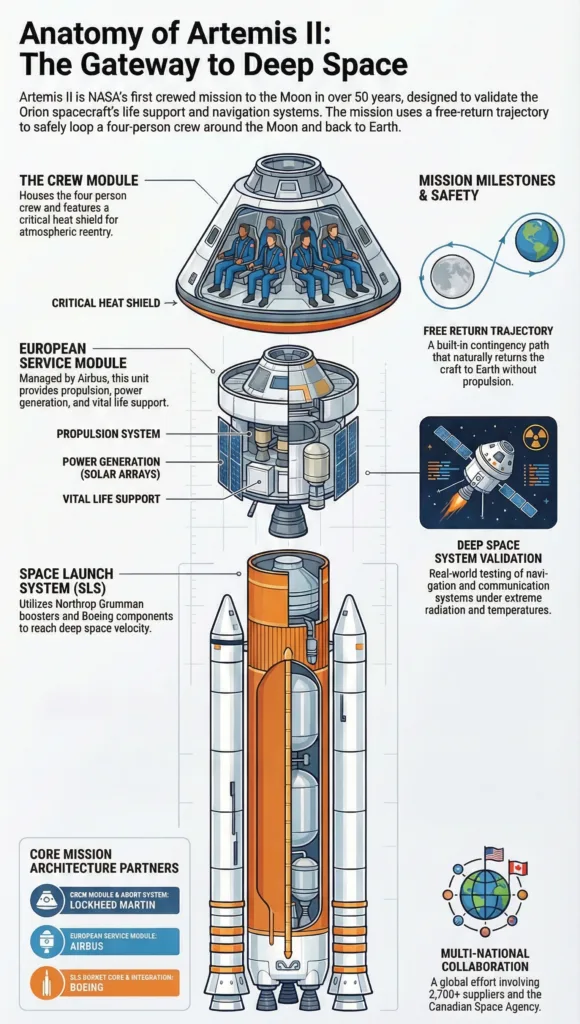
Lockheed Martin serves as the prime contractor for the Orion spacecraft. The company is responsible for building the crew module, crew module adapter, and the launch abort system. Their work ensures that the spacecraft can safely carry astronauts through all phases of the mission, from launch to reentry.
Airbus plays a critical role by manufacturing the European Service Module. This module provides essential functions such as power generation, propulsion, and life support. Its solar panels generate electricity, while its propulsion system enables precise maneuvering in space.
Northrop Grumman contributes by producing the solid rocket boosters used in the Space Launch System. These boosters provide the thrust needed to lift the massive rocket off the ground. Additionally, the company is involved in developing components for the launch abort system and future lunar infrastructure.
Boeing is another key partner, responsible for major components of the Space Launch System. The company’s role includes manufacturing and integrating parts of the rocket that will carry Orion into space.
Beyond these major players, more than 2700 suppliers across the United States and Europe contribute to the Artemis program. These suppliers provide a wide range of technologies, from advanced avionics to life support systems, highlighting the scale and complexity of modern space missions. This extensive network of partners ensures that Artemis II benefits from cutting edge innovation and expertise from around the world.
Artemis II Launch Date and Mission Timeline
The Artemis II mission is scheduled to launch no earlier than April 1, 2026, with a planned liftoff time of 6:24 p.m. EDT from the Kennedy Space Center in Florida. This date represents the culmination of years of development, testing, and preparation by NASA and its partners.
The mission will last approximately 10 days, during which the crew will travel thousands of miles beyond the Moon before returning to Earth. The timeline includes several critical phases, starting with launch aboard the Space Launch System rocket. After reaching orbit, the Orion spacecraft will separate from the rocket and begin its journey toward the Moon.
As the spacecraft approaches the Moon, it will perform a flyby maneuver, using the Moon’s gravity to alter its trajectory and send it back toward Earth. This phase will allow astronauts to observe the lunar surface and test navigation systems in real time. The free return trajectory ensures that the spacecraft will naturally head back to Earth even in the event of propulsion issues.
If the primary launch date is not met, additional launch windows are available through April 6, and later in the month on April 30, 2026. These backup dates provide flexibility to account for weather conditions or technical adjustments, ensuring that the mission can proceed safely.
When is Artemis 2 Splashdown
The Artemis II crew is expected to return with a splashdown in the Pacific Ocean near San Diego on Friday, April 10, 2026, at around 8:07 p.m. EDT (5:07 p.m. PDT / 00:07 GMT on April 11). After completing a 10-day mission orbiting the Moon, the Orion spacecraft—carrying four astronauts—will be recovered by the USS John P. Murtha.
NASA Just Shared 12000 Artemis II Photos and They Are Worth Seeing
Why Artemis II Matters for Future Space Exploration
Artemis II is more than just a test mission, it is a critical step toward establishing a long term human presence on and around the Moon. By successfully demonstrating crewed deep space travel, NASA aims to lay the groundwork for future missions that will explore the lunar surface and eventually venture to Mars.
One of the key goals of the Artemis program is sustainability. Unlike the Apollo missions, which focused on short term exploration, Artemis seeks to create a lasting human presence on the Moon. This includes building infrastructure such as lunar habitats and space stations that can support extended missions.
Also read: Science Finds a Place on Artemis 2
The data collected during Artemis II will inform the design and operation of future missions, including Artemis III, which plans to land astronauts on the Moon. By identifying potential challenges and refining technologies, NASA can reduce risks and improve the overall success rate of future missions.
International collaboration is another important aspect of Artemis II. With contributions from agencies and companies around the world, the mission represents a unified effort to advance human exploration of space. This collaborative approach not only enhances technological capabilities but also fosters global cooperation in addressing the challenges of space exploration.
Conclusion
Artemis II stands as a historic milestone in the return of human spaceflight beyond low Earth orbit. With its ambitious goal of conducting a crewed lunar flyby, the mission will test critical systems, validate human capabilities in deep space, and prepare the foundation for future lunar landings. Supported by leading aerospace companies and an international crew, Artemis II represents the next major step in humanity’s journey toward sustainable exploration of the Moon and beyond.
Frequently Asked Questions
What is Artemis II?
Artemis II is NASA’s first crewed mission in the Artemis program, designed to send astronauts on a lunar flyby and test deep space systems.
When will Artemis II launch?
The mission is scheduled to launch no earlier than April 1, 2026, with backup dates available in early and late April.
How long will the mission last?
Artemis II will last approximately 10 days, including travel to the Moon and back to Earth.
Will Artemis II land on the Moon?
No, the mission will perform a lunar flyby and return to Earth without landing.
Who are the Artemis II astronauts?
The crew includes Reid Wiseman, Victor Glover, Christina Koch, and Jeremy Hansen.
Why is Artemis II important?
It will validate technologies and human capabilities needed for future missions, including lunar landings and long term exploration.
Related search:
Smiley Face Moon: Something You Have Never Seen!
Strawberry Moon Explained: Meaning, Myths & Magic

Dony Garvasis is the founder of Search Ethics, a freelance SEO consultant, and a passionate technology blogger. With over 8 years of experience in SEO, blogging and content marketing, I provide expert content on Tech, digital marketing, SEO, Artificial intelligence, gadgets, science, automobiles, lifestyle, tips, tutorials and much more. My mission is simple: Ethical Search, Genuine Results! I will make sure people everywhere get trustworthy and helpful information.