Now Reading: VA vs IPS: Display Panels Differences Explained
-
01
VA vs IPS: Display Panels Differences Explained
When comparing VA vs IPS, the main differences come down to contrast ratio, color accuracy, viewing angles, response times, and price. VA panels deliver deeper blacks and higher contrast, while IPS panels provide better color accuracy and wider viewing angles, making each technology suitable for different users and needs.
Choosing the right display panel can significantly affect your overall experience, whether you are watching movies, editing photos, gaming competitively, or simply browsing the web. Understanding the practical differences between VA vs IPS helps you make a confident, informed decision that aligns with your specific usage and expectations.
Understanding VA and IPS Display Technologies
To fully grasp the VA vs IPS debate, it is important to understand what these panel types represent. VA stands for Vertical Alignment, while IPS stands for In Plane Switching. Both are types of LCD technology, but they manage liquid crystals differently to control light and produce images on the screen.
In a VA panel, liquid crystals align vertically when no voltage is applied. This structure allows the panel to block more backlight in dark scenes, resulting in deeper blacks and higher contrast ratios. In contrast, IPS panels use a different alignment method where liquid crystals move parallel to the panel surface. This configuration improves color consistency and viewing angles but typically limits contrast performance compared to VA.
The choice between VA vs IPS depends largely on how these structural differences impact real world performance. Each panel type has strengths and weaknesses, and understanding them is the foundation for making the right purchase.
Contrast Ratio and Black Levels
One of the most noticeable differences in the VA vs IPS comparison is contrast ratio. Contrast ratio measures the difference between the darkest blacks and the brightest whites a display can produce. Higher contrast generally results in more depth and realism, especially in dark scenes.
VA panels excel in contrast performance. They typically offer contrast ratios ranging from 3000 to 6000 to 1. This higher ratio means that blacks appear much deeper and more convincing. When watching movies with dark scenes or playing immersive games with shadow rich environments, VA panels create a more dramatic and cinematic experience.
IPS panels usually have contrast ratios around 1000 to 1. While this is perfectly acceptable for everyday use, blacks may appear more grayish when compared directly to VA panels. In a dimly lit room, this difference becomes more noticeable. However, IPS panels still perform well in most lighting conditions and provide consistent brightness across the screen.
If deep blacks and strong contrast are your top priority in the VA vs IPS decision, VA panels generally offer a clear advantage.
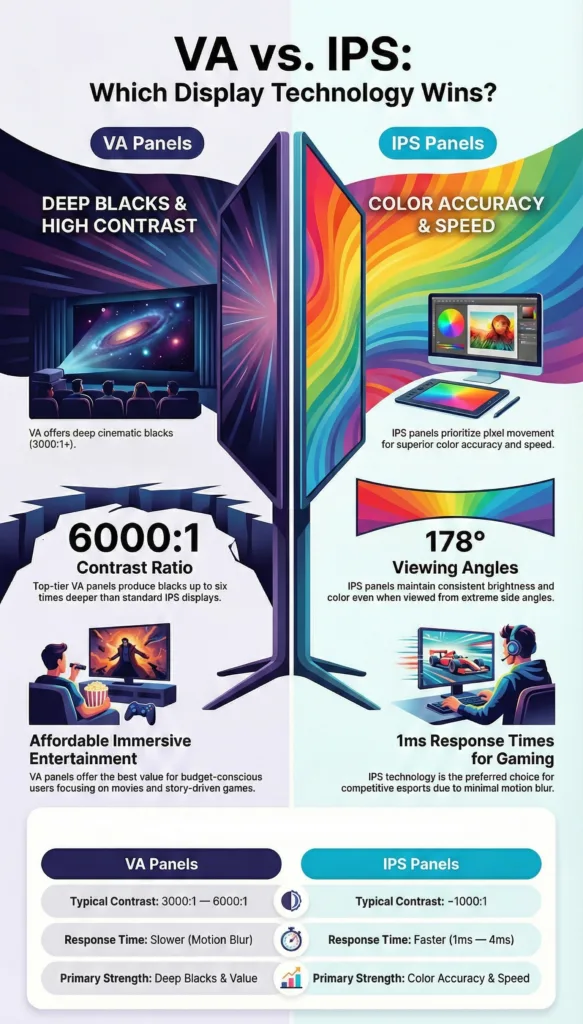
VA vs. IPS Display Comparison Infographic Guide
Color Accuracy and Color Reproduction
Color performance is another crucial factor when discussing VA vs IPS. For professionals and creative users, accurate and consistent color reproduction can be more important than contrast alone.
IPS panels are widely recognized for superior color accuracy and wider color gamut coverage. They typically provide better representation of color spaces such as sRGB and AdobeRGB. This results in natural, vibrant, and consistent colors that remain stable across the entire screen. For tasks like photo editing, video production, graphic design, and other color sensitive work, IPS panels are often the preferred choice.
VA panels also deliver vibrant colors and can look impressive in everyday use. However, they generally fall short of IPS panels in precise color accuracy. Subtle variations in tone and shade may be less accurate, which can be noticeable in professional workflows that demand exact color fidelity.
When evaluating VA vs IPS for creative work, IPS panels usually stand out as the more reliable option for color critical tasks.
Also read: Best Interactive Whiteboards for Home Use with Budget Options
Viewing Angles and Screen Consistency
Viewing angles play a major role in overall display quality, especially in environments where multiple people may be looking at the screen from different positions.
IPS panels are known for their excellent viewing angles, typically up to 178 degrees both horizontally and vertically. Colors and brightness remain stable even when viewed from the side. This consistency makes IPS panels ideal for collaborative work, presentations, and shared entertainment experiences.
VA panels have narrower viewing angles compared to IPS. When viewed off center, colors can shift slightly and brightness may decrease. Although VA panels still perform better than some older panel types, they cannot match the stability offered by IPS technology.
In the VA vs IPS comparison, if wide and consistent viewing angles are essential for your setup, IPS panels are generally the better choice.
Response Times and Gaming Performance
For gamers, response time is a key factor when deciding between VA vs IPS. Response time refers to how quickly a pixel can change from one color to another. Faster response times reduce motion blur and ghosting, which are especially important in fast paced games.
IPS panels typically offer response times ranging from 1 to 4 milliseconds. This fast performance helps deliver smoother motion and clearer visuals during competitive gaming. As a result, many esports players and competitive gamers prefer IPS monitors for their speed and responsiveness.
VA panels tend to have slower response times compared to IPS. This can lead to slight motion blur in high speed scenes, particularly in fast action games. However, VA panels compensate with higher contrast, which can enhance immersion in story driven or visually rich games.
When analyzing VA vs IPS for gaming, competitive players often lean toward IPS for faster response, while casual or immersive gamers may appreciate the deeper contrast of VA panels.
Price and Overall Value
Budget is often a deciding factor in the VA vs IPS discussion. While both panel types are widely available, there can be noticeable differences in cost.
VA panels are often more affordable. They provide excellent contrast and strong overall performance at a lower price point. For general multimedia use, office work, and entertainment, VA monitors can deliver excellent value for money.
IPS panels tend to be more expensive due to their superior color accuracy, better viewing angles, and faster response times. For professionals who rely on accurate visuals or gamers who demand high performance, the extra cost may be justified.
When weighing VA vs IPS in terms of price, it is important to consider your primary use case and whether the additional benefits of IPS align with your needs.
Best Use Cases for VA Panels
VA panels are particularly well suited for users who prioritize deep blacks and high contrast. If you enjoy watching movies in a darker room, a VA panel can provide a more cinematic and immersive experience. The higher contrast ratio enhances shadow detail and creates a stronger sense of depth.
They are also a good option for gamers who value visual immersion over ultra fast response times. In many single player games with rich environments and dramatic lighting, the contrast advantage of VA can significantly enhance the atmosphere.
Additionally, for buyers on a budget, VA panels often deliver an attractive balance between performance and affordability. In the broader VA vs IPS comparison, VA panels are a practical and cost effective solution for general entertainment and everyday computing.
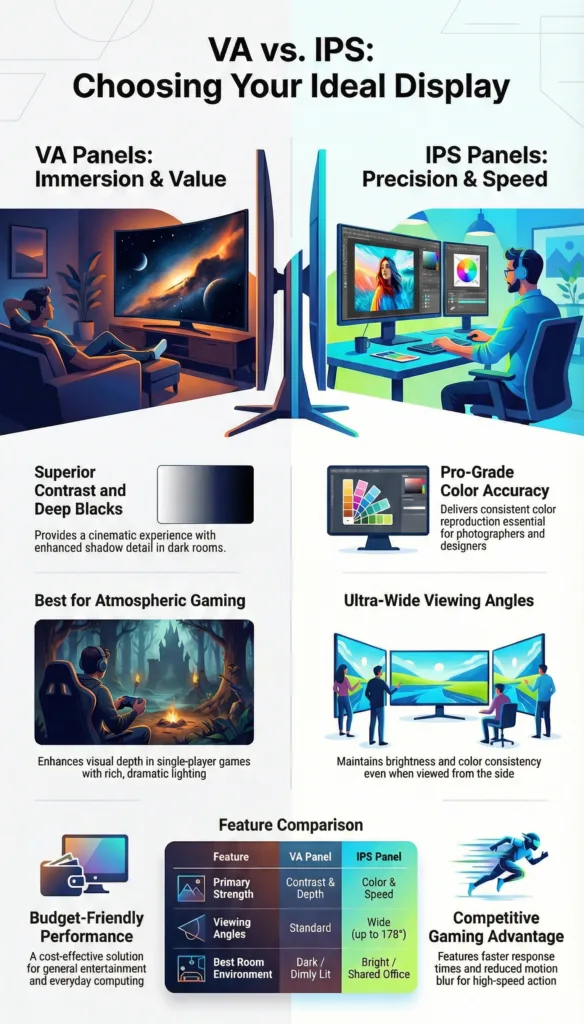
VA vs. IPS Display Comparison Infographic Guide
Best Use Cases for IPS Panels
IPS panels are ideal for users who require accurate colors and wide viewing angles. Photographers, video editors, and graphic designers benefit from the consistent color reproduction that IPS technology provides. When precision matters, IPS often becomes the preferred option.
Competitive gamers also frequently choose IPS panels due to their faster response times and reduced motion blur. In high speed multiplayer games, smoother motion can offer a tangible advantage.
In office environments or shared workspaces, IPS panels ensure that colors and brightness remain consistent, even when viewed from different angles. Within the VA vs IPS debate, IPS stands out for professional work, collaborative settings, and performance focused gaming.
How to Choose Between VA vs IPS
Selecting between VA vs IPS ultimately depends on your personal priorities. Start by identifying how you will primarily use your monitor. If your main activities include watching movies, browsing the web, and casual gaming, a VA panel may offer better contrast and excellent value.
If you are involved in creative work that demands accurate color representation, or if you play competitive games that require fast response times, IPS may be the more suitable option.
It is also important to consider your viewing environment. In darker rooms, the deeper blacks of a VA panel can be more noticeable and enjoyable. In bright offices or shared spaces, the wide viewing angles of IPS can improve overall usability.
Rather than asking which technology is universally better, the more practical question in the VA vs IPS discussion is which panel type best matches your specific needs and budget.
Also read: Top-Rated Noise-Canceling Headphones Under $100
Conclusion
The VA vs IPS comparison highlights two strong display technologies, each with distinct advantages. VA panels offer superior contrast and deeper blacks, making them ideal for immersive entertainment and budget conscious buyers. IPS panels deliver better color accuracy, wider viewing angles, and faster response times, making them a favorite among creative professionals and competitive gamers.
Understanding these core differences allows you to make a confident decision based on how you use your monitor. By carefully evaluating contrast, color performance, viewing angles, response speed, and price, you can choose the panel type that enhances your viewing experience and meets your long term expectations.
Frequently Asked Questions
What is the main difference between VA vs IPS panels?
The main difference between VA vs IPS panels lies in contrast and color performance. VA panels offer higher contrast and deeper blacks, while IPS panels provide better color accuracy and wider viewing angles.
Which is better for gaming, VA or IPS?
For competitive gaming, IPS is usually better due to faster response times and reduced motion blur. For immersive gaming with rich visuals and deeper blacks, VA can also be a strong choice.
Are VA panels good for photo editing?
VA panels can display vibrant colors, but they generally do not match the color accuracy and consistency of IPS panels, which are preferred for professional photo editing.
Do IPS panels have better viewing angles?
Yes, IPS panels maintain consistent colors and brightness even at wide angles, typically up to 178 degrees, making them better for shared viewing.
Is VA cheaper than IPS?
In many cases, VA panels are more affordable than IPS panels, making them a good option for budget conscious buyers who still want strong contrast and solid overall performance.

Dony Garvasis is the founder of Search Ethics, a platform dedicated to transparency, authenticity, and ethical digital practices. With over 8 years of experience in SEO and digital marketing, I provide expert content on Tech, digital marketing, SEO, Artificial intelligence, gadgets, science, automobiles, lifestyle, tips, tutorials and much more. My mission is simple: Ethical Search, Genuine Results! I will make sure people everywhere get trustworthy and helpful information.