Now Reading: Scientists Discover a Hidden Galaxy Buried Deep Within the Milky Way
-
01
Scientists Discover a Hidden Galaxy Buried Deep Within the Milky Way

A recent Milky Way buried galaxy study reveals that an ancient dwarf galaxy, named Loki, is hidden within our own galaxy. Scientists believe it was absorbed billions of years ago, leaving behind a unique group of stars with distinct chemical and orbital properties that still exist today within the Milky Way.
A Galaxy Hidden in Plain Sight
The idea that a galaxy could exist within another galaxy may sound extraordinary, yet this is exactly what astronomers are now uncovering. According to new research published in the journal Monthly Notices of the Royal Astronomical Society, an ancient dwarf galaxy appears to be buried deep within the Milky Way. This hidden structure, named Loki, represents a relic from the early stages of galactic formation, offering a rare glimpse into the past.
The Milky Way buried galaxy study highlights how this lost galaxy was not always part of our cosmic home. Instead, it was gradually consumed during the Milky Way’s growth, becoming one of many smaller galaxies that merged to form the massive structure we observe today. While invisible to the naked eye, its remnants still exist in the form of stars that carry a unique chemical signature.
The Milky Way as a Cosmic Predator
Our galaxy did not form in isolation. The Milky Way is often described as a cosmic predator, steadily growing by absorbing smaller neighboring galaxies over billions of years. This process, known as galactic merging, has played a crucial role in shaping its current size and structure.
Astronomers have developed methods to identify stars that originated outside the Milky Way. These so called alien stars can be distinguished by their unusual orbital patterns and their low abundance of heavy elements. In many cases, these stars follow elongated paths that differ significantly from those formed within the galaxy itself.
The Milky Way buried galaxy study builds on this understanding by identifying a group of stars that likely originated from the Loki dwarf galaxy. These stars serve as evidence of past mergers, helping scientists reconstruct the evolutionary history of our galaxy.
The Discovery of the Loki Dwarf Galaxy
The discovery of Loki is based on the analysis of a small but significant sample of 20 stars. These stars are believed to have formed together in a dwarf galaxy that merged with the Milky Way during its early development. Although the sample size is limited, the findings provide compelling evidence of a previously unknown galactic structure.
One of the most striking features of these stars is their chemical composition. They are metal poor, meaning they contain very low amounts of heavy elements. This characteristic is typical of ancient stars that formed in the early universe, before successive generations of stars enriched the cosmos with heavier materials.
However, what makes these stars particularly interesting is that their chemical profile differs from other metal poor stars found in the Milky Way’s halo. This distinction suggests that they originated from a separate system, supporting the idea of a buried galaxy within the Milky Way.
Chemical Clues and Cosmic Explosions
The chemical composition of stars acts as a cosmic fingerprint, revealing details about their origins and the environments in which they formed. In the case of the Loki group, researchers identified traces of several high energy events that contributed to their formation.
These stars show evidence of enrichment from supernova explosions, hypernova events, and collisions between neutron stars. Such processes release heavy elements into space, which are then incorporated into new stars. The presence of these elements indicates that the parent galaxy experienced intense and energetic conditions.
Interestingly, the study found no evidence of white dwarf explosions among these stars. This absence is significant because white dwarfs take billions of years to form. The lack of such signatures suggests that the Loki dwarf galaxy had a very short lifespan, ending before white dwarfs could develop. This finding reinforces the idea that Loki was a rapidly evolving and short lived system.
Unusual Orbits and Galactic Motion
Another fascinating aspect of the Milky Way buried galaxy study is the motion of the stars associated with Loki. These stars do not all move in the same direction, which is unusual for a group that originated from a single system.
Out of the 20 stars studied, eleven follow a prograde orbit, meaning they move in the same direction as the Milky Way’s rotation. The remaining nine follow a retrograde orbit, moving in the opposite direction. This mix of orbital patterns initially raised questions about whether the stars could have come from different sources.
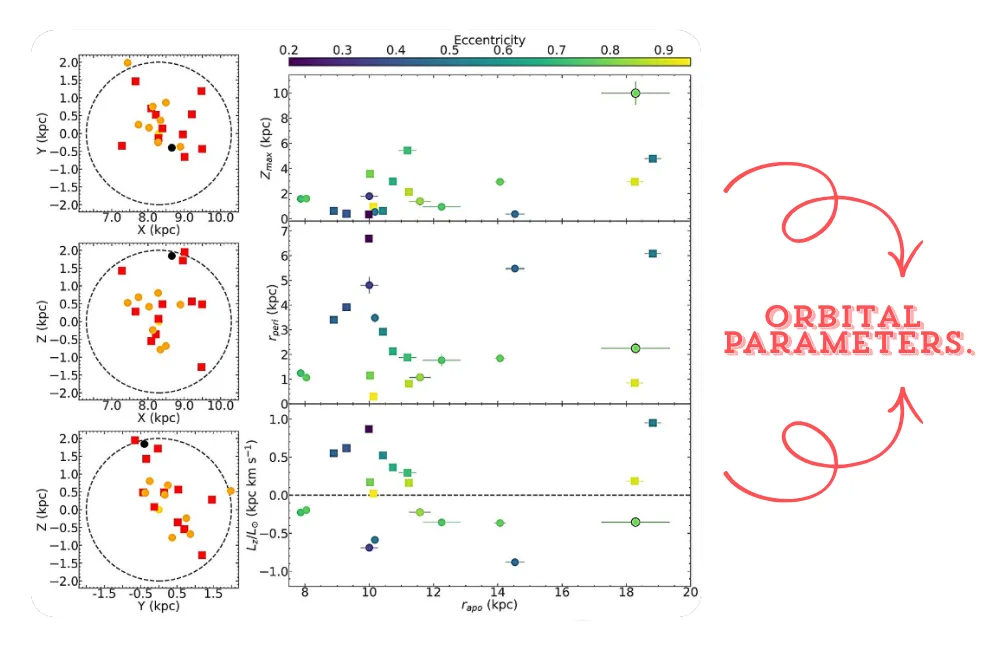
Left panel: current galactocentric coordinates: Y relative to X (top left), Z relative to X (center left), and Z relative to Y (bottom left). Source: Monthly Notices of the Royal Astronomical Society (2026)
However, researchers concluded that all the stars likely originated from the same dwarf galaxy. The explanation lies in the chaotic conditions of the early Milky Way. When Loki merged with our galaxy, the gravitational interactions would have been highly turbulent, causing the stars to scatter and adopt different orbital paths.
A Single Origin Confirmed
The possibility that these stars came from multiple galaxies was carefully examined and ultimately ruled out. Computer simulations of gas and star dynamics showed that a single dwarf galaxy could produce the observed distribution of stars.
If the stars had originated from two separate systems, those systems would need to have identical chemical compositions and evolutionary histories. Such a scenario is extremely unlikely, given the diversity of conditions in the universe. Additionally, the combined mass of two systems would be significantly larger than what the data suggests.
These findings strengthen the case for Loki as a single, self contained dwarf galaxy that was absorbed by the Milky Way. Its remnants now provide valuable insights into the processes that shaped our galaxy’s formation.
The Role of Dwarf Galaxies in Galactic Evolution
Dwarf galaxies play a crucial role in the evolution of larger galaxies. Despite their relatively small size, often containing only a few billion stars, they serve as building blocks in the hierarchical structure of the universe.
The Milky Way buried galaxy study emphasizes the importance of understanding how dwarf galaxies form and evolve. These systems often have irregular shapes and unique characteristics, raising questions about the forces that shape them. Some theories suggest that gravitational interactions cause them to merge and grow, while others point to the influence of dark matter in bringing them together.
The Loki dwarf galaxy provides a valuable case study, offering clues about the conditions that existed in the early universe. Its chemical composition and rapid evolution suggest that it formed under extreme conditions, making it an important piece of the cosmic puzzle.
Future Research and New Discoveries
Although the current study is based on a relatively small sample of stars, it opens the door to further exploration. Astronomers are optimistic that future large scale spectroscopic surveys will provide more data, allowing for a deeper understanding of the Milky Way’s history.
Projects such as WEAVE and 4MOST are expected to play a key role in this effort. These surveys will analyze the chemical and physical properties of millions of stars, helping scientists identify additional remnants of past galactic mergers.
As more data becomes available, researchers hope to confirm the existence of Loki and uncover other hidden structures within the Milky Way. These discoveries will not only enhance our understanding of our own galaxy but also shed light on the broader processes that govern the universe.
Conclusion
The Milky Way buried galaxy study offers a fascinating glimpse into the hidden history of our galaxy. The discovery of the Loki dwarf galaxy reveals that the Milky Way is not just a collection of stars, but a complex structure shaped by countless mergers and interactions over billions of years.
By studying the remnants of these events, astronomers can piece together the story of how our galaxy formed and evolved. As new technologies and surveys continue to advance, the secrets of the cosmos are gradually being uncovered, bringing us closer to understanding our place in the universe.
Frequently Asked Questions
What is the Milky Way buried galaxy study about
It is a study that suggests an ancient dwarf galaxy named Loki is hidden within the Milky Way, based on the analysis of unique stars with distinct chemical and orbital properties.
What is the Loki dwarf galaxy
Loki is a proposed ancient dwarf galaxy that was absorbed by the Milky Way billions of years ago, leaving behind a group of stars that still exist today.
How did scientists identify the hidden galaxy
Scientists analyzed the chemical composition and orbital behavior of 20 stars, finding patterns that indicate they originated from a separate galaxy.
Why are metal poor stars important in this study
Metal poor stars are typically very old and formed early in the universe, making them useful for tracing the origins of ancient galactic structures.
What makes the Loki stars unique
These stars have a distinct chemical signature, show evidence of high energy cosmic events, and lack signs of white dwarf explosions, indicating a short lived origin.
Can stars moving in opposite directions come from the same galaxy
Yes, in this case, the stars likely came from the same dwarf galaxy but were scattered into different orbits due to chaotic conditions during the merger.
What does this discovery mean for our understanding of the Milky Way
It shows that the Milky Way has grown through multiple mergers and still contains remnants of ancient galaxies, helping scientists understand its formation history.
Also read: Smiley Face Moon: Something You Have Never Seen!

Dony Garvasis is the founder of Search Ethics, a freelance SEO consultant, and a passionate technology blogger. With over 8 years of experience in SEO, blogging and content marketing, I provide expert content on Tech, digital marketing, SEO, Artificial intelligence, gadgets, science, automobiles, lifestyle, tips, tutorials and much more. My mission is simple: Ethical Search, Genuine Results! I will make sure people everywhere get trustworthy and helpful information.