Now Reading: SEO vs SEA: Critical Differences That Impact Your Digital Growth
-
01
SEO vs SEA: Critical Differences That Impact Your Digital Growth
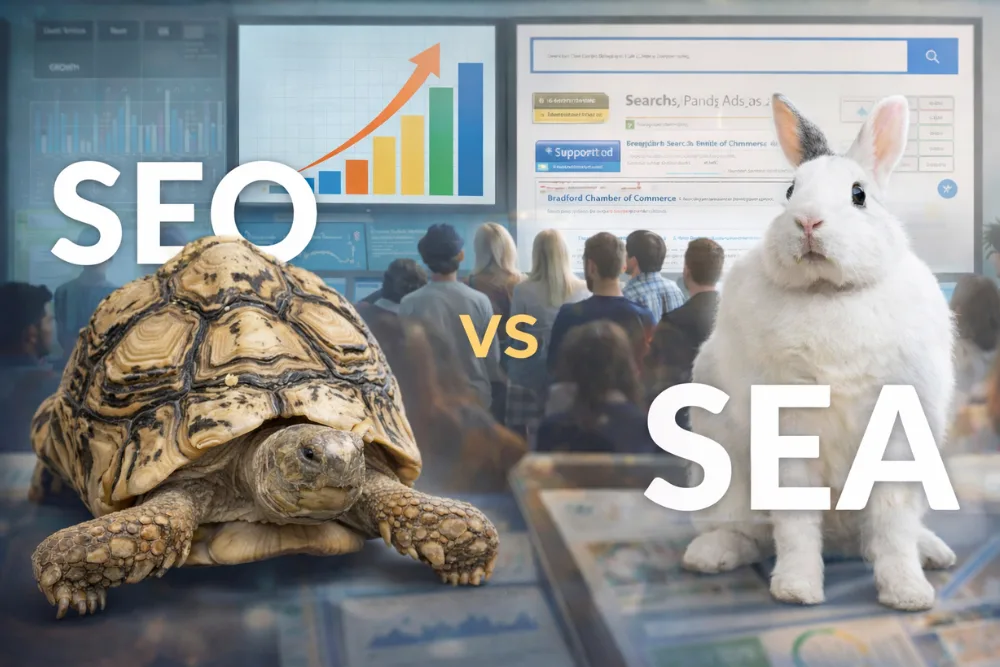
SEO vs. SEA refers to two core digital marketing strategies used to increase visibility on search engines. SEO focuses on optimizing websites to gain organic search traffic, while SEA uses paid advertising to appear prominently in search results. Both methods help businesses attract visitors, but they differ in cost structure, timing of results, and long term impact on online growth.
Understanding the distinction between SEO and SEA is essential for anyone managing an online presence. Businesses rely on search engines to connect with potential customers, and choosing the right strategy can significantly influence marketing success. SEO aims to improve a website’s position in organic search results through optimization techniques, while SEA places advertisements on search engine results pages to generate immediate visibility.
Although they serve similar goals, their approach, cost structure, and performance timelines differ greatly. Some organizations focus entirely on organic search optimization, while others rely heavily on paid advertising. However, many digital marketing experts recommend integrating both strategies for a balanced and effective search marketing approach.
In this detailed guide from Search Ethics, you will learn the main differences between SEO and SEA, how each strategy works, their benefits and limitations, and how small businesses can use them effectively to grow their online presence.
Understanding SEO and SEA in Digital Marketing
SEO and SEA are fundamental components of search engine marketing. Both strategies aim to increase website visibility when users search for relevant information online. However, they operate through entirely different mechanisms.
SEO, which stands for Search Engine Optimization, focuses on improving a website’s organic ranking on search engines. This involves optimizing content, improving site structure, enhancing page speed, ensuring mobile friendliness, and acquiring backlinks that increase a website’s authority. SEO relies on search engine algorithms recognizing the value and relevance of a website’s content.
SEA, which stands for Search Engine Advertising, involves paying for advertising placements within search engine results pages. Advertisements appear at the top or bottom of search results and are usually labeled as sponsored content. Advertisers bid on specific keywords, and when users search for those terms, the ads may appear based on bidding competition and quality scores.
Both strategies target search engine users who are actively seeking information, products, or services. However, the process through which visibility is achieved differs significantly. SEO requires ongoing optimization and patience, while SEA provides immediate placement in search results once a campaign is launched.
Understanding how these strategies work provides the foundation for making informed marketing decisions and choosing the most suitable approach for business goals.
SEO vs SEA: Nature of Traffic and Cost Structure
One of the most important distinctions in SEO vs. SEA lies in the nature of traffic and how costs are incurred. SEO focuses on generating organic traffic from search engine results. These clicks are not paid for directly. Instead, businesses invest in improving their website content, technical performance, and authority in order to rank higher in search results.
Although organic clicks are technically free, SEO requires a significant investment in time, effort, and expertise. Content creation, keyword research, website optimization, and link building are essential components of an effective SEO strategy. Over time, however, strong organic rankings can deliver consistent traffic without paying for each individual visitor.
SEA operates on a completely different cost structure. Businesses pay for advertisements that appear within search results, typically through a pay per click model. Each time a user clicks on an advertisement, the advertiser is charged a predetermined amount. This system allows companies to gain immediate visibility but requires continuous financial investment.
The key difference is sustainability. SEO traffic can continue long after the initial optimization work has been completed, while SEA traffic stops as soon as the advertising budget runs out. Because of this, SEO is often viewed as a long term investment, whereas SEA is considered a short term traffic acquisition strategy.
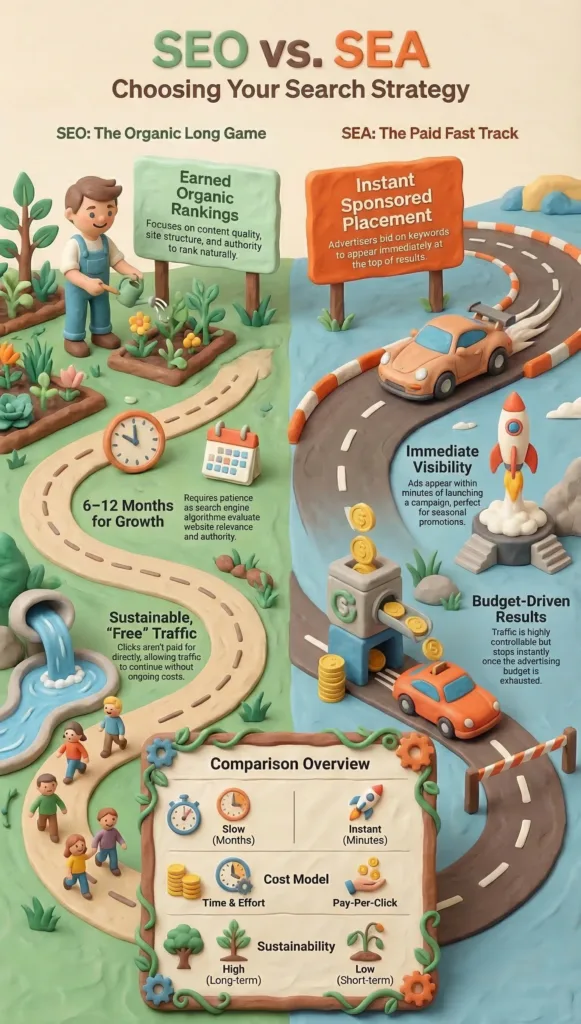
SEO vs. SEA Search Strategy Infographic
SEO vs SEA: Time Required to See Results
Another major difference in SEO vs. SEA involves the time needed to see measurable results. SEO is widely recognized as a long term strategy that requires patience and consistent effort. Search engines evaluate numerous factors before ranking a website, including content relevance, website authority, user experience, and technical performance.
For most websites, noticeable improvements in organic rankings can take several months. Initial work often focuses on building a strong technical foundation, optimizing content, and establishing authority through backlinks. Early ranking improvements may appear within a few months, but meaningful traffic growth often takes between six and twelve months.
SEA, in contrast, delivers immediate results. Once an advertising campaign is created and funded, advertisements can appear instantly in search engine results pages. This allows businesses to attract visitors within minutes of launching a campaign.
Because of this speed, SEA is particularly useful for short term campaigns such as product launches, seasonal promotions, or limited time offers. Companies that need rapid visibility often rely on paid search advertising while waiting for SEO efforts to gain traction.
The difference in timing highlights the strategic roles both methods play in digital marketing. SEO builds long term organic growth, while SEA provides instant traffic when immediate exposure is required.
Related search: How to Choose an SEO Platform for Small Business Websites
SEO vs SEA: Control and Data Insights
Control and data analysis represent another key distinction between SEO and SEA strategies. SEA provides marketers with extensive control over campaign parameters and performance metrics. Advertisers can choose which keywords trigger their ads, set bidding amounts, adjust budgets, and target specific audiences.
This level of control allows advertisers to optimize campaigns in real time. Metrics such as click through rate, conversion rate, and cost per click can be monitored closely. Campaign adjustments can be made immediately to improve performance or reduce advertising costs.
SEO, on the other hand, offers less direct control over search engine rankings. Website owners cannot pay or bid to influence their organic positions. Instead, they must optimize content and site structure according to search engine guidelines and wait for algorithms to evaluate those improvements.
Data insights from SEO tend to focus on overall website performance rather than individual keyword behavior. Analytics tools provide information about organic traffic, user engagement, and search visibility, but detailed data about every specific search query may not always be available.
Despite these differences, both strategies rely heavily on data analysis. Monitoring user behavior, tracking keyword performance, and evaluating conversion rates are essential for refining both SEO and SEA campaigns.
SEO vs SEA: Approach and Effort Required
The effort involved in implementing SEO vs. SEA strategies differs significantly in terms of technical work and campaign management. SEO requires continuous effort across multiple areas of website optimization. Technical improvements such as page speed, mobile compatibility, and structured site architecture are essential components of a successful SEO strategy.
Content quality also plays a crucial role. Search engines prioritize valuable, informative content that answers user questions effectively. This means businesses must regularly create and update articles, guides, and other resources that meet user intent.
Another important aspect of SEO involves building backlinks from other reputable websites. Backlinks signal trust and authority to search engines, helping websites achieve higher rankings.
SEA requires a different type of effort focused on advertising campaign management. Marketers must create compelling ad copy, select relevant keywords, determine bidding strategies, and manage advertising budgets. Campaign performance must be monitored constantly to ensure that advertisements remain competitive and cost effective.
Both strategies demand ongoing attention and expertise. However, the nature of the work varies significantly between organic optimization and paid advertising management.
SEO vs SEA: Long Term Impact Versus Short Term Results
The long term impact of SEO vs. SEA represents one of the most important considerations for businesses planning their marketing strategies. SEO is widely regarded as a long term investment that builds sustainable traffic and brand authority. Once a website achieves strong organic rankings, it can continue to attract visitors without paying for each click.
This long lasting visibility helps businesses reduce their reliance on paid advertising over time. As organic traffic grows, the cost per lead typically decreases, making SEO highly cost effective in the long run.
SEA, by contrast, focuses primarily on immediate visibility and rapid traffic acquisition. Advertisements can drive large volumes of visitors quickly, but this traffic disappears as soon as the advertising budget ends. Because of this limitation, SEA is often used for short term marketing objectives rather than long term growth.
Both strategies have valuable roles in digital marketing. SEO supports sustainable growth and brand credibility, while SEA provides quick access to targeted audiences during critical campaigns.
When to Use SEO
SEO is best suited for businesses that are focused on long term growth and building a strong online presence. Companies that invest in SEO aim to establish authority within their industry and attract consistent organic traffic over time.
Organizations that publish valuable content and provide helpful information to users are particularly well positioned to benefit from SEO. As search engines recognize the quality and relevance of this content, organic rankings gradually improve.
SEO is also ideal for businesses seeking to reduce marketing costs in the long term. Although the initial investment in content creation and technical optimization may be significant, the resulting traffic does not require payment for each individual visitor.
Because SEO results accumulate gradually, businesses must be prepared to maintain consistent optimization efforts over an extended period. However, the long lasting benefits make it one of the most effective strategies for sustainable digital growth.
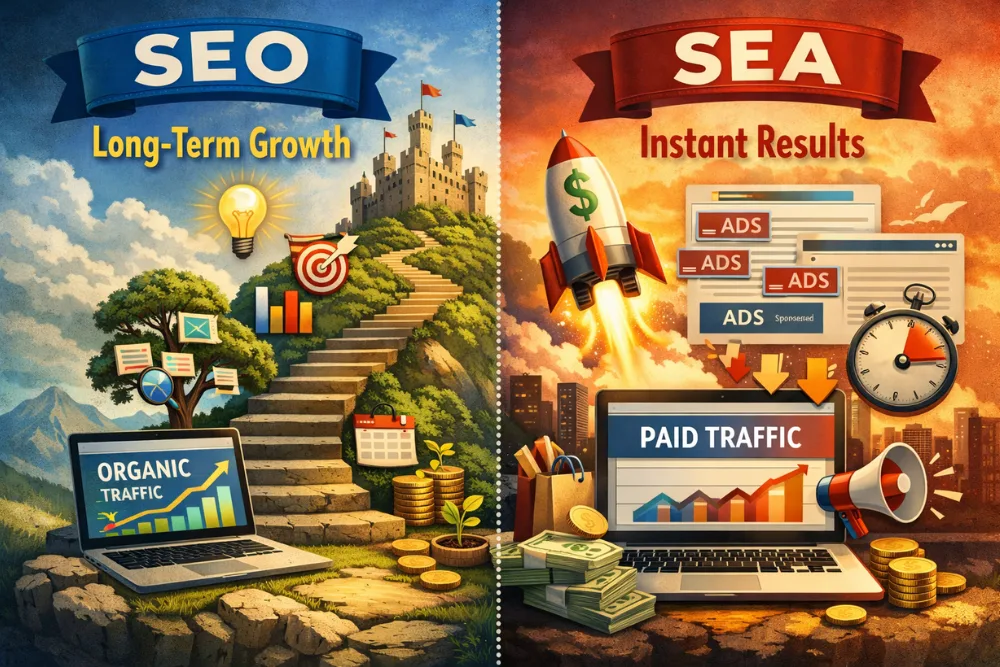
SEO vs SEA: Long-Term Organic Traffic vs Instant Paid Results
When to Use SEA
SEA is most effective when businesses require immediate visibility and rapid customer acquisition. Paid search advertising allows companies to reach potential customers instantly by placing advertisements directly within search results.
This makes SEA particularly useful for time sensitive campaigns. Product launches, seasonal promotions, and limited time offers can benefit greatly from paid advertising because of its ability to generate immediate traffic.
Another advantage of SEA is its ability to test keywords and marketing messages quickly. Advertisers can experiment with different keywords, ad copy variations, and landing pages to determine which combinations generate the best results.
However, businesses must carefully manage advertising budgets to maintain profitability. In highly competitive industries, cost per click can become expensive, requiring constant optimization to achieve a positive return on investment.
Also read: Benefits of Guest posting for SEO and Brand Awareness
SEO vs. SEA for Small Business Marketing
For small businesses, choosing between SEO and SEA can be challenging due to limited budgets and resources. Both strategies offer unique advantages depending on the company’s marketing goals.
SEO provides long term growth opportunities by improving organic search visibility. Small businesses that invest in high quality content, technical optimization, and authority building can gradually increase their online presence without paying for each visitor. Over time, this leads to lower customer acquisition costs and stronger brand credibility.
SEA offers a faster route to visibility for businesses that need immediate traffic. Paid advertisements can help new companies gain exposure quickly while they build their organic search presence. However, the cost of continuous advertising must be carefully managed to avoid exceeding marketing budgets.
Many experts recommend a balanced approach that combines both strategies. Small businesses can use SEA to generate quick traffic and leads while simultaneously investing in SEO to build long term organic visibility.
This integrated approach helps businesses maintain consistent online exposure while gradually reducing reliance on paid advertising.
Best Tools for Managing SEO and SEA Campaigns
Effective campaign management requires reliable tools that provide insights, analytics, and optimization capabilities. Several platforms are widely recognized for supporting both SEO and SEA strategies.
One of the most versatile platforms is Semrush, which offers comprehensive features for keyword research, competitor analysis, and campaign monitoring. Semrush allows marketers to analyze organic search performance while also tracking paid advertising campaigns.
Another powerful SEO tool is Ahrefs, known for its advanced backlink analysis and competitor research capabilities. Ahrefs helps marketers understand link building opportunities and evaluate website authority.
For WordPress users, All in One SEO provides a comprehensive optimization plugin that simplifies technical SEO tasks, keyword tracking, and performance reporting.
In the field of search engine advertising, Google Keyword Planner plays a critical role in identifying keyword opportunities, estimating search volumes, and planning advertising budgets.
Another valuable tool for campaign monitoring is Google Data Studio, which allows marketers to create detailed dashboards that consolidate data from multiple advertising platforms. This makes it easier to evaluate campaign performance and generate reports.
Using a combination of these tools enables marketers to optimize both organic and paid search campaigns more effectively.
Related search: Best SEO Tools for Keyword Research and Competitor Analysis
Integrating SEO and SEA for Maximum Visibility
Rather than choosing between SEO and SEA, many successful digital marketing strategies combine both approaches. Integrating these methods allows businesses to dominate both organic and paid search results, increasing overall visibility and brand recognition.
| Aspect | How SEO and SEA Work Together |
|---|---|
| Data Insights | Paid advertising campaigns provide valuable data about keyword performance and user behavior, which can help improve SEO content strategies. |
| Brand Credibility | Strong organic rankings increase brand credibility and trust among users searching online. |
| Higher Click-Through Rates | When users see both organic search results and paid ads from the same brand, it increases visibility and improves overall click-through rates. |
| Customer Journey Coverage | Organic content helps users in the research stage, while paid ads target users who are ready to purchase. |
| Integrated Search Strategy | Combining SEO and SEA ensures consistent visibility across search engines throughout different stages of the buyer journey. |
| Business Growth | Using both strategies together helps businesses maximize reach, improve conversions, and build a stronger digital marketing presence. |
SEO vs SEA: Conclusion
The comparison of SEO vs. SEA highlights two powerful but distinct approaches to increasing online visibility. SEO focuses on building organic search rankings through content optimization, technical improvements, and authority building. Although it requires time and consistent effort, it delivers sustainable traffic and long term marketing benefits.
SEA, on the other hand, provides immediate visibility through paid advertising on search engine results pages. It offers precise targeting, detailed performance tracking, and rapid traffic generation, making it ideal for short term campaigns and promotional efforts.
For most businesses, the most effective strategy involves integrating both methods. SEA can generate immediate traffic and valuable keyword insights, while SEO builds long term credibility and organic visibility. By leveraging the strengths of both strategies, companies can create a balanced digital marketing approach that drives both short term results and long term growth.
Frequently Asked Questions
What is the main difference between SEO and SEA
The main difference is that SEO focuses on improving organic search rankings without paying for clicks, while SEA uses paid advertisements to appear prominently in search engine results pages.
Which strategy produces faster results
SEA produces faster results because advertisements appear immediately after a campaign is launched. SEO takes longer because search engines need time to evaluate and rank optimized content.
Is SEO better than SEA for long term growth
SEO is generally better for long term growth because it builds sustainable organic traffic and reduces reliance on paid advertising over time.
Can SEO and SEA work together
Yes, combining SEO and SEA can improve overall search visibility. Paid campaigns can generate immediate traffic while SEO builds long term organic rankings.
Which strategy is better for small businesses
Small businesses often benefit from using both strategies. SEA can generate quick leads, while SEO helps build a lasting online presence and reduces marketing costs in the future.
Also read: How to Find High-Authority Blogs for Guest Posting Opportunities?

Dony Garvasis is the founder of Search Ethics, a freelance SEO consultant, and a passionate technology blogger. With over 8 years of experience in SEO, blogging and content marketing, I provide expert content on Tech, digital marketing, SEO, Artificial intelligence, gadgets, science, automobiles, lifestyle, tips, tutorials and much more. My mission is simple: Ethical Search, Genuine Results! I will make sure people everywhere get trustworthy and helpful information.