Now Reading: Elon Musk Vs Mark Zuckerberg: How Their Leadership Differs
-
01
Elon Musk Vs Mark Zuckerberg: How Their Leadership Differs
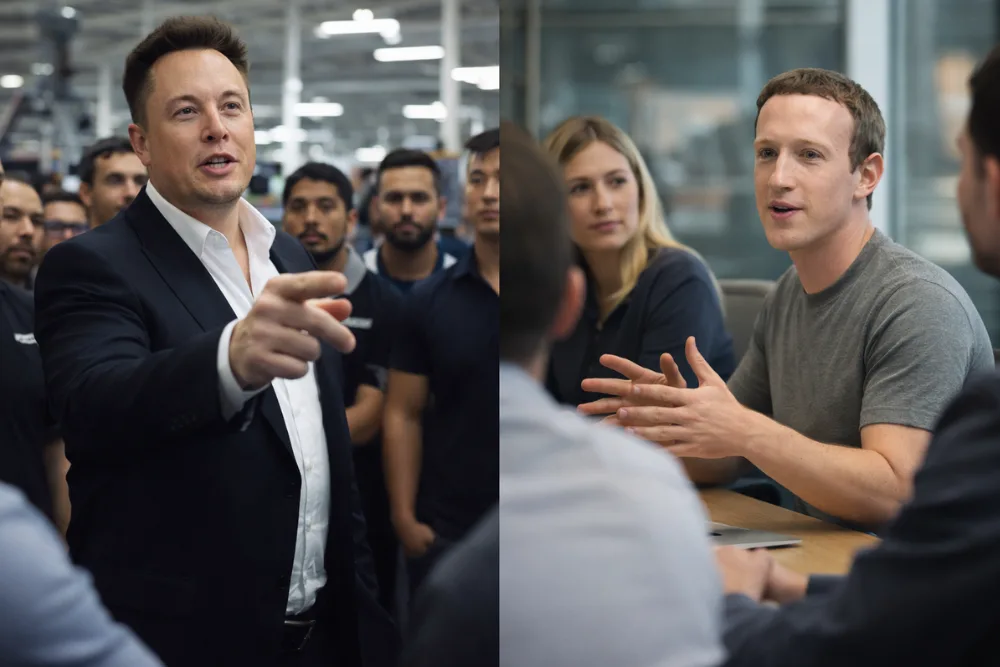
Elon Musk vs Mark Zuckerberg highlights a powerful contrast between two influential technology leaders, one driven by intense hands on innovation and futuristic ambition, the other guided by adaptive collaboration and global connectivity. Their leadership differences shape how their companies evolve, inspire teams, and influence the future of technology.
Elon Musk vs Mark Zuckerberg: Leadership Differences
Leadership defines the direction of an organization, shapes its culture, and determines how innovation unfolds. Few comparisons are as compelling as Elon Musk vs Mark Zuckerberg, two entrepreneurs who have not only built transformative companies but have also redefined what modern leadership looks like in the technology sector. While both leaders share visionary thinking and an appetite for innovation, the way they motivate teams, approach risk, and execute long term strategies reveals striking differences.
Elon Musk is often described as a relentless innovator who pushes boundaries across industries like electric vehicles, space exploration, and renewable energy. His leadership is intense, immersive, and rooted in a desire to solve humanity’s biggest challenges. Mark Zuckerberg, on the other hand, emerged from a startup culture focused on speed and experimentation and gradually evolved into a leader emphasizing responsibility, privacy, and global social impact.
Understanding how these two leaders differ offers valuable insight into how leadership style influences company culture, product development, and long term success. This article explores their philosophies, decision making approaches, and visions for the future, while showing how each style has contributed to extraordinary achievements.
Related search: Elon Musk is the World’s First Eight Hundred Billionaire
Vision as the Foundation of Leadership
Both Elon Musk and Mark Zuckerberg are visionary leaders, but the nature of their visions differs significantly. Musk’s vision is expansive and often oriented toward the survival and advancement of humanity. He speaks openly about creating a sustainable energy future and enabling life beyond Earth. These ambitions are not abstract ideas but concrete goals that drive the direction of companies like Tesla and SpaceX.
Musk uses vision as a motivational force. He frames work as part of a larger mission, encouraging employees to see themselves as contributors to world changing breakthroughs. This sense of purpose can be deeply inspiring, particularly for engineers and innovators who want to work on cutting edge challenges. His vision is bold, uncompromising, and often framed in terms of what seems impossible today but necessary tomorrow.
Zuckerberg’s vision is more focused on human connection. From the beginning, his goal has been to bring people closer together through technology. As Facebook grew into a global platform, this vision expanded to include building digital communities, facilitating communication, and eventually shaping the concept of a connected virtual world.
Unlike Musk’s emphasis on humanity’s physical future, Zuckerberg’s vision centers on social interaction and digital experience. His leadership reflects a belief that technology should enhance how people communicate and share ideas. This vision has guided Meta’s investments in social platforms, virtual reality, and immersive digital environments.
The contrast between their visions explains much about their leadership. Musk leads with a future oriented, problem solving mindset aimed at redefining industries. Zuckerberg leads with a people oriented perspective focused on how technology can reshape relationships and communication.
Hands On Leadership Versus Collaborative Leadership
One of the clearest distinctions in Elon Musk vs Mark Zuckerberg is how directly involved each leader is in daily operations. Musk is famously hands on. He spends long hours working alongside engineers, reviewing designs, and engaging deeply in technical problem solving. His leadership style is rooted in personal involvement and detailed oversight.
This approach allows Musk to move quickly from idea to execution. When he identifies a problem, he often dives into the details himself, challenging assumptions and pushing for better solutions. Employees often describe working under Musk as demanding but exhilarating, as they are encouraged to meet extremely high standards.
Zuckerberg’s leadership is more collaborative and team oriented. While he remains deeply involved in strategic direction, he relies heavily on leadership teams and subject matter experts to guide execution. His role has evolved as Meta has grown, shifting from startup founder to chief executive overseeing a vast organization.
Zuckerberg emphasizes building systems and processes that allow teams to innovate independently. He fosters an environment where ideas can be tested quickly and refined through collaboration. This approach supports scalability and helps manage the complexity of a global company.
The difference reflects their personalities and company cultures. Musk thrives on direct control and intense engagement. Zuckerberg prioritizes coordination, communication, and shared responsibility.
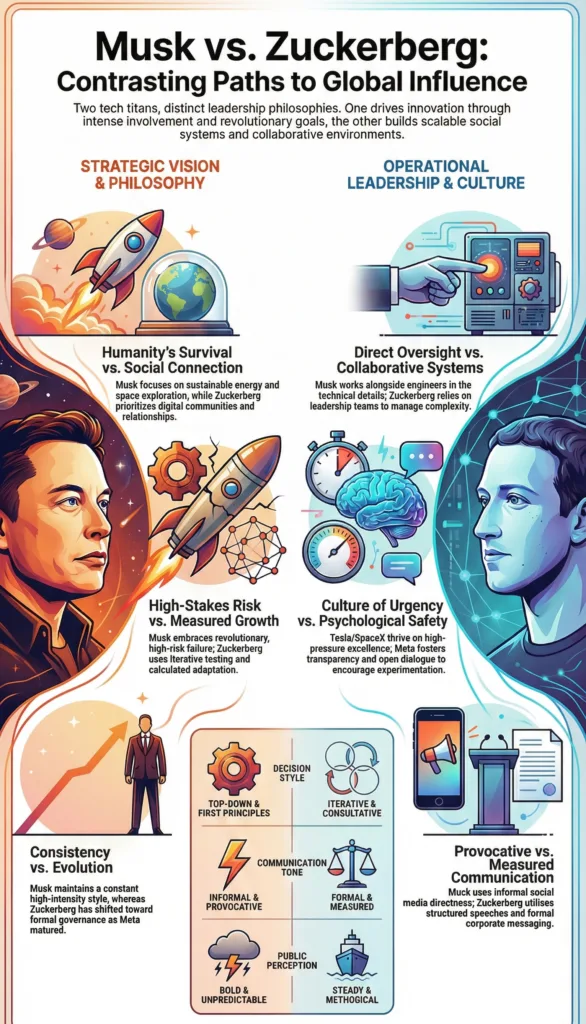
Elon Musk Vs Mark Zuckerberg Leadership Infographic Comparison
Approach to Risk and Innovation
Risk tolerance is another defining element of their leadership styles. Elon Musk is widely known for his willingness to take enormous risks. He has invested much of his personal wealth into ventures that many considered unlikely to succeed. His belief in transformative innovation drives him to pursue projects that challenge conventional thinking.
Musk views failure as part of the process. He encourages experimentation and accepts that setbacks are inevitable when pushing technological boundaries. This mindset has enabled breakthroughs in electric vehicle manufacturing, reusable rockets, and energy storage.
Zuckerberg also embraces risk, but his approach is more measured. In the early days of Facebook, the company operated under the philosophy of moving fast and experimenting aggressively. This mindset allowed rapid product development and quick adaptation to user feedback.
As Meta matured, Zuckerberg recognized the need for greater responsibility. His leadership evolved to balance innovation with considerations around privacy, security, and social impact. While he continues to invest in ambitious projects like virtual reality and immersive digital spaces, he does so with a stronger emphasis on governance and long term sustainability.
In Elon Musk vs Mark Zuckerberg, Musk represents bold, high stakes risk taking aimed at revolutionary change, while Zuckerberg represents calculated risk taking that evolves with organizational maturity.
Leadership Intensity and Workplace Culture
Musk’s leadership intensity is legendary. He sets extremely high expectations and often pushes teams to work at a pace that exceeds industry norms. This creates a culture of urgency and relentless pursuit of excellence.
For many employees, this environment is both challenging and motivating. Those who thrive under pressure find Musk’s style energizing, as they are constantly pushed to improve and innovate. However, the intensity can also lead to burnout and controversy, highlighting the trade offs of such an approach.
Zuckerberg’s workplace culture emphasizes openness and communication. He encourages employees to share ideas and challenge assumptions in a constructive manner. Meta has traditionally promoted a culture of transparency, where leaders explain decisions and solicit feedback.
This environment supports psychological safety, allowing employees to experiment without fear of severe consequences for failure. While expectations remain high, the tone is generally less confrontational than Musk’s style.
These cultural differences reflect broader leadership philosophies. Musk uses pressure and urgency to drive performance. Zuckerberg uses collaboration and dialogue to foster creativity.
Decision Making Styles
Elon Musk is known for making fast, decisive choices. When he identifies a direction, he commits fully and pushes aggressively toward execution. This decisiveness enables rapid progress, particularly in industries where speed can provide a competitive advantage.
Musk often relies on first principles thinking, breaking problems down to their most basic components and building solutions from the ground up. This analytical approach allows him to challenge industry norms and develop unconventional strategies.
Zuckerberg’s decision making is more iterative. He favors testing ideas, gathering data, and refining products based on user feedback. This method aligns well with software development and social platforms, where continuous improvement is essential.
Zuckerberg also places significant value on consensus building among leadership teams. While he retains ultimate authority, he seeks input from others before making major strategic moves.
In the context of Elon Musk vs Mark Zuckerberg, Musk exemplifies decisive, top down leadership, while Zuckerberg exemplifies iterative, consultative leadership.
Communication and Public Presence
Both leaders are highly visible, but their communication styles differ. Musk is outspoken and often uses social media to share thoughts, announcements, and opinions directly with the public. His communication is informal, sometimes provocative, and frequently generates widespread attention.
This directness reinforces Musk’s image as an unconventional leader who operates outside traditional corporate norms. It also allows him to shape narratives around his companies in real time.
Zuckerberg’s communication is more measured and formal. He typically delivers messages through structured announcements, keynote speeches, and official statements. His tone reflects the responsibilities of leading a global social platform with billions of users.
Zuckerberg focuses on clarity and reassurance, particularly when addressing issues related to privacy, security, and regulation. This approach aligns with his emphasis on responsibility and trust.
These contrasting styles influence how each leader is perceived. Musk is seen as bold and unpredictable. Zuckerberg is seen as steady and methodical.
Adaptability Over Time
An important aspect of leadership is the ability to evolve. Musk’s core style has remained relatively consistent, centered on bold vision, high intensity, and technical involvement. While he adapts strategies as needed, his fundamental approach to leadership has not changed significantly.
Zuckerberg, however, has demonstrated notable evolution. His early leadership focused heavily on speed and disruption. As Meta grew and faced increasing scrutiny, he shifted toward a more mature style emphasizing ethics, accountability, and long term impact.
This adaptability reflects Zuckerberg’s recognition that leadership must change as organizations scale. What works for a startup may not work for a global corporation.
In Elon Musk vs Mark Zuckerberg, Musk represents consistency of style, while Zuckerberg represents evolution of style.
Impact on Industry and Society
The influence of both leaders extends far beyond their companies. Musk’s work has accelerated the adoption of electric vehicles, revitalized interest in space exploration, and advanced renewable energy technologies. His leadership has reshaped entire industries.
Zuckerberg’s platforms have transformed how people communicate, share information, and build communities. Meta’s products influence social dynamics, political discourse, and cultural trends worldwide.
Their leadership styles play a crucial role in these impacts. Musk’s aggressive pursuit of innovation drives technological breakthroughs. Zuckerberg’s focus on connection shapes digital ecosystems.
Together, they demonstrate that there is no single formula for effective leadership. Different approaches can produce extraordinary results when aligned with clear vision and execution.
Strengths and Limitations of Each Style
Musk’s leadership excels in environments requiring rapid innovation and bold experimentation. His ability to inspire through grand vision and personal involvement can unlock remarkable achievements. However, the intensity of his style can strain teams and create operational challenges.
Zuckerberg’s leadership excels in building scalable systems and fostering collaboration. His emphasis on adaptability and responsibility supports long term stability. However, his more cautious approach may sometimes slow radical innovation.
Understanding these trade offs provides valuable lessons for aspiring leaders. Effective leadership involves balancing vision, execution, and empathy.
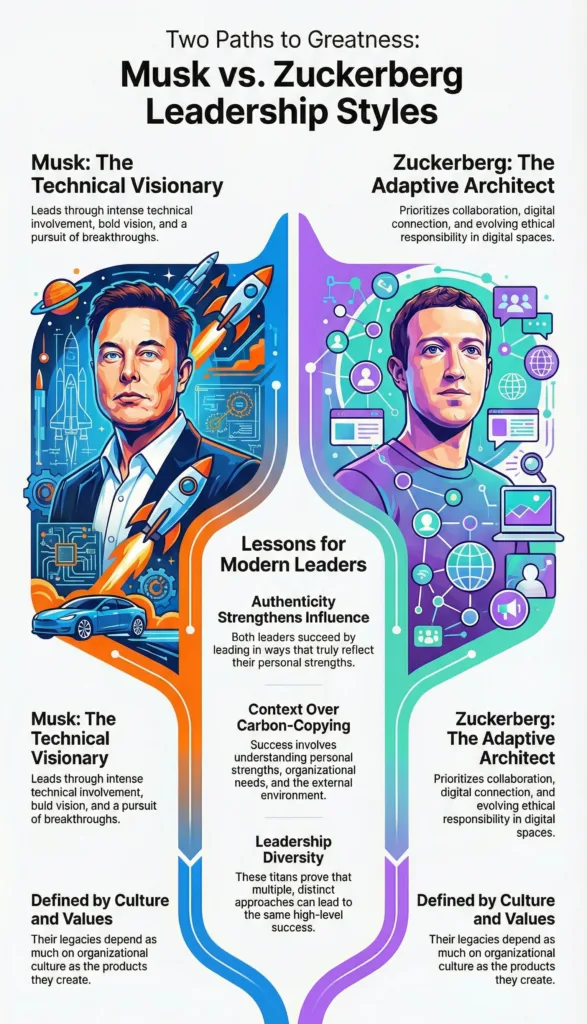
Elon Musk vs. Zuckerberg Leadership Lessons for Modern Leaders
Lessons for Modern Leaders
The comparison of Elon Musk vs Mark Zuckerberg offers practical insights for anyone seeking to lead in a complex, fast changing world. Leaders can learn from Musk’s commitment to ambitious goals and deep technical engagement. They can also learn from Zuckerberg’s emphasis on collaboration, adaptability, and ethical responsibility.
Successful leadership does not require copying one style exactly. Instead, it involves understanding personal strengths, organizational needs, and external context.
By studying these two leaders, we see that authenticity matters. Both Musk and Zuckerberg lead in ways that reflect who they are, and that authenticity strengthens their influence.
The Future of Their Leadership Legacies
As technology continues to evolve, both leaders will face new challenges and opportunities. Musk will likely continue pushing the boundaries of what is technologically possible. Zuckerberg will continue shaping how people interact in digital spaces.
Also read: Leadership Lessons From Elon Musk
Their legacies will be defined not only by the products they create but also by the cultures they build and the values they promote.
The ongoing story of Elon Musk vs Mark Zuckerberg will remain a fascinating case study in leadership diversity and innovation.
Final Thoughts
Elon Musk and Mark Zuckerberg represent two distinct yet highly effective approaches to leadership. Musk leads with intense involvement, bold vision, and relentless pursuit of technological breakthroughs. Zuckerberg leads with adaptive collaboration, focus on connection, and evolving responsibility.
Both styles have produced extraordinary success, demonstrating that there is no single path to great leadership. By understanding their differences, we gain deeper insight into how leadership shapes organizations, industries, and society.
Frequently Asked Questions
What is the main difference between Elon Musk and Mark Zuckerberg’s leadership styles?
Musk is hands on and intensely involved in technical details, while Zuckerberg focuses more on collaborative and adaptive leadership.
Who takes more risks in business decisions?
Elon Musk is generally more willing to take extreme risks in pursuit of transformative innovation.
How has Zuckerberg’s leadership evolved over time?
He has shifted from a speed focused startup mentality to a more responsible and ethical leadership approach.
Which leader is more visionary?
Both are visionary, but Musk focuses on humanity’s technological future, while Zuckerberg focuses on global connectivity.
What can leaders learn from Elon Musk vs Mark Zuckerberg?
Leaders can learn the importance of clear vision, adaptability, and aligning leadership style with organizational goals.

Dony Garvasis is the founder of Search Ethics, a freelance SEO consultant, and a passionate technology blogger. With over 8 years of experience in SEO, blogging and content marketing, I provide expert content on Tech, digital marketing, SEO, Artificial intelligence, gadgets, science, automobiles, lifestyle, tips, tutorials and much more. My mission is simple: Ethical Search, Genuine Results! I will make sure people everywhere get trustworthy and helpful information.