Now Reading: Who Is Zach Yadegari and Why Is Cal AI So Popular
-
01
Who Is Zach Yadegari and Why Is Cal AI So Popular

Zach Yadegari is an 18 year old entrepreneur who learned to code at age seven and is now the co founder and CEO of Cal AI, an artificial intelligence powered app that calculates calories and macros from a single food photo, generating around $1.4 million per month after app store fees.
Early Life and First Exposure to Coding
From a very young age, Zach Yadegari showed a deep fascination with technology and digital creation. As a child, he spent countless hours playing video games such as Minecraft and Roblox, but instead of only enjoying the gameplay, he became curious about how those virtual worlds were built. That curiosity pushed him to ask his mother to enroll him in a summer coding camp where he could learn how to create his own games. This early exposure to programming planted the foundation for everything that followed in his life.

Learning to code at such a young age helped Zach develop logical thinking, problem solving skills, and confidence in his ability to build real products. Coding quickly transformed from a hobby into a powerful tool that allowed him to experiment with ideas and turn them into functional applications. Over time, he realized that he did not just enjoy programming, but also enjoyed creating things that people actually used.
Developing an Entrepreneurial Mindset at a Young Age
Zach’s entrepreneurial mindset was shaped by his experience within the traditional education system. He felt that school pushed students toward a narrow path that focused on getting good grades, entering a good college, finding a good job, and eventually making money. This linear structure did not excite him. Instead, he wondered why he could not skip several of those steps and attempt to build something that generated income directly.
During his freshman year of high school, Zach built an unblocked gaming website that allowed students to play games in school by bypassing internet restrictions. The site gained traction quickly, and for the first time, he saw proof that people would use something he created. This experience taught him how to identify demand, build a working product, and attract users. More importantly, it showed him that entrepreneurship was a realistic path.

Coder to CEO Cal AI Success of Zach Yadegari
The Personal Problem That Inspired Cal AI
A few years later, Zach began working out in hopes of gaining muscle and improving his physique. Like many beginners, he struggled to see progress and decided to download one of the most popular calorie tracking apps. However, the app required him to weigh every portion of food and manually type in everything he ate. After only three days, he quit because the process felt tedious and unsustainable.
That frustration stayed in the back of his mind. When artificial intelligence tools began gaining widespread attention, Zach and his future co founders realized that AI could solve the very problem he had experienced. They believed it was possible to build an app where users could simply take a photo of their food and let AI handle the calorie and macro calculations automatically. This idea became the foundation for Cal AI.
Building Cal AI With a Small Team
Zach co founded Cal AI alongside three partners, including Henry, who serves as the company’s CTO. Because Zach and Henry could program the product themselves, building the initial version of the app was inexpensive. The team did not need large outside funding to get started.
When they launched Cal AI publicly, the response was immediately positive. Users appreciated the simplicity and speed of the experience. This early traction convinced the founders that they had discovered a real opportunity and decided to fully commit to the company.
Meet Cal AI – Track your calories with just a picture
The Turning Point in San Francisco
Determined to scale the app, Zach and Henry spent a pivotal summer in San Francisco. They lived in a hacker house, slept in the office, and worked nearly nonstop. That month became a turning point for the company, as they began hiring their first team members and establishing a consistent development rhythm.
Being surrounded by other ambitious founders helped push them to think bigger and move faster. The habits formed during that summer continued to shape the company throughout the following year.
Balancing High School and Running a Company
Running Cal AI while still in high school required immense discipline. Before this company, Zach always treated his projects as side ventures and placed school first. With Cal AI, that changed. He began spending around forty hours per week working on the app on top of attending classes.
Zach admitted that he did not prioritize standardized exams such as AP tests because he did not initially plan on attending college. He believed his time was better spent building a real business.
How Cal AI Generates Revenue
Cal AI makes money through subscriptions purchased inside app stores. After Apple takes its share, the app generates about $1.4 million per month. Most of this revenue is reinvested back into the business to improve the product, expand the team, and scale marketing efforts.
When sufficient cash remains, the founders pay themselves dividends. Zach recently received a personal dividend of $100,000.
Spending, Lifestyle, and Financial Perspective
Zach has spent much of the money he has earned so far, including purchasing a Lamborghini, which he describes as a lifelong dream. While some critics view this as irresponsible at his age, Zach believes experiences and rewards have diminishing returns over time.
He also emphasizes that he is not highly materialistic and plans to focus more on saving in the future.
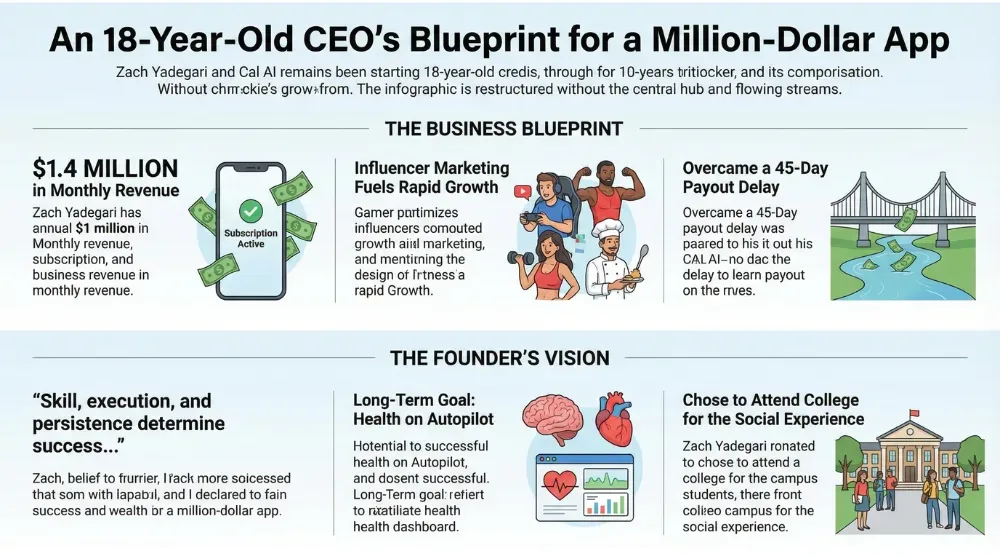
Zach Yadegari’s Business Blueprint
Marketing Strategy Behind Rapid Growth
One of the primary reasons for Cal AI’s rapid growth is its focus on influencer marketing. Instead of relying heavily on traditional advertising, the company works with content creators who demonstrate the app in real world scenarios.
This approach builds trust and allows potential users to immediately understand the value of the product.
Understanding What Cal AI Can and Cannot Do
There are common misconceptions about what Cal AI can do. Some users expect the app to identify ingredients that are hidden or not visible in a photo. Zach explains that the AI does not have x ray vision, and users must ensure that all ingredients are clearly visible for the most accurate results.
The app includes tutorials that teach users how to scan food properly.
Payments, Refunds, and App Store Control
Cal AI does not process credit card information or handle refunds. All transactions are managed directly by Apple, and refund requests must be submitted through the app store.
This transparency helps reduce confusion and builds trust with users.
Managing Cash Flow and Apple Payout Delays
Apple sends revenue to developers approximately forty five days after a sale. During periods of rapid growth, Cal AI was spending money faster than Apple was paying it out.
Although the company remained profitable, it took about six months before payouts caught up with expenses. Once this happened, cash flow became much easier to manage.
Why Zach Ultimately Chose College
Despite once planning to skip college entirely, Zach ultimately decided to attend. He wants to experience student life, make friends his age, and enjoy a social environment before fully immersing himself in the corporate world.
He plans to live near campus with other app founders in a house they call the App Mafia, where they will create content, host events, and teach others how to build apps.
Long Term Vision for Cal AI and Beyond
Zach’s long term vision for Cal AI is to create a system that helps people improve their health on autopilot. When users can effortlessly track nutrition without friction, he will consider the mission successful.
Beyond Cal AI, he hopes to build a generational company that creates even broader impact.
Why Age Does Not Define Success
Zach believes entrepreneurship is one of the few fields where age truly does not matter. Skill, execution, and persistence determine success, and the market ultimately decides the outcome.
Bottom Line
Zach Yadegari’s journey from a curious seven year old learning to code to an 18 year old CEO running a multimillion dollar AI app proves that self belief, problem solving, and consistent action can create extraordinary results. His story shows that traditional paths are optional and that meaningful innovation often starts with personal frustration turned into opportunity.
Frequently Asked Questions
Who is Zach Yadegari?
Zach Yadegari is an 18 year old co founder and CEO of Cal AI.
What does Cal AI do?
Cal AI allows users to take a photo of food and automatically calculates calories and macros using artificial intelligence.
How much revenue does Cal AI generate?
Cal AI generates around $1.4 million per month after app store fees.
When did Zach start coding?
He began learning to code at age seven.
Does Cal AI handle payments?
No, all payments and refunds are processed by Apple.
Is Zach attending college?
Yes, he chose to attend college while continuing to run his company.

Dony Garvasis is the founder of Search Ethics, a freelance SEO consultant, and a passionate technology blogger. With over 8 years of experience in SEO, blogging and content marketing, I provide expert content on Tech, digital marketing, SEO, Artificial intelligence, gadgets, science, automobiles, lifestyle, tips, tutorials and much more. My mission is simple: Ethical Search, Genuine Results! I will make sure people everywhere get trustworthy and helpful information.